
Home | Category: Religion / Art and Architecture
FAMOUS ANCIENT GREEK TEMPLES
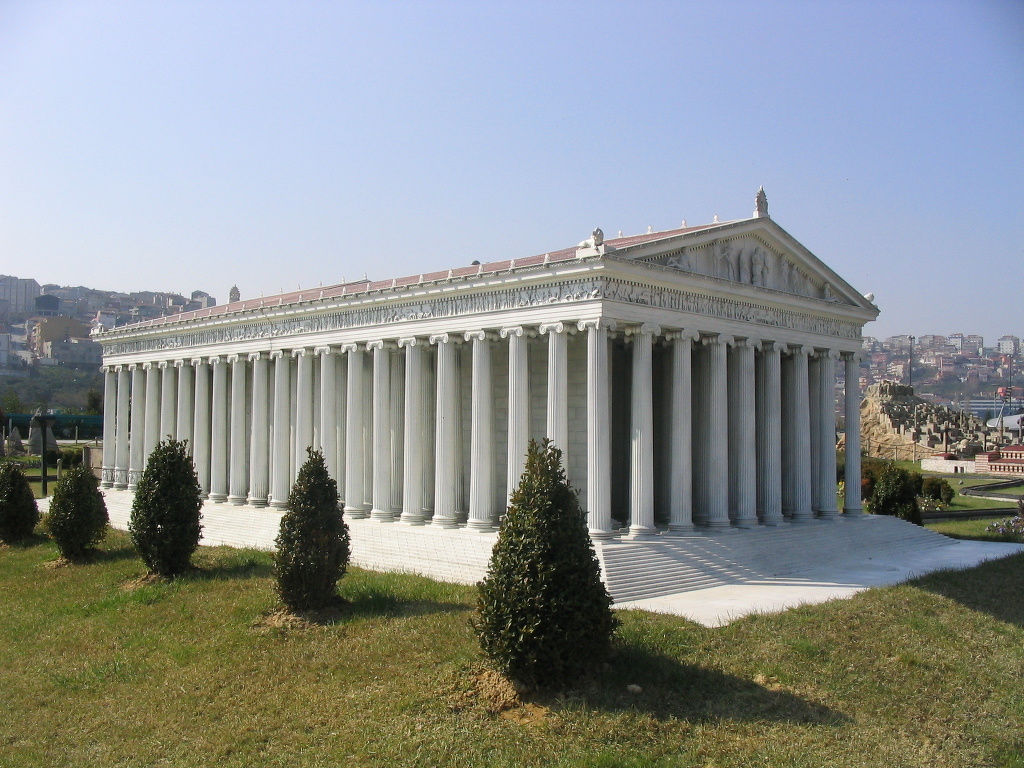
model of the Temple of Artemis, at Miniatürk Park, Istanbul, Turkey,
The Parthenon Temple in Athens is arguably the world’s most famous temple. Located on the Acropolis of Athens, it was was dedicated to Athena, the ancient Greeks a goddess of Athens, war and wisdom. Constructed in the fifth century B.C., it is 69 meters (228 feet) long by 31 meters (101 feet) wide, standing roughly 20 meters (65 feet) high. According to Love Science: The Parthenon's pediments — triangular shapes that form the gables of a roof — have sculptures depicting scenes involving Greek gods. For instance, sculptures on the east side tell the tale of the birth of Athena, while those on the west depict a battle between Athena and the god Poseidon to determine who would be the patron deity of Athens. Some of the sculptures were removed by Thomas Bruce, the seventh Earl of Elgin and Britain's ambassador to the Ottoman Empire, in the early 19th century and were placed in the British Museum. There are ongoing discussions about the sculptures' return. [Source Owen Jarus, Live Science April 11, 2023]
The Temple of Artemis, located in Ephesus, modern-day western Turkey, was regarded as one of the Seven Wonders of the World by ancient writers, who praised it for its beauty. Artemis is a goddess the ancient Greeks associated with animals and hunting; this temple to her was built in 550 B.C. by Croesus, a king of Lydia. Over time, the temple suffered damage from various events such as a fire in 356 B.C. and earthquake in A.D. 262. Ancient records indicate that it was abandoned or destroyed in the fifth century A.D., and little of it remains today.
The Apollo Temple in Delphi is where the Pythia, also known as the "oracle of Delphi" would give predictions. Apollo was a Greek god associated with prophecy, among many other things. Notable individuals from across Greece and other parts of the ancient world would come to this temple to provide offerings and have the oracle predict what their future might hold. This temple is over 2,600 years old.
See Separate Articles: ORACLE IN DELPHI: PYTHIA, TEMPLE, VAPORS europe.factsanddetails.com ANCIENT GREEK TEMPLES, SANCTUARIES AND SACRED PLACES europe.factsanddetails.com ; ACROPOLIS AND TEMPLES IN ANCIENT ATHENS europe.factsanddetails.com PARTHENON: ITS HISTORY, ARCHITECTURE AND SCULPTURES europe.factsanddetails.com
RECOMMENDED BOOKS:
“The Complete Greek Temples” by Tony Spawforth (2006) Amazon.com;
“Origins of Classical Architecture: Temples, Orders, and Gifts to the Gods in Ancient Greece” by Mark Wilson Jones (2013) Amazon.com;
“The Earth, the Temple, and the Gods: Greek Sacred Architecture” by Vincent Scully (1979 Amazon.com;
“Greek Sanctuaries and Temple Architecture: An Introduction” by Mary Emerson (2018) Amazon.com;
“The Optical Corrections of the Doric Temple: Form and Meaning in Greek Sacred Architecture” by Tapio Uolevi Prokkola (2011) Amazon.com;
“The Parthenon” (Wonders of the World)
by Mary Beard Amazon.com;
“The Parthenon: The Height of Greek Civilization” (Wonders of the World Book) by Elizabeth Mann (Author), Yuan Lee (Illustrator) (2025) Amazon.com;
“Greek Architecture” (The Yale University Press Pelican History of Art)
by A. W. Lawrence (1996) Amazon.com;
“Greek and Roman Architecture” Gene Waddell (2017) Amazon.com;
“Orders of Architecture” by R. A. Cordingley (2015) Amazon.com;
“Homo Necans: The Anthropology of Ancient Greek Sacrificial Ritual and Myth”
by Walter Burkert and Peter Bing (1972) Amazon.com;
“Practitioners of the Divine: Greek Priests and Religious Officials from Homer to Heliodorus” by Dignas (2008) Amazon.com;
“Smoke Signals for the Gods: Ancient Greek Sacrifice from the Archaic Through Roman Periods” by F. S. Naiden (2012) Amazon.com;
“The Oxford Dictionary of Classical Myth and Religion” by Simon Price and Emily Kearns (2003) Amazon.com;
“Miasma: Pollution and Purification in Early Greek Religion” by Robert Parker (1983) Amazon.com;
“Ancient Greek Religion: A Sourcebook” by Emily Kearns (2010) Amazon.com;
“A Companion to Greek Religion” by Daniel Ogden (2007) Amazon.com;
“The Minoan-Mycenaean Religion and Its Survival in Greek Religion” by Martin. Nilsson (1968) Amazon.com;
Delphi
According to UNESCO: “The pan-Hellenic sanctuary of Delphi, where the oracle of Apollo spoke, was the site of the omphalos, the 'navel of the world'. Blending harmoniously with the superb landscape and charged with sacred meaning, Delphi in the 6th century B.C. was indeed the religious centre and symbol of unity of the ancient Greek world. [Source: UNESCO World Heritage Site website =]
“Delphi lies between two towering rocks of Mt. Parnassus, known as the Phaidriades (Shining) Rocks, in the Regional unit of Phocis in Central Greece. Here lies the Pan-Hellenic sanctuary of Apollo, the Olympian god of light, knowledge and harmony. The area was inhabited in the 2nd millennium B.C. as is evident from Mycenaean remains (1500-1100 B.C.). The development of the sanctuary and oracle began in the 8th century B.C. and their religious and political influence over the whole of Greece increased in the 6th century B.C. . At the same time, their fame and prestige spread throughout the whole of the then known world, from which pilgrims came to the site to receive an oracle from the Pythia, the priestess of Apollo. =
“A place with a rich intangible heritage, Delphi was the centre of the world (omphalos) in the eyes of the ancient Greeks: according to myth, it was the meeting point of two eagles released by Zeus, one to the East and one in the West. The magnificent monumental complex is a human-made environment in perfect harmony with the rare natural environment, the principal features of which gave rise to the organisation of the cults. This harmonious relationship, which has remained undisturbed from ancient times to the present day, makes Delphi a unique monument and a priceless legacy bequeathed by the ancient Greek world to following generations. =
“The layout of Delphi is a unique artistic achievement. Mt. Parnassus is a veritable masterpiece and is where a series of monuments were built whose modular elements – terraces, temples, treasuries, etc. – combine to form a strong expression of the physical and moral values of a site which may be described as magical. Delphi had an immense impact throughout the ancient world, as can be ascertained by the various offerings of kings, dynasts, city-states and historical figures, who deemed that sending a valuable gift to the sanctuary, would ensure the favour of the god. The Sanctuary at Delphi, the object of great generosity and the crossroads of a wide variety of influences, was in turn imitated throughout the ancient world. Its influence extended as far as Bactria, following the conquest of Asia by Alexander the Great. Even pillaging of the Sanctuary by the emperor Nero and by Constantine the Great, who transported spoils from it to Rome and Constantinople, added to the artistic influence of Delphi. =
“Delphi bears a unique testimony to the religion and civilization of ancient Greece. At the legendary site where Apollo slew the serpent Python, celestial cults replaced chthonian cults and introduced the old heritage of myths originating from primitive times. The Delphic oracle, over which four sacred wars were fought, is one of the focal points of Greek political history, while the Theatre and the Stadium, where the Pythian Games took place every four years, were places of community celebrations reflecting triumphant Hellenism. According to the ancients, the Temple of Apollo was where the Omphalos was located, that is, the navel of the universe, the centre of the earth. Delphi is consequently directly and tangibly associated with a belief of manifest universal significance. =
See Separate Articles: ORACLE IN DELPHI: PYTHIA, TEMPLE, VAPORS europe.factsanddetails.com
Olympia
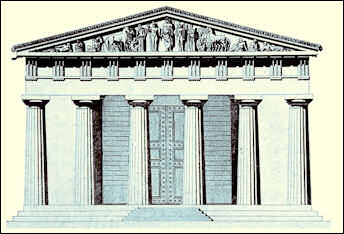
Temple of Zeus in Olympia According to UNESCO: “The site of Olympia, in a valley in the Peloponnesus, has been inhabited since prehistoric times. In the 10th century B.C., Olympia became a centre for the worship of Zeus. The Altis – the sanctuary to the gods – has one of the highest concentrations of masterpieces from the ancient Greek world. In addition to temples, there are the remains of all the sports structures erected for the Olympic Games, which were held in Olympia every four years beginning in 776 B.C. [Source: UNESCO World Heritage Site website =]
“The sanctuary of Olympia, in the North West of the Peloponnese, in the Regional Unit of Eleia (Elis), has been established in the valley created by the confluence of the Alpheios and Kladeos rivers in a natural setting of beauty and serenity. The Pan-Hellenic sanctuary has been established in the history of culture, as the most important religious, political and sports centre, with a history that dates back to the end of the Neolithic times (4th millennium B.C.). The famous sanctuary became the centre of worship of Zeus, the father of the twelve Olympian gods. For the Altis, the sacred grove and the centre of the sanctuary, some of the most remarkable works of art and technique have been created, constituting a milestone in the history of art. Great artists, such as Pheidias, have put their personal stamp of inspiration and creativity, offering unique artistic creations to the world. In this universal place, the Olympic Idea was born, making Olympia a unique universal symbol of peace and competition at the service of virtue. Here, too, prominence was given to the ideals of physical and mental harmony, of noble contest, of how to compete well, of the Sacred Truce; values, which remain unchanged in perpetuity. =
The sanctuary of the Altis contained one of the highest concentrations of masterpieces of the ancient Mediterranean world. Many have been lost, such as the Olympia Zeus, a gold-and-ivory cult statue which was probably destroyed by Pheidias between 438 and 430 B.C. and one of the seven wonders of the ancient world. Other masterpieces have survived: large votive archaic bronzes, pedimental sculptures and metopes from the temple of Zeus, and the famous complex of Hermes by Praxiteles. These are all major works of sculpture and key references in the history of art. =
Olympia’s Importance
According to UNESCO:“The influence of the monuments of Olympia has been considerable: the temple of Zeus, built in 470-457 B.C. is a model of the great Doric temples constructed in the Peloponnese, as well as in southern Italy and in Sicily during the 5th century B.C. ; the Nike by Paionios, sculptured circa 420 B.C. so lastingly influenced iconographic allegories of victory that neoclassic art of the 19th century is still much indebted to it; the Olympian Palaestra with reference to the Roman period, a square and an open space for athletes’ training as well as a place for their mental and physical preparation before the Games, is undoubtedly the typological reference made by Vitruvius in “De Architectura”. Its value as a standard in architecture is in any case indisputable. [Source: UNESCO World Heritage Site website =]
Olympia bears exceptional testimony to the ancient civilizations of Peloponnese, both in terms of duration and quality. The first human settlements date back to prehistoric times when the valley was occupied from 4000 to 1100 B.C. . Settlements and necropolises from the Bronze Age have been unearthed along the banks of the Alpheios river. The Middle Helladic and Mycenaean periods are represented at the site. Consecrated to Zeus, the Altis is a major sanctuary from the 10th century B.C. to the 4th century AD, corresponding to the zenith of Olympia, marked more specifically by celebration of the Olympic Games from 776 B.C. to 393 AD. A Christian settlement survived for a time at the site of the ruins of the great Pan-Hellenic sanctuary: discovery of the workshop of Pheidias under the remains of a Byzantine church is an outstanding indication of continuous human settlement, which was interrupted only in the 7th century AD, as a result of natural disasters. =
“Criterion (iv): Olympia is an outstanding example of a great Pan-Hellenic sanctuary of antiquity, with its multiple functions: religious, political and social. Ancient sanctuaries, such as the Pelopion and a row of Treasuries to the north at the foot of Kronion Hill, are present within the peribolus of the Altis, consecrated to the gods, alongside the principal temples of Zeus and Hera. All around the divine precinct are the structures used by the priests (Theokoleon) and the administration (Bouleuterion), as well as common buildings (Prytaneion), accommodation (Leonidaion and Roman hostel), residences for distinguished guests (Nero’s House), and all the sports structures used for the preparation and celebration of the Olympic Games: the stadium and the hippodrome to the east, and the thermal baths, the Palaestra and the Gymnasium to the south and west. =

an imagining of the statue of Zeus, one of the Seven Wonders of the World, in the Temple of Zeus in Olympia
“Olympia is directly and tangibly associated with an event of universal significance. The Olympic Games were celebrated regularly beginning in 776 B.C. . The Olympiad –the four-year period between two successive celebrations falling every fifth year- became a chronological measurement and system of dating used in the Greek world. However, the significance of the Olympic Games, where athletes benefitting from a three-month Sacred Truce came together from all the Greek cities of the Mediterranean world to compete, demonstrates above all the lofty ideals of Hellenic humanism: peaceful and loyal competition between free and equal men, who are prepared to surpass their physical strength in a supreme effort, with their only ambition being the symbolic reward of an olive wreath. The revival of the Olympic Games in 1896 through the efforts of Pierre de Coubertin illustrates the lasting nature of the ideal of peace, justice and progress, which is no doubt the most precious but also the most fragile feature of the world’s heritage. =
Statue of Zeus, One of the Seven Wonders of the World
The Statue of Zeus at Olympia was one of the Seven Wonders of the World. Reputed to be 40 feet high and placed in the great temple of Zeus in 457 B.C. the statue depicted Zeus seated on a throne. His body was carved from ivory and his robe and ornaments were made of gold. It was sculpted by Phidias (who created a similar statue of Athena in the Parthenon in Athens) sometime after 432 B.C.
The statue of Zeus was made of gold and ivory plates placed over a wood structure (making it from bronze and gold would have been too heavy for a statue of this size). A system of pipes was devised to bring oil to the wood to prevent it from rotting, The oil also helped preserve the ivory. Zeus sat on the golden throne with jewels for eyes, with his feet resting on a foot stool of gold. Worshippers used to pray at the statue's feet. Chroniclers said the statue was still there in the 2nd century B.C. After that it disappeared, most likely it was stripped and looted.
The original Temple of Zeus was destroyed in A.D. 426. The new temple one that housed the statue was 32 meters wide, 75 meters long and and 12 meters high, It was made of the finest marble and topped by a gilded statue of Nike. Sculpted lion heads with their mouths open served as drain spouts for the Temple of Zeus roof.
Delos
Delo is a small (350.64 hectares), rocky island in the centre of the Aegean Sea in the Cyclades archipelago. Considered “the most sacred of all islands” (Callimachus, 3rd century B.C.) in ancient Greek culture, it was where, the Greek legend goes, Apollo-Sun, god of daylight, and his twin sister Artemis-Moon, goddess of night light, were born. According to UNESCO: “Apollo's sanctuary attracted pilgrims from all over Greece and Delos was a prosperous trading port. The island bears traces of the succeeding civilizations in the Aegean world, from the 3rd millennium B.C. to the palaeochristian era. The archaeological site is exceptionally extensive and rich and conveys the image of a great cosmopolitan Mediterranean port. [Source: UNESCO World Heritage Site website =]
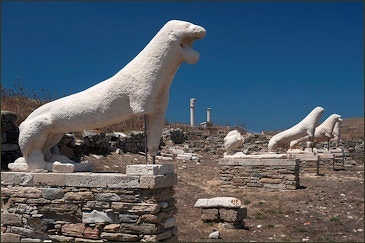
Terrace of the Lions at Delos
“The island was first settled in the third millennium B.C. . The Apollonian sanctuary, established at least since the 9th century B.C. reached the peak of its glory during the Archaic and Classical period, when it acquired its Pan-Hellenic character. After 167 B.C. as a result of the declaration of Delos as a free port, all the commercial activity of the eastern Mediterranean was concentrated on the isle. Rich merchants, bankers and ship-owners from all over the world settled there, attracting many builders, artists and craftsmen, who built for them luxurious houses, richly decorated with frescoes and mosaic floors.
“The small island became soon the maximum emporium totius orbis terrarium (S. P. Festus, 2nd century AD) – the greatest commercial centre of the whole world. The prosperity of the island and the friendly relations with the Romans were the main cause of its destruction. Delos was attacked and looted twice: in 88 B.C. by Mithridates, the King of Pontus, an enemy of the Romans, and later, in 69 B.C. by the pirates of Athenodorus, an ally of Mithridates. Since then, the island fell rapidly into decline and was gradually abandoned. Captured after its abandonment successively by the Byzantines, Slavs, Saracens, the Venetians, the Knights of St. John and the Ottomans, Delos was turned into a quarry site with its temple columns burnt for lime, and its houses left in ruins.” =
The island of Delos bears unique witness to the civilizations of the Aegean world since the 3rd millennium B.C.. During the Palaeo-Christian era, it was the seat of the bishopric of the Cyclades. From the 7th century B.C. to the pillage by Athenodoros in 69 B.C. the island of Delos was one of the principal Pan-Hellenic sanctuaries. The feast of the Delians, which was celebrated every four years in the month of May until 316 B.C. included gymnastic, equestrian and musical competitions, Archaic Age dances, theatrical productions and banquets. Like the Olympic and the Pythic Games, it was one of the major events in the Greek world. =
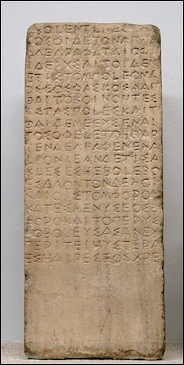
Delian League tributes
“Delos had considerable influence on the development of architecture and monumental arts during the Greco-Roman period, as seen in the immense Hellenistic sanctuary. A great part of its treasure of masterpieces was found during the excavations and is exhibited today in Delos’ Museum. This influence was matched later by the important role it has played since the 15th century in furthering our knowledge of ancient Greek art from a widely renowned site, which is among the first sites in Greece that captured the attention of archaeologists and travellers. =
The archaeological site of Delos provides an outstanding example of an architectural ensemble that restores the image of an extremely important cosmopolitan Mediterranean port that began to prosper since 314 B.C. reaching outstanding levels during the 2nd and 1st centuries B.C. . Warehouses and trading companies abounded, large residential areas were established, public buildings were founded by associations of bankers, traders and ship-owners. Moreover, there were an unprecedented number of sanctuaries dedicated to foreign religions: temples of Sarapis, Isis and Anubis, temples to the Syrian gods Haadad and Atargatis, and even a synagogue in the stadium district. =
“Delos is directly and tangibly associated with one of the principal myths of Hellenic civilisation. It was on this arid islet that Leto, made pregnant by Zeus and fleeing the vengeance of Hera, gave birth to Apollo and Artemis after a difficult labour. According to a Homeric hymn, the island, which until then had been floating, became anchored to the floor of the ocean. The newborn Phoebus- Apollo threw off his swaddling clothes bathed the universe in light and began walking with his cither and his bow. Kynthos, the mountain of Zeus, and the wheel-shaped lake, close to which the pregnant Leto suffered labor pains for nine days and nights, remain essential landmarks of the island's sacred geography, which was clearly defined by the additions made to the Delian sanctuary to Apollo between the 6th and the 1st centuries B.C.” =
Temples in Troezen in the Northeast Peloponnese
On Troezen, a town and region in the northeastern Peloponnese, Pausanias wrote in “Description of Greece”, Book II: Cornith (A.D. 160): “To Hippolytus, the son of Theseus, is devoted a very famous precinct, in which is a temple with an old image. Diomedes, they say, made these, and, moreover, was the first to sacrifice to Hippolytus. The Troezenians have a priest of Hippolytus, who holds his sacred office for life, and annual sacrifices have been established. They also observe the following custom. Every maiden before marriage cuts off a lock for Hippolytus, and, having cut it, she brings it to the temple and dedicates it. They will not have it that he was dragged to death by his horses, and, though they know his grave, they do not show it. But they believe that what is called the Charioteer in the sky is the Hippolytus of the legend, such being the honor he enjoys from the gods. [Source: Pausanias, “Description of Greece,” with an English Translation by W.H.S. Jones, Litt.D. in 4 Volumes. Volume 1.Attica and Cornith, Cambridge, MA, Harvard University Press; London, William Heinemann Ltd., 1918]
“Within this enclosure is a temple of Apollo Seafaring, an offering of Diomedes for having weathered the storm that came upon the Greeks as they were returning from Troy. They say that Diomedes was also the first to hold the Pythian games in honor of Apollo. Of Damia and Auxesia (for the Troezenians, too, share in their worship) they do not give the same account as the Epidaurians and Aeginetans, but say that they were maidens who came from Crete. A general insurrection having arisen in the city, these too, they say, were stoned to death by the opposite party; and they hold a festival in their honor that they call Stoning.
“In the other part of the enclosure is a race-course called that of Hippolytus, and above it a temple of Aphrodite Spy. For from here, whenever Hippolytus practised his exercises, Phaedra, who was in love with him, used to gaze upon him. Here there still grew the myrtle, with its leaves, as I have described above, pierced with holes. When Phaedra was in despair and could find no relief for her passion, she used to vent her spleen upon the leaves of this myrtle.There is also the grave of Phaedra, not far from the tomb of Hippolytus, which is a barrow near the myrtle. The image of Asclepius was made by Timotheus, but the Troezenians say that it is not Asclepius, but a likeness of Hippolytus. I remember, too, seeing the house of Hippolytus; before it is what is called the Fountain of Heracles, for Heracles, say the Troezenians, discovered the water.On the citadel is a temple of Athena, called Sthenias. The wooden image itself of the goddess I was made by CalIon, of Aegina.1 Callon was a pupil of Tectaeus and Angelion, who made the image of Apollo for the Delians. Angelion and Tectaeus were trained in the school of Dipoenus and Scyllis. On going down from here you come to a sanctuary of Pan Lyterius (Releasing), so named because he showed to the Troezenian magistrates dreams which supplied a cure for the epidemic that had afflicted Troezenia, and the Athenians more than any other people. Having crossed the sanctuary, you can see a temple of Isis, and above it one of Aphrodite of the Height. The temple of Isis was made by the Halicarnassians in Troezen, because this is their mother-city, but the image of Isis was dedicated by the people of Troezen.
“On the road that leads through the mountains to Hermione is a spring of the river Hyllicus, originally called Taurius (Bull-like), and a rock called the Rock of Theseus; when Theseus took up the boots and sword of Aegeus under it, it, too, changed its name, for before it was called the altar of Zeus Sthenius (Strong). Near the rock is a sanctuary of Aphrodite Nymphia (Bridal), made by Theseus when he took Helen to wife. Outside the wall there is also a sanctuary of Poseidon Nurturer (Phytalmios). For they say that, being wroth with them, Poseidon smote the land with barrenness, brine (halme) reaching the seeds and the roots of the plants (phyta),1 until, appeased by sacrifices and prayers, he ceased to send up the brine upon the earth. Above the temple of Poseidon is Demeter Lawbringer (Thesmophoros), set up, they say, by Althepus. On going down to the harbor at what is called Celenderis, you come to a place called Birthplace (Genethlion), where Theseus is said to have been born. Before this place is a temple of Ares, for here also did Theseus conquer the Amazons in battle. These must have belonged to the army that strove in Attica against Theseus and the Athenians.”
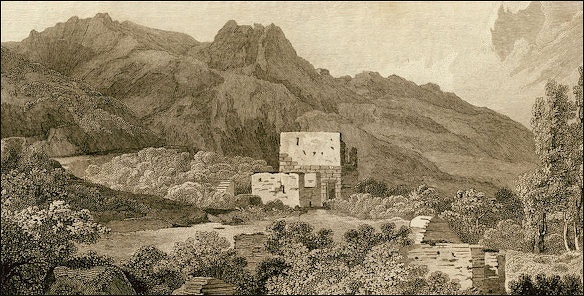
ruins of Troezen in 1819
Temples in Corinth
Pausanias wrote in “Description of Greece” Book II: Corinth (A.D. 160): “On the market-place, where most of the sanctuaries are, stand Artemis surnamed Ephesian and wooden images of Dionysus, which are covered with gold with the exception of their faces; these are ornamented with red paint. They are called Lysius and Baccheus, and I too give the story told about them. They say that Pentheus treated Dionysus despitefully, his crowning outrage being that he went to Cithaeron, to spy upon the women, and climbing up a tree beheld what was done. When the women detected Pentheus, they immediately dragged him down, and joined in tearing him, living as he was, limb from limb. Afterwards, as the Corinthians say, the Pythian priestess commanded them by an oracle to discover that tree and to worship it equally with the god. For this reason they have made these images from the tree. [Source: Pausanias, “Description of Greece,” with an English Translation by W.H.S. Jones, Litt.D. in 4 Volumes. Volume 1.Attica and Cornith, Cambridge, MA, Harvard University Press; London, William Heinemann Ltd., 1918]
“There is also a temple of Fortune, with a standing image of Parian marble. Beside it is a sanctuary for all the gods. Hard by is built a fountain, on which is a bronze Poseidon; under the feet of Poseidon is a dolphin spouting water. There is also a bronze Apollo surnamed Clarius and a statue of Aphrodite made by Hermogenes of Cythera. There are two bronze, standing images of Hermes, for one of which a temple has been made. The images of Zeus also are in the open; one had not a surname, another they call Chthonius (of the Lower World) and the third Most High.
“On the summit of the Acrocorinthus is a temple of Aphrodite. The images are Aphrodite armed, Helius, and Eros with a bow. The spring, which is behind the temple, they say was the gift of Asopus to Sisyphus. The latter knew, so runs the legend, that Zeus had ravished Aegina, the daughter of Asopus, but refused to give information to the seeker before he had a spring given him on the Acrocorinthus. When Asopus granted this request Sisyphus turned informer, and on this account he receives — if anyone believes the story — punishment in Hades. I have heard people say that this spring and Peirene are the same, the water in the city flowing hence under-ground. This Asopus rises in the Phliasian territory, flows through the Sicyonian, and empties itself into the sea here. His daughters, say the Phliasians, were Corcyra, Aegina, and Thebe. Corcyra and Aegina gave new names to the islands called Scheria and Oenone, while from Thebe is named the city below the Cadmea. The Thebans do not agree, but say that Thebe was the daughter of the Boeotian, and not of the Phliasian, Asopus. The other stories about the river are current among both the Phliasians and the Sicyonians, for instance that its water is foreign and not native, in that the Maeander, descending from Celaenae through Phrygia and Caria, and emptying itself into the sea at Miletus, goes to the Peloponnesus and forms the Asopus. I remember hearing a similar story from the Delians, that the stream which they call Inopus comes to them from the Nile. Further, there is a story that the Nile itself is the Euphrates, which disappears into a marsh, rises again beyond Aethiopia and becomes the Nile. Such is the account I heard of the Asopus. When you have turned from the Acrocorinthus into the mountain road you see the Teneatic gate and a sanctuary of Eilethyia. The town called Tenea is just about sixty stades distant. The inhabitants say that they are Trojans who were taken prisoners in Tenedos by the Greeks, and were permitted by Agamemnon to dwell in their present home. For this reason they honor Apollo more than any other god.
“As you go from Corinth, not into the interior but along the road to Sicyon, there is on the left not far from the city a burnt temple. There have, of course, been many wars carried on in Corinthian territory, and naturally houses and sanctuaries outside the wall have been fired. But this temple, they say, was Apollo's, and Pyrrhus the son of Achilles burned it down. Subsequently I heard another account, that the Corinthians built the temple for Olympian Zeus, and that suddenly fire from some quarter fell on it and destroyed it. The Sicyonians, the neighbours of the Corinthians at this part of the border, say about their own land that Aegialeus was its first and aboriginal inhabitant, that the district of the Peloponnesus still called Aegialus was named after him because he reigned over it, and that he founded the city Aegialea on the plain. Their citadel, they say, was where is now their sanctuary of Athena; further, that Aegialeus begat Europs, Europs Telchis, and Telchis Apis. This Apis reached such a height of power before Pelops came to Olympia that all the territory south of the Isthmus was called after him Apia. Apis begat Thelxion, Thelxion Aegyrus, the Thurimachus, and Thurimachus Leucippus. Leucippus had no male issue, only a daughter Calchinia. There is a story that this Calchinia mated with Poseidon; her child was reared by Leucippus, who at his death handed over to him the kingdom. His name was Peratus.”
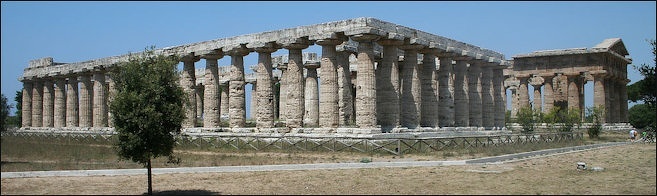
Temples of Hera and Poseidon in Paestum, Italy
Poseidon Temples in Corinth
Pausanias wrote in “Description of Greece” Book II: Corinth (A.D. 160): “A legend of the Corinthians about their land is not peculiar to them, for I believe that the Athenians were the first to relate a similar story to glorify Attica. The Corinthians say that Poseidon had a dispute with Helius (Sun) about the land, and that Briareos arbitrated between them, assigning to Poseidon the Isthmus and the parts adjoining, and giving to Helius the height above the city.Ever since, they say, the Isthmus has belonged to Poseidon. Worth seeing here are a theater and a white-marble race-course. Within the sanctuary of the god stand on the one side portrait statues of athletes who have won victories at the Isthmian games, on the other side pine trees growing in a row, the greater number of them rising up straight.[Source: Pausanias, “Description of Greece,” with an English Translation by W.H.S. Jones, Litt.D. in 4 Volumes. Volume 1.Attica and Cornith, Cambridge, MA, Harvard University Press; London, William Heinemann Ltd., 1918]
“On the temple, which is not very large, stand bronze Tritons. In the fore-temple are images, two of Poseidon, a third of Amphitrite, and a Sea, which also is of bronze. The offerings inside were dedicated in our time by Herodes the Athenian, four horses, gilded except for the hoofs, which are of ivory, and two gold Tritons beside the horses, with the parts below the waist of ivory. On the car stand Amphitrite and Poseidon, and there is the boy Palaemon upright upon a dolphin. These too are made of ivory and gold. On the middle of the base on which the car is has been wrought a Sea holding up the young Aphrodite, and on either side are the nymphs called Nereids. I know that there are altars to these in other parts of Greece, and that some Greeks have even dedicated to them precincts by shores, where honors are also paid to Achilles. In Gabala is a holy sanctuary of Doto, where there was still remaining the robe by which the Greeks say that Eriphyle was bribed to wrong her son Alcmaeon. Among the reliefs on the base of the statue of Poseidon are the sons of Tyndareus, because these too are saviours of ships and of sea-faring men. The other offerings are images of Calm and of Sea, a horse like a whale from the breast onward, Ino and Bellerophontes, and the horse Pegasus.
“Within the enclosure is on the left a temple of Palaemon, with images in it of Poseidon, Leucothea and Palaemon himself. There is also what is called his Holy of Holies, and an underground descent to it, where they say that Palaemon is concealed. Whosoever, whether Corinthian or stranger, swears falsely here, can by no means escape from his oath. There is also an ancient sanctuary called the altar of the Cyclopes, and they sacrifice to the Cyclopes upon it. The graves of Sisyphus and of Neleus--for they say that Neleus came to Corinth, died of disease, and was buried near the Isthmus--I do not think that anyone would look for after reading Eumelus. For he says that not even to Nestor did Sisyphus show the tomb of Neleus, because it must be kept unknown to everybody alike, and that Sisyphus is indeed buried on the Isthmus, but that few Corinthians, even those of his own day, knew where the grave was. The Isthmian games were not interrupted even when Corinth had been laid waste by Mummius, but so long as it lay deserted the celebration of the games was entrusted to the Sicyonians, and when it was rebuilt the honor was restored to the present inhabitants.
“The names of the Corinthian harbors were given them by Leches and Cenchrias, said to be the children of Poseidon and Peirene the daughter of Achelous, though in the poem called The Great Eoeae1 Peirene is said to be a daughter of Oebalus. In Lechaeum are a sanctuary and a bronze image of Poseidon, and on the road leading from the Isthmus to Cenchreae a temple and ancient wooden image of Artemis. In Cenchreae are a temple and a stone statue of Aphrodite, after it on the mole running into the sea a bronze image of Poseidon, and at the other end of the harbor sanctuaries of Asclepius and of Isis. Right opposite Cenchreae is Helen's Bath. It is a large stream of salt, tepid water, flowing from a rock into the sea. As one goes up to Corinth are tombs, and by the gate is buried Diogenes1 of Sinope, whom the Greeks surname the Dog. Before the city is a grove of cypresses called Craneum. Here are a precinct of Bellerophontes, a temple of Aphrodite Melaenis and the grave of Lais, upon which is set a lioness holding a ram in her fore-paws.”
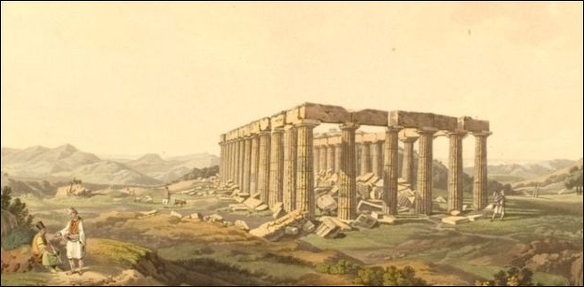
Temple of Apollo in Epicurius
Temple of Apollo Epicurius at Bassae
According to UNESCO: “The columned temple of Apollo Epicurius rises majestically within the sanctuary of Bassae in the mountains of Arkadia. It is one of the best-preserved monuments of classical antiquity and an evocative and poignant testament to classical Greek architecture. It is highly significant for its architectural features and influence.” The temple is dedicated to the god of healing and the sun, has the oldest Corinthian capital yet found, and combines the Archaic style and the serenity of the Doric style with some daring architectural features. [Source: UNESCO World Heritage Site website =]
“The temple was built at the height of the Greek civilization in the second half of the 5th century B.C. (420-400 B.C.). It was dedicated to Apollo Epicurius by the Phigaleians, who believed the god of sun and healing had protected them from plague and invasion. In 174 AD the ancient traveller Pausanias admired the beauty and harmony of the temple and attributed it to Iktinos, the architect of the Parthenon. =
“The temple appears to have been forgotten for almost 1700 years until it was rediscovered in the 18th century and attracted intense interest from scholars and artists. The isolation of the site ensured many significant features survived largely intact. The temple is one of the earliest post-Parthenonian edifices and the earliest monument in which all three ancient Greek architectural orders – Doric, Ionic and Corinthian – are found together. It also included the earliest surviving Corinthian column capital. The temple further exhibits a number of bold and innovative architectural designs that mark a turning point in the development of temple-building. Through a series of ingenious devices, the architect successfully balanced contrasting elements and blended the old with the new, contributing to the unique architectural and artistic value of the monument. The temple, as well as its sculptural decoration consist one of the best-preserved samples of the ancient Greek civilization, from the period of its heyday (5th century B.C.). =
“The Temple of Bassae represents a unique artistic achievement, remarkable for its archaic features (elongated surface, an exceptional proportion of 15 columns on the longer side and 6 columns on the facade, and a north-south exposure), and for its daring innovations: use of Ionic and Corinthian orders for a Doric edifice, the variety of materials used, and the originality of the layout of the cella and the adyton. The capital of the central column of the Temple of Bassae is the most ancient conserved Corinthian capital, and as such the temple may be considered a model for all “Corinthian” monuments of Greek, Roman and subsequent civilisations. Isolated as it is in a conserved environment, the temple of Apollo is an outstanding example of a Hellenic votive sanctuary in a rural setting. =
Temple of Diana in Ephesus, Another of the Seven Wonders
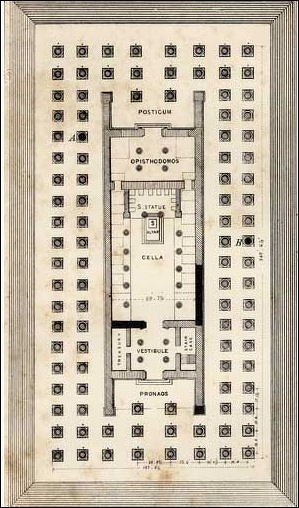
Plan of the Temple of Diana
The Temple of Diana (in Ephesus) was ordered by King Croesus and completed around 550 B.C. after 120 years of labor. Described by Phion as the greatest of the seven wonders, the Temple of Diana was 225-feet-wide and 525-feet-long, with 127 sixty-foot-high marble columns. The largest and most complex temple in ancient times, it was made out of marble, wood and tile, and built on marshy soil so it would be immune to earthquakes. Even so the temple had to be rebuilt three times before Goths destroyed it in 262 A.D.
The Temple of Diana was built around 550 B.C. near the sea and destroyed by invading Goths around A.D. 262. Ertastratus ordered the Temple of Diana to be burned down he did so to ensure that it was remembered, English archeologist J. T. Wood rediscovered the temple in 1874 after 11 years of digging. Today the ruins are located a mile or so away from Ephesus, and unfortunately all that remains is a foundation.
Diana of Ephesus, also known as the virgin huntress of the moon, was worshipped throughout most of Europe and the Mediterranean during ancient times and she still has followers today. The Greeks knew her as Artemis, and her origins can be traced as far back as Babylon. She may even have evolved from Stone Age earth mothers goddesses that dominated primitive cultures before the Greeks popularized male gods.
Despite the fact she was a permanent virgin, she was the goddess of fertility, and the famous statue of her now in the Selçuk Museum has endowed her with 18 breasts. None of the breasts have nipples, however, which led one classical scholar to venture they were actually bull's testes or the ova on scared bees. Whatever they were Diana's image has fascinated artists for centuries. Other statues have placed bees on her knees and lions over her shoulders. A Raphael painting of her graces the Vatican. And recently a Brooklyn artist gave her four buttocks as well as a chestful of breasts.
What got St. Paul into trouble was his statement: "Diana should be despised and her magnificence should be destroyed" The Temple that honored her was a popular tourist attraction and silver souvenirs of Diana and her temple were sold on the streets of Ephesus like miniature Eiffel towers and Statues of Liberty are sold today. During the festival of Artemis images of Diana were placed on the steps of her temple for worshipers to kiss. [Source: Vicky Goldberg, New York Times, August 21, 1994].
Acropolis Area in Athens
The Acropolis is the name of the huge rock in Ayhens on which the Parthenon stands. Anchored by huge walls and surrounded by a forest of unassembled ruins the Acropolis rises out of Athens like a miniature Mt. Olympus. An important secular and sacred site, it was home to he city's treasury as well as temples for religious rites and sacrifices.
Caves near a natural spring on the steep north side of the Acropolis have been inhabited since Neolithic times and the fortress-like walls around the Acropolis were built by the Mycenaeans to protect a palace they had erected at the top. This was superseded by a Greek temple dedicated to Poseidon and Athena that was destroyed in 480 B.C. when the entire city of Athens was burned to ground by the Persian army of Xeres. In the Golden Age of Greece the caves contained a shrine to Pan and other Gods.
From the Acropolis , it is easy to see why this abrupt steep-sided rock was chosen as the first citadel of ancient Athens: it is a superb natural defensive site. Once fortified, it was virtually impregnable, although defenders were hampered by the lack of water on the Acropolis . Still, the Acropolis was a fitting home for the virgin warrior goddess, Athena. [Source: Internet Archive, from vacation.net.gr]
Many of the temples built on the Acropolis were shrines to Athena, as is the Parthenon which remains today. Its predecessor, the massive Hekatompedon of Peisistratus, was located slightly to the north of the Parthenon, beside the present Erechtheion. The Hekatompedon (also known as the "Old Temple of Athena"), was burnt in the Persian sack of Athens in 480 B.C. Its foundations remain on the Acropolis , and are the only remnants of the buildings which were on the Acropolis before the Persians sacked the city. Parts of the temple were built into the north wall of the Acropolis , where some of the massive column drums may still be seen.
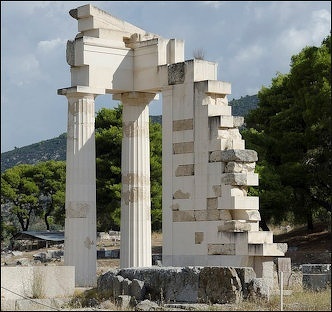
Asclepeion in Epidaurus
However grand the buildings with which Peisistratos adorned the Acropolis , they did not survive the Persian onslaught. Fortunately, many of the buildings erected by Pericles a half century later have survived, and it is the Periclean Acropolis which we visit today. Of these buildings, the most famous is the Parthenon (447-32 B.C.), flanked by the temple of Athena Nike (427-24 B.C.) and the Erechtheion (421-06 B.C.). In addition, Pericles was responsible for the building of the Propylaia (437-32 B.C.), the monumental entrance way to the Acropolis .
“The Acropolis of Athens is the most striking and complete ancient Greek monumental complex still existing in our times. It is situated on a hill of average height (156 meters, 510 feet) that rises in the basin of Athens. Its overall dimensions are approximately 170 by 350 meters (560 by 1150 feet). The hill is rocky and steep on all sides except for the western side, and has an extensive, nearly flat top. Strong fortification walls have surrounded the summit of the Acropolis for more than 3,300 years. The first fortification wall was built during the 13th century B.C. and surrounded the residence of the local Mycenaean ruler. In the 8th century B.C. the Acropolis gradually acquired a religious character with the establishment of the cult of Athena, the city’s patron goddess. The sanctuary reached its peak in the archaic period (mid-6th century to early 5th century B.C.). In the 5th century B.C. the Athenians, empowered from their victory over the Persians, carried out an ambitious building programme under the leadership of the great statesman Perikles, comprising a large number of monuments including the Parthenon, the Erechtheion, the Propylaia and the temple of Athena Nike.
See Separate Articles: ACROPOLIS AND TEMPLES IN ANCIENT ATHENS europe.factsanddetails.com PARTHENON: ITS HISTORY, ARCHITECTURE AND SCULPTURES europe.factsanddetails.com
Healing Temples of Ancient Greece
According to the Metropolitan Museum of Art: “Two of the most famous healing sanctuaries sacred to the god were at Epidauros and on the island of Kos. The success of the cult of Asklepios in antiquity was due to his accessibility—although the son of Apollo, he was still human enough to attempt to cancel death. Those who sought a cure in the temples erected to him were subjected to ritual purifications, fasts, prayers, and sacrifices. A central feature of the cult and the process of healing was known as incubation, during which the god appeared to the afflicted one in a dream and prescribed a treatment. [Source: Colette Hemingway, Independent Scholar,Metropolitan Museum of Art, October 2004, metmuseum.org \^/]
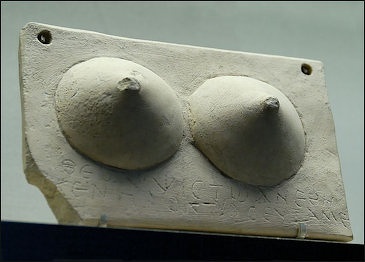
votive plaque
According to UNESCO: “In a small valley in the Peloponnesus, the shrine of Asklepios, the god of medicine, developed out of a much earlier cult of Apollo (Maleatas), during the 6th century B.C. at the latest, as the official cult of the city state of Epidaurus. Its principal monuments, particularly the temple of Asklepios, the Tholos and the Theatre - considered one of the purest masterpieces of Greek architecture – date from the 4th century. The vast site, with its temples and hospital buildings devoted to its healing gods, provides valuable insight into the healing cults of Greek and Roman times. [Source: UNESCO World Heritage Site website =]
“The Sanctuary of Asklepios at Epidaurus is a remarkable testament to the healing cults of the Ancient World and witness to the emergence of scientific medicine. Situated in the Peloponnese, in the Regional unit of Argolis, the site comprises a series of ancient monuments spread over two terraces and surrounded by a preserved natural landscape. Among the monuments of the Sanctuary is the striking Theatre of Epidaurus, which is renowned for its perfect architectural proportions and exemplary acoustics. The Theatre, together with the Temples of Artemis and Asklepios, the Tholos, the Enkoimeterion and the Propylaia, comprise a coherent assembly of monuments that illustrate the significance and power of the healing gods of the Hellenic and Roman worlds. =
See Separate Article: HEALTH CARE IN ANCIENT GREECE: SPELLS, MEDICINES AND HEALING TEMPLES europe.factsanddetails.com
Image Sources: Wikimedia Commons
Text Sources: Internet Ancient History Sourcebook: Greece sourcebooks.fordham.edu ; Internet Ancient History Sourcebook: Hellenistic World sourcebooks.fordham.edu ; BBC Ancient Greeks bbc.co.uk/history/; Canadian Museum of History, Perseus Project - Tufts University; perseus.tufts.edu ; MIT Classics Online classics.mit.edu ; Gutenberg.org, Metropolitan Museum of Art, National Geographic, Smithsonian magazine, New York Times, Washington Post, Live Science, Discover magazine, Natural History magazine, Archaeology magazine, The New Yorker, Encyclopædia Britannica, "The Discoverers" and "The Creators" by Daniel Boorstin. "Greek and Roman Life" by Ian Jenkins from the British Museum, Wikipedia, Reuters, Associated Press, The Guardian, AFP and various books and other publications.
Last updated September 2024