
Home | Category: Themes, Archaeology and Prehistory
VESUVIUS
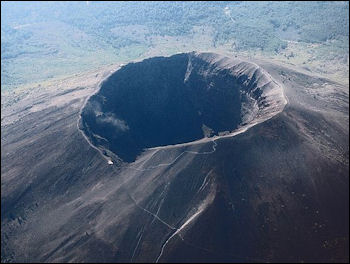
Vesuvius from a plane Vesuvius, one the world's most famous volcano, looms above the Bay of Naples. It exploded with huge force on August 24, A.D. 79 and buried the cities of Pompeii and Heracuelum and killed many of their residents.
Vesuvius (10 miles from Naples) is 4,203 feet (1,281 meters) high. It is now relatively quiet but still very active. The bottom of the crater is about 800 feet below the crater rim. Several fumaroles innocuously release fumes. Vesuvius actually lies inside the exploded remnants of an older volcano. A ridge from the much large volcano lies on the north edge.
The chamber where Vesuvius’s magma is stored is seven miles below the earth's surface. The collision between the African plate and the European plate in southern Italy produces molten rock, rich in volatile gases. Under pressure these gases stay dissolved. But when the magma rises to the surface, the gases expand and when they are released they tend to produce explosive eruptions.
See Separate Articles:
ERUPTION OF VESUVIUS IN A.D. 79: EFFECTS, EARTHQUAKES AND PLINY THE ELDER europe.factsanddetails.com ;
POMPEII: HISTORY, BUILDINGS, INTERESTING SITES europe.factsanddetails.com ;
POMPEII VICTIMS: THEIR LIVES, CASTS, DEATHS AND DNA europe.factsanddetails.com ;
HERCULANEUM VICTIMS: THEIR LIVES, DEATHS AND VAPORIZATION europe.factsanddetails.com ;
HERCULANEUM: HISTORY, ARCHAEOLOGY, BUILDINGS europe.factsanddetails.com ;
VOLCANO COMPONENTS, STRUCTURE AND ACTIVITY factsanddetails.com ;
VOLCANIC ERUPTIONS: TYPES, PHASES AND CAUSES factsanddetails.com ;
DESTRUCTIVE ERUPTIONS: LAHARS, PYROCLASTIC FLOWS AND GLACIAL BURSTS factsanddetails.com
Websites and Sources on Volcanoes: USGS Volcanoes volcanoes.usgs.gov ; Volcano World volcano.oregonstate.edu ; Volcanoes.com volcanoes.com ; Wikipedia Volcano article Wikipedia , Smithsonian Global Volcanism Program volcano.si.edu operated by the Smithsonian has descriptions of volcanoes around the globe and a catalog of over 8,000 eruptions in the last 10,000 years.; Websites on Ancient Rome: Internet Ancient History Sourcebook: Rome sourcebooks.fordham.edu ; Internet Ancient History Sourcebook: Late Antiquity sourcebooks.fordham.edu ; Forum Romanum forumromanum.org ; “Outlines of Roman History” forumromanum.org; “
RECOMMENDED BOOKS:
“Vesuvius: A Biography” by Alwyn Scarth (2009) Amazon.com;
“Vesuvius, Campi Flegrei, and Campanian Volcanism” by Benedetto De Vivo, Harvey E. Belkin, et al. (2019) Amazon.com;
“Neapolitan Volcanoes: A Trip Around Vesuvius, Campi Flegrei and Ischia” (GeoGuide)
by Stefano Carlino (2018) Amazon.com;
“The Eruption of Vesuvius in 1872: Unveiling the Catastrophic Fury of Mount Vesuvius”
by Luigi Palmieri and Robert Mallet (2019) Amazon.com;
“Pliny and the Eruption of Vesuvius” by Pedar W. Foss Amazon.com;
“The Letters of the Younger Pliny (Penguin Classics) by Pliny the Younger and Betty Radice (1963) Amazon.com;
“Ghosts of Vesuvius: A New Look at the Last Days of Pompeii, How Towers Fall, and Other Strange Connections” by Charles R Pellegrino (2005) Amazon.com;
“Pompeii: The History, Life and Art of the Buried City” by Marisa Ranieri Panetta (2023) Amazon.com;
“The Complete Pompeii”, Illustrated, by Joanne Berry (2007) Amazon.com;
“Life and Death in Pompeii and Herculaneum” by Paul Roberts Amazon.com;
"Pompeii's Living Statues: Ancient Roman Lives Stolen from Death” by Eugene Dwyer | (2010) Amazon.com;
“Pompeii: The Life of a Roman Town” by Mary Beard (2010) Amazon.com;
“The Fires of Vesuvius: Pompeii Lost and Found” by Mary Beard (2010) Amazon.com;
“Houses and Society in Pompeii and Herculaneum” by Andrew Wallace-Hadrill (1996) Amazon.com;
“Pompeii: An Archaeological Guide by Paul Wilkinson (2019) Amazon.com;
“Pompeii” by Robert Harris (2003), Novel Amazon.com
“Inside Pompeii”, a photographic tour, by Luigi Spina (2023) Amazon.com;
“Secrets of Pompeii: Everyday Life in Ancient Rome” by Emidio De Albentiis, Alfredo Foglia (Photographer) Amazon.com;
“Pompeii and Herculaneum: A Sourcebook (Routledge) by Alison E. Cooley (2013) Amazon.com;
“Herculaneum: Italy's Buried Treasure” by Joseph Deiss (1989) Amazon.com;
“The Library of the Villa dei Papiri at Herculaneum” by David Sider (2005) Amazon.com;
“Buried by Vesuvius: The Villa dei Papiri at Herculaneum” by Kenneth Lapatin (2019) Amazon.com;
Is Vesuvius the World's Most Dangerous Volcano
Some scientists regard Vesuvius as the world's most dangerous volcano. An estimated 1 million people live within the "death zone" five miles of the crater and three million live within an eight-mile radius of the crater. Should the volcano repeat its Pompeii performance ashfall, pyroclastic flows, and mud slides would probably destroy 500,000 homes and kill 200,000 people if no warnings were given and no preparations were made. A huge pyroclastic flow like the one that occurred in 1780 B.C. could wipe out all of Naples.
A large eruption in 1631, when there was only a 24 hour warning that something was amiss, killed 4,000 people. Streams of lava were produced by frequent eruptions in the 18th, 19th and 20th centuries but few people were hurt. The last major eruption occurred during World War II in 1944, when there were small ash showers and a small lava flow. Clouds of ash blew towards U.S. bombers as they headed toward German targets. About 45 people were killed and 88 Allied aircraft based nearby were damaged. Some serious damage occurred in some places but the eruptions was nothing like the one in A.D. 79. Since 1944 the volcano has been mostly quiet. Some say this is bad news: a sign that pressure is building up inside and it could blow violently when next time it erupts.
The area around Vesuvius is the only real volcanically active region of the European mainland. Nearby on the island of Ischia is a volcano that erupted in 1302 and opposite the Bay of Naples from Vesuvius are the Phlegraean Fields which are made up of 20 craters, including one, Monte Nuovo, which was formed by an eruption in 1538. About 36,000 years ago an eruption occurred here that dwarfed both Krakatau and Mount St. Helens and covered the area with a layer of ash 160 feet thick. In the 1980s the region started to kick up again but all is quiet now.
Eruptions of Vesuvius
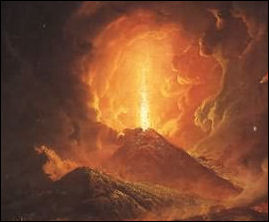 Vesuvius lets loose with a major eruption about once every 2000 years. The last one was the famous one that destroyed Pompeii in B.C. 79. The one before that was in 1780 B.C. Before that there were major ones about 8,000 years ago, 11,400 years ago, 15,000 years ago, 17,000 years ago, 22,500 years ago and 25,000 years ago.
Vesuvius is plugged by a huge cork of solid rock, which according to some estimates is 10 kilometers thick. It takes a huge amount of energy and pressure for the magma chamber below the rock to blow a hole to the surface. When Vesuvius erupts it typically releases a massive column of hot ash and stones, mostly light. air-hole-filled pumice and harder, more rock-like lapilli. Liquid rock is propelled into the air at supersonic speeds, producing a sonic boom. The cloud of material produced in A.D. 79 that Pliny the Younger wrote was shaped like an umbrella pine tree.
The way the eruption unfolds and the damage occurs depends on where the crater on the volcano is (which determines where the pyroclastic flows might go) and wind directions (which determines where the ash cloud will go). Eruption occurring in ancient Monte Somma crater have funneled pyroclastic flows in the direction of Naples. Wind in 1780 B.C. carried the fallout mainly to the east while winds in B.C. 97 carried debris from that eruption to the south towards Pompeii.
The height of the Vesuvius changes from eruption to eruption. It looks now like the top half of the mountain is missing, which is in partly true. The mountain was several hundred feet higher in A.D. 79. It is now 4,203 feet high, 140 feet or so shorter than it was during its last major eruption in 1906. Vesuvius's major eruptions occur at the end of a cycle that begins with a 7 year quiescent period which is followed by 20 to 30 years of minor activity before the mountain finally blows.
Pyroclastic Surges and Mudlfows from Vesuvius
During Vesuvius eruptions a column of ash, gas and heated rock collapses on itself, creating burning hot clouds in a pyroclastic surges that shoot out sideways and flow down the slopes initially at great speed, destroying everything in their path. Many volcanos have produced pryoclastic flows but the ones produced by Vesuvius cover many kilometers, making Vesuvius in the eyes of some experts perhaps the world’s most dangerous volcano.
Stephen Hall wrote in National Geographic, “A pyroclastic surge is baked in a subterranean chamber to temperatures of up to 1650 degrees F. The initial surge of the eruption, especially in the zones closest to Vesuvius is instantly lethal. Hot, choking, wind, advancing at about 240 miles an hour, reach temperatures of at least 900 degrees F, and retain enough heat to bring water to a boil ten miles from the event.”
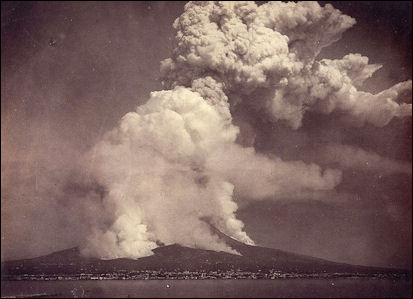
Vesuvius1872 Giuseppe Mastrolorenzo, a volcanologist at the Osservatorio Vesuviano in Naples, told National Geographic, “Below 200 degrees Fahrenheit, you can survive for several seconds, perhaps if the wave passes quickly...But even if you survive the temperature , you will suffocate on the fine powder in the air.”
“When vast amounts of solid ash and debris mixes with steam fed by underground aquifers,” Hall wrote, “a violent microclimate of pitched thunderstorms and torrential rains occurs, producing great mudflows. Ash falling into rivers creates more mudflows, known as lahars, that fill river valleys long after the eruption is over.” Mastrolornzo said, “There are more victims from the mudlfows than from the eruption itself. These mud flows travel with a force that moves houses hundreds of meters,”
Avellino Eruption of Vesuvius in 1780 B.C.
In 1780 B.C. Vesuvius exploded with more powerful blast than it did in A.D. 79. A pyroclastic surge and flow engulfed an area to the north of the volcano about 30 kilometers north to south and 30 kilometers east to east and destroyed almost everything in its path. This is a huge area, covering all of modern-day Naples and its suburbs and much of the countryside surrounding it too. [Source: Stephen Hall, National Geographic, September 2007]
Mastrolorenza and Peir Paolo Petrone, an anthropologist at the University of Naples, are two figures who have been at the forefront of trying to figure what happened during the 1780 B.C. eruption geologically and anthropologically. They have done this primarily by measuring ash depths in different places and studying footprints of victims as they fled the eruption. The eruption is sometimes called the Avellino eruption because volcanic material was found at the town of Avelliono about 40 kilometers to east.
Mastrolorenzo, Petrone and American volcanologist Michael Sheriden sparked interest in the eruption in the spring of 2006 with a paper about it in the Proceeding of the National Academy of Sciences (PNAS) in which they said the Avellion event “caused a social-demographic collapse and the abandonment of the entire area for centuries.”
The initial blast hurled material — cinders, heated rock and ash — at a rate of 100,000 tons a second. A column reached about 35 kilometers into the stratosphere — roughly three times the altitude of cruising commercial airliners. The column of ash may have hung in the air for as long as 12 hours. Pumice and lapilli collected into piles as high as three meters near the volcano. This eruption and what occurred afterwards also offers a scary warming what is store for the modern Naples metropolitan area, and its three million people, sometime in the not too distant future. If an Avellino eruption occurred without warning today everyone in Naples would die.
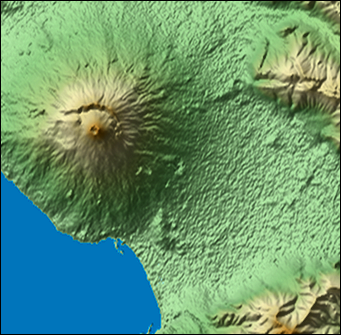
Vesuvius from a satellite Describing what the blast must have been like for villagers from 1780 B.C. whose bones were found in 1995, Stephen Hall wrote in National Geographic, “When the first thunderous boom echoed across the plain of Campania, quickly followed by a blistering hail of volcanic rock, the men and the woman had abandoned their village and made a run for it to the east.. A violent downpour of rubbly pumice mixed with incandescent rocks capable of crushing skulls and scalding skin obscure their escape....Thousands of other people were at the same moment running for their lives, marking the soft ash and wet volcanic mud with footprints...The people whose footprints led to the north or northwest chose a path that probably saved their lives; those who set out to the east...unwittingly chose a bath that led them to certain death. They headed by ill luck, smack into the middle of a fallout zone that would swiftly bury them under three feet of pumice.” Victims either died from trauma wounds caused by being struck on the head by large volcanic rocks of by being slowly asphyxiated.
Mastrolornzo told National Geographic, “The entire countryside surrounding Vesuvius was covered by foot upon foot of the powder produced by the pyrcoclastic flow: “645 feet deep at a distance of three miles from the crater and about 10 inches thick at a distance of 15 miles. Eight inches of ash is enough to cause modern roofs to collapse.”
Image Sources: Wikimedia Commons
Text Sources: Internet Ancient History Sourcebook: Rome sourcebooks.fordham.edu ; Internet Ancient History Sourcebook: Late Antiquity sourcebooks.fordham.edu ; “Outlines of Roman History” by William C. Morey, Ph.D., D.C.L. New York, American Book Company (1901) ; “The Private Life of the Romans” by Harold Whetstone Johnston, Revised by Mary Johnston, Scott, Foresman and Company (1903, 1932); BBC Ancient Rome bbc.co.uk/history/ ; Project Gutenberg gutenberg.org ; Metropolitan Museum of Art, National Geographic, Smithsonian magazine, New York Times, Washington Post, Los Angeles Times, Live Science, Discover magazine, Archaeology magazine, Reuters, Associated Press, The Guardian, AFP, The New Yorker, Wikipedia, Encyclopædia Britannica, Encyclopedia.com and various other books, websites and publications.
Last updated November 2024