
Home | Category: Education, Health and Transportation
ANCIENT GREEK MEDICINES
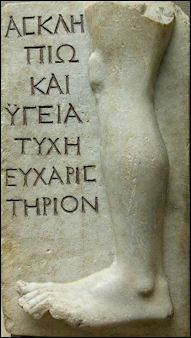
Votive relief Asklepios Ancient Greek medicines consisted primarily of herbs and plants. Seeds of the autumn crocus were used by the ancient Greeks as a treatment for gout. Quill was used as a heart stimulant and fennel and senna were taken for heartburn. To get rid of worms doctors prescribed tansy and belladonna. In the first century A.D., Pedanius Dioscorides, the Galen of pharmacology, noted that juices from willow bark and leaves eased aches related to clots and fever. In the 19th century aspirin was synthesized from the same bark and trees. In the 5th century B.C., Hippocrates also described the use of willow bark.
Dioscorides' medical manual, which consisted of descriptions and drawings of hundreds of plants and herbs, was followed by doctors for 1,600 years. He wrote the berry of the juniper was good for "the stomach, infirmities of the thorax, coughs, inflammations, poisons of venomous beasts." The common radish was "welcome to the mouth, but not good for the stomach, besides it causes belching." Mandrakes was recommended for anesthesia but it was advised not to prepare too much for "they make men speechless" for days at a time.
Theophrastus (371-287 B.C.), a Greek naturalist and philosopher, was one of the first to write about the use of opium poppy juice. In his time the juice of the poppy was taken orally. Some Romans grew it in their gardens.
For snake bites the physician Nicander Addie recommended the victim to drink wine with a viper's head. Aristotle recommended eating the snake while Pliny suggested rubbing the wounds with snake intestines. For a spider bite Nicander prescribed a mixture of wine, sheep dung, rabbit curd and salt.
RELATED ARTICLES:
HEALTH IN ANCIENT GREECE europe.factsanddetails.com ;
DISEASE IN ANCIENT GREECE factsanddetails.com ;
HEALTH CARE IN ANCIENT GREECE: TREATMENTS, HEALING TEMPLES, MIRACULOUS CURES europe.factsanddetails.com ;
DOCTORS AND HEALTH CARE PRACTITIONERS IN ANCIENT GREECE europe.factsanddetails.com ;
FATHERS OF GRECO-ROMAN MEDICINE: HIPPOCRATES, GALEN, THE GOD ASCLEPIUS europe.factsanddetails.com ;
SURGERY AND DENTISTRY IN ANTIQUITY AND VERY ANCIENT TIMES factsanddetails.com ;
SURGERY IN ANCIENT GREECE AND ROME europe.factsanddetails.com
RECOMMENDED BOOKS:
“Ancient Medicine” (Sciences of Antiquity) by Vivian Nutton (2012) Amazon.com;
“Greek and Roman Medicine” by Helen King (2001) Amazon.com;
The Oxford Handbook of Science and Medicine in the Classical World (Oxford Handbooks) by Paul Keyser and with John Scarborough (2018) Amazon.com;
“The Heart and Vascular System in Ancient Greek Medicine From Alcmaeon to Galen
by C. R. S. Harris Amazon.com;
“A Companion to Science, Technology, and Medicine in Ancient Greece and Rome (Blackwell) by Georgia L. Irby (2016) Amazon.com;
“Tools and the Organism: Technology and the Body in Ancient Greek and Roman Medicine” by Colin Webster (2023) Amazon.com;
“Hippocrates' Oath and Asclepius' Snake: The Birth of the Medical Profession” by T.A. Cavanaugh Amazon.com;
“The Invention of Medicine: From Homer to Hippocrates” by Robin Lane Fox (2020)
Amazon.com;
“The Expressiveness of the Body and the Divergence of Greek and Chinese Medicine”
by Shigehisa Kuriyama (2002) Amazon.com;
“A Cabinet of Ancient Medical Curiosities: Strange Tales and Surprising Facts from the Healing Arts of Greece and Rome” by J.C. McKeown (2016) Amazon.com;
“Greco-Roman Medicine and What It Can Teach Us Today” (2021) by Nick Summerton Amazon.com;
“Asclepius: The God of Medicine” by Gerald D. Hart (2000) Amazon.com;
“Cure and Cult in Ancient Corinth: A Guide to the Asklepieion” by Mabel Lang (1977) href="https://amzn.to/4ccWuMq"> Amazon.com;
“The Temples and Ritual of Asklepios at Epidauros and Athens” (Classic reprint) by Richard Caton Amazon.com;
“Illness and Health Care in the Ancient Near East: The Role of the Temple in Greece, Mesopotamia, and Israel” (Harvard Semitic Monographs) by Hector Avalos (1995) Amazon.com;
“Votive Body Parts in Greek and Roman Religion” by Jessica Hughes (2017) Amazon.com;
“Healing, Disease and Placebo in Graeco-Roman Asclepius Temples: A Neurocognitive Approach” by Olympia Panagiotidou (2022) Amazon.com;
Birth Control and Contraceptives in Ancient Greece
According to historians, demographic studies suggest the ancients attempted to limit family size. Greek historians wrote that urban families in the first and second centuries B.C. tried to have only one or two children. Between A.D. 1 and 500, it was estimated the population within the bounds of the Roman Empire declined from 32.8 million to 27.5 million (but there can be all sorts of reason for this excluding birth control).
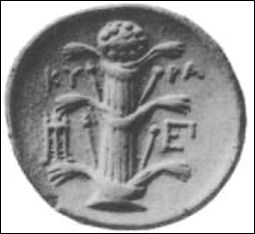
silphion Birth control methods in ancient Greece included avoiding deep penetration when menstruation was "ending and abating" (the time Greeks thought a woman was most fertile); sneezing and drinking something cold after having sex; and wiping the cervix with a lock of fine wool or smearing it with salves and oils made from aged olive oil, honey, cedar resin, white lead and balsam tree oil. Before intercourse women tried applying a perceived spermicidal oil made from juniper trees or blocking their cervix with a block of wood. Women also ate dates and pomegranates to avoid pregnancy (modern studies have shown that the fertility of rats decreases when they ingest these foods).
Women in Greece and the Mediterranean were told that scooped out pomegranates halves could be used as cervical caps and sea sponges rinsed in acidic lemon juice could serve as contraceptives. The Greek physician Soranus wrote in the 2nd century A.D. : "the woman ought, in the moment during coitus when the man ejaculates his sperm, to hold her breath, draw her body back a little so the semen cannot penetrate into the uteri, then immediately get up and sit down with bent knees, and this position provoke sneezes."
See Separate Article: ANCIENT GREEK PEOPLE: SIZE, AGE, DNA, SKIN COLOR, POPULATION, BIRTH CONTROL europe.factsanddetails.com
Health and Healing Spells in Ancient Greece
John Opsopaus of hermetic.com wrote: Most of the spells from the magical papyri here were discovered in Egypt the nineteenth century and brought together as part of the Anastasi Collection. It is quite likely that many of the papyri come from a single source, perhaps a tomb or temple library, and it is commonly supposed that they were collected by a Theban Magician. In any case, they are one of the best sources of Greco-Egyptian magic and religion.” [Source: John Opsopaus, Papyri Graecae Magicae hermetic.com |+|]
Spell for Migraine Headache: “Take Oil in your Hands and utter the Spell: “Zeus sowed a Grape Seed: it parts the Soil; He does not sow it; it does not sprout.” [Papyri Graecae Magicae VII.199-201] |+|
Spell for Scorpion Sting: “OR OR PHOR PHOR SABAO'TH ADO'NE SALAMA TARCHEI ABRASAX, I bind you, Scorpion of Artemisia, three-hundred and fifteen times, on the fifteenth day of Pachon . . .” [Papyri Graecae Magicae XXVIIIa.1-7] |+|
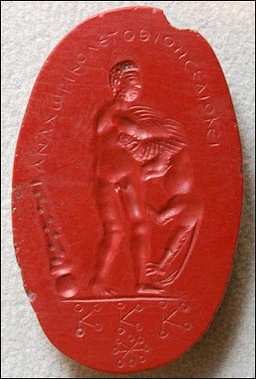
red jasper magical intaglio
Fever Amulet: “ABLANATHANABLANAMACHARAMARACHARAMARACH
BLANATHANABLANAMACHARAMARACHARAMARA
LANATHANABLANAMACHARAMARACHARAMAR
ANATHANABLANAMACHARAMARACHARAMA
NATHANABLANAMACHARAMARACHARAM
ATHANABLANAMACHARAMARACHARA
THANABLANAMACHARAMARACHAR
ANABLANAMACHARAMARACHA
NABLANAMACHARAMARACH
ABLANAMACHARAMARA
BLANAMACHARAMAR
LANAMACHARAMA
ANAMACHARAM
NAMACHARA
AMACHAR
MACHA
ACH
[Source: translations by Hans Dieter Betz (ed.), “The Greek Magical Papyri in Translation Including the Demotic Spells,” Chicago: The University of Chicago Press, 1986, hermetic.com |+|]
““O Tireless One, KOK KOUK KOUL, save Tais whom Taraus bore from every Shivering Fit, whether Tertian or Quartan or Quotidian Fever, or an Every-other-day Fever, or one by Night, or even a Mild Fever, because I am the ancestral, tireless God, KOK KOUK KOUL! Immediately, immediately! Quickly, quickly!” [Papyri Graecae Magicae XXXIII.1-25] |+|
Spell for Coughs: In Black Ink, write on Hyena Parchment: “THAPSATE STHRAITO'” - or as I found in another: “TEUTHRAIO' THRAITEU THRAITO' THABARBAO'RI [symbol: an X in a circle] LIKRALIRE'TA - deliver NN from the Cough that holds him fast.” [Papyri Graecae Magicae VII.203-5] |+|
A Contraceptive, the Only One in the World: “Take as many Bittervetch Seeds as you want for the Number of Years you wish to remain Sterile. Steep them in the Menses of a Menstruating Woman. Let them steep in her own Genitals. And take a Frog that is alive and throw the Bittervetch Seeds into its Mouth so that the Frog swallows them, and release the Frog alive at the place where you captured him. And take a Seed of Henbane, steep it in Mare's Milk; and take the Nasal Mucus of a Cow, with Grains of Barley, put these into a Leather Skin made from a Fawn and on the outside bind it up with Mulehide Skin, and attach it as an Amulet during the Waning of the Moon in a Female Sign of the Zodiac on a Day of Kronos or Hermes [i.e., Saturn or Mercury]. Mix in also, with the Barley Grains, Cerumen from the Ear of a Mule. [Papyri Graecae Magicae XXXVI.320-32] |+|
“A Prescription to Stop Blood: “Juice of “Great-Nile” Plant together with Beer; you should make the Woman drink it at Dawn before she has eaten. It stops. [Papyri Demoticae Magicae xiv.953-5] |+|
“The Way to Know it of a Woman Whether She will be Pregnant: You should make the Woman urinate on this Plant, above [i.e., “Great-Nile” plant], at Night. When Morning comes, if you find the Plant scorched, she will not conceive. If you find it green, she will conceive. [Papyri Demoticae Magicae xiv.956-60] |+|
Herbal Medicines and Spells in Ancient Greece
ointment stamps
Spell for Picking a Plant: “Use it before Sunrise. The Spell to be spoken: “I am picking you, such and such a plant, with my Five-fingered Hand, I, NN, and I am bringing you home so that you may work for me for a Certain Purpose. I adjure you by the Undefiled Name of the God: if you pay no Heed to me, the Earth which produced you will no longer be watered as far as you are concerned - ever in Life again, if I fail in this Operation, MOUTHABAR NACH BARNACHO'CHA BRAEO' MENDA LAUBRAASSE PHASPHA BENDEO'; fulfil for me the Perfect Charm!” [Papyri Graecae Magicae IV.286-95] [Source: translations by Hans Dieter Betz (ed.), “The Greek Magical Papyri in Translation Including the Demotic Spells,” Chicago: The University of Chicago Press, 1986, hermetic.com |+|]
Procedure for Obtaining Herbs: “Among the Egyptians Herbs are always obtained like this: the Herbalist first purifies his own Body, then sprinkles with Natron and fumigates the Herb with Resin from a Pine Tree after carrying it around the Place 3 times. Then, after burning Kyphi and pouring the Libation of Milk as he prays, he pulls up the Plant while invoking by Name the Daimon to whom the Herb is being dedicated and calling upon Him to be more effective for the Use for which it is being acquired. |+|
“The Invocation for him, which he speaks over any Herb, generally at the Moment of Picking, is as follows: “You were sown by Kronos, you were conceived by Hera, you were maintained by Ammon, you were given birth by Isis, you were nourished by Zeus the God of Rain, you were given growth by Helios and Drosos [Dew]. You are the Dew of all the Gods, you are the Heart of Hermes, you are the Seed of the Primordial Gods, you are the Eye of Helios, you are the Light of Selene, you are the Zeal of Osiris, you are the Beauty and Glory of Ouranos, you are the Soul of Osiris' Daimon which revels in Every Place, you are the Spirit of Ammon. As you have exalted Osiris, so exalt yourself and rise just as Helios rises each day. Your size is equal to the Zenith of Helios, your Roots come from the Depths, but your Powers are in the Heart of Hermes, your Fibers are the Bones of Mnevis [i.e., Mr-wr, the holy bull of Heliopolis], and your Flowers are the Eye of Horus, your Seed is Pan's Seed. I am washing you in Resin as I also wash the Gods [i.e., the cult statues] even as I do this for my own Health. You also be cleaned by Prayer and give us Power as Ares and Athena do. I am Hermes! I am acquiring you with Good Fortune and Good Daimon both at a Propitious Hour and on a Propitious Day that is effective for all things.” |+|
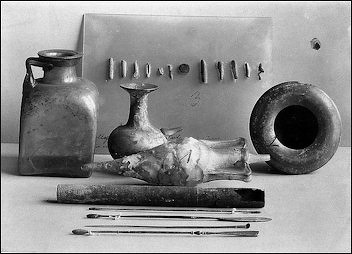
Contents of a grave of a Greek Aural doctor, 3rd century
“After saying this, he rolls the Harvested Stalk in a Pure Linen Cloth (but into the place of its Roots they threw seven Seeds of Wheat and an equal number of Barley, after mixing them with Honey), and after pouring in the Ground which has been dug up, he departs. [Papyri Graecae Magicae IV.2967-3006] |+|
Interpretations of Herbs and Other Ingredients: “Which the Temple Scribes employed, from the Holy Writings, in translation. Because of the Curiosity of the Masses they [i.e., the scribes] inscribed the Names of the Herbs and Other Things which they employed on the Statues of the Gods, so that they [the masses], since they do not take Precaution, might not practice Magic, [being prevented] by the Consequence of their Misunderstanding. But we have collected the explanations from many Copies, all of them Secret. |+|
“Here they are:
A Snake's Head: a Leech.
A Snake's Ball of Thread: this means Soapstone.
Blood of a Snake: Hematite.
A Bone of an Ibis: this is Buckthorn.
Blood of a Hyrax: truly of a Hyrax [probably the rock hyrax, Procavia capensis].
Tears [Sleep Sand] of a Hamadryas Baboon: Dill Juice.
Crocodile Dung: Ethiopian Soil.
Blood of a Hamadryas Baboon: Blood of a Spotted Gecko.
Lion Semen: Human Semen.
Blood of Hephaistos: Wormwood.
Hairs of a Hamadryas Baboon: Dill Seed.
Semen of Hermes: Dill.
Blood of Ares: Purslane.
Blood of an Eye: Tamarisk Gall.
Blood from a Shoulder: Bear's Breach [probably Acanthus mollis L. or Helleborus foetidus L.].
From the Loins: Camomile.
A Man's Bile: Turnip Sap [probably Brassica napus L.].
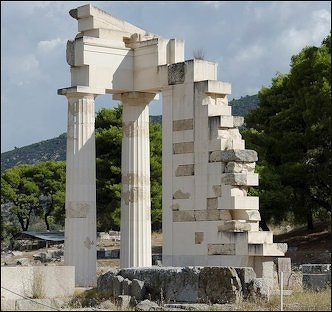
ruins of the healing temple at Epidaurus
A Pig's Tail: Leopard's Bane [probably a variety of leopard's bane in the genus Boronicum, or one of the heliotropes].
A Physician's Bone: Sandstone.
Blood of Hestia: Camomile.
An Eagle: Wild Garlic [Trigonella foenumgraecum, but the reading is doubtful].
Blood of a Goose: A Mulberry Tree's Milk.
Kronos' Spice: Piglet's Milk.
A Lion's Hairs: Tongue of a Turnip [i.e., the leaves of the taproot].
Kronos' Blood: . . . of Cedar.
Semen of Helios: White Hellebore.
Semen of Herakles: this is Mustard-rocket [probably Eruca sativa].
A Titan's Blood: Wild Lettuce.
Blood from a Head: Lupine.
A Bull's Semen: Egg of a Blister Beetle.
A Hawk's Heart: Heart of Wormwood.
Semen of Hephaistos: This is Fleabane.
Semen of Ammon: Houseleek.
Semen of Ares: Clover.
Fat from a Head: Spurge.
From the Belly: Earth-apple.
From the Foot: Houseleek.
[Papyri Graecae Magicae XII.401-44]
[Similar lists can be found in De succedaneis transmitted among the works of Galen, Claudii Galeni Opera Omnia (Kuehn, ed.), vol. 19, 721-47; adapted version in Paul of Aegina, Paulus Aegineta, Corpus Medicorum Graecorum IX/2 (Heiberg, ed.), vol. II, 401-8; and in Dioscorides' Materia Medica.] |+|
Well Cure in Ancient Greece
Pausanias wrote in “Description of Greece”, Book I: Attica (A.D. 160): The Oropians have near the temple a spring, which they call the Spring of Amphiaraus; they neither sacrifice into it nor are wont to use it for purifications or for lustral water. But when a man has been cured of a disease through a response the custom is to throw silver and coined gold into the spring, for by this way they say that Amphiaraus rose up after he had become a god. Iophon the Cnossian, a guide, produced responses in hexameter verse, saying that Amphiaraus gave them to the Argives who were sent against Thebes. These verses unrestrainedly appealed to popular taste. [Source: Pausanias, “Description of Greece,” with an English Translation by W.H.S. Jones, Litt.D. in 4 Volumes. Volume 1.Attica and Cornith, Cambridge, MA, Harvard University Press; London, William Heinemann Ltd., 1918]
“Except those whom they say Apollo inspired of old none of the seers uttered oracles, but they were good at explaining dreams and interpreting the flights of birds and the entrails of victims. My opinion is that Amphiaraus devoted him self most to the exposition of dreams. It is manifest that, when his divinity was established, it was a dream oracle that he set up. One who has come to consult Amphiaraus is wont first to purify himself. The mode of purification is to sacrifice to the god, and they sacrifice not only to him but also to all those whose names are on the altar. And when all these things have been first done, they sacrifice a ram, and, spreading the skin under them, go to sleep and await enlightenment in a dream.”
Image Sources: Wikimedia Commons, The Louvre, The British Museum
Text Sources: Internet Ancient History Sourcebook: Greece sourcebooks.fordham.edu ; Internet Ancient History Sourcebook: Hellenistic World sourcebooks.fordham.edu ; BBC Ancient Greeks bbc.co.uk/history/; Canadian Museum of History, Perseus Project - Tufts University; perseus.tufts.edu ; MIT Classics Online classics.mit.edu ; Gutenberg.org, Metropolitan Museum of Art, National Geographic, Smithsonian magazine, New York Times, Washington Post, Live Science, Discover magazine, Archaeology magazine, The New Yorker, Encyclopædia Britannica, Wikipedia, Reuters, Associated Press, The Guardian, AFP and various books and other publications.
Last updated September 2024