
Home | Category: People, Marriage and Society
ANCIENT GREEK CUSTOMS
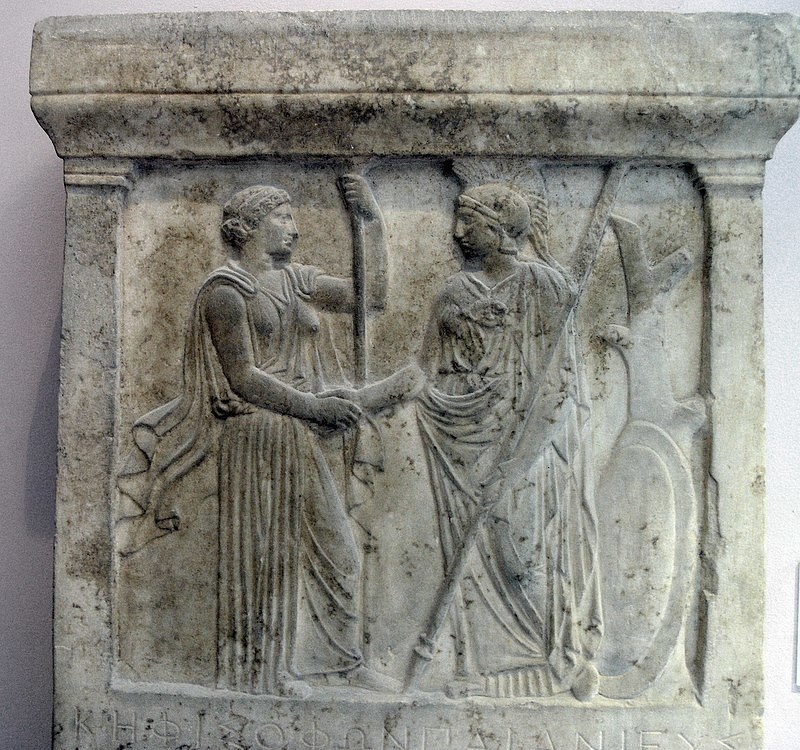
Hera and Athena handshaking, late 5th century BC
The custom of making a toast to one's health dates back to 5th century B.C. Greece when a host took a drink of wine from a decanter to show it was safe to drink before his guest took a drink. Later the act became associated with pledge of friendship. The Romans sometimes dropped a piece of burnt toast into a cup of wine, which gave birth to expression toast.
The handshake may have originated in prehistory as a demonstration of peaceful intent, showing that one possessed no weapons. Another possibility is that it originated as a symbolic gesture of mutual commitment to an oath or promise. One of the earliest known depictions of a handshake is an ancient Assyrian relief of the 9th century B.C. depicting the Assyrian king Shalmaneser III clasping the hand of the Babylonian king Marduk-zakir-shumi I to seal an alliance. [Source Wikipedia]
Archaeological ruins and ancient texts show that handshaking was practiced in ancient Greece, where it was knwon as dexiosis, as early as the 5th century B.C. A depiction of two soldiers joining hands can be found on part of a 5th-century B.C. funerary stele that is on display in Berlin's Pergamon Museum on other funerary steles, such as one from the 4th century BC that depicts Thraseas and his wife Euandria shaking hands.
The Ancient Egyptians, Asian, Persians, Greeks and Romans showed respect by kissing the hand, feet or hem of the shirt of important people. Herodotus wrote that Persian kisses ranged from lip on lip for equals to the ground or feet by an exorbitantly lower status person to a higher one. A Babylonian creation story recorded on stone tablets in the seventh-century B.C. — based on much older oral legends — includes references to a kiss of greeting and a kiss of the ground or feet in supplication. The Roman emperor Caligula had subjects kiss his feet, which also was a custom throughout the Middle Ages. [Source: Leanne Italie, Associated Press, March 12, 2011]
RECOMMENDED BOOKS:
“The History of the Manners and Customs of Ancient Greece (Vol. 1-3): Tradition and Social Life in Antique” by James Augustus St. John (1795-1875) Amazon.com;
“The Greeks: Life and Customs” by E. Guhl and W. Koner (2009) Amazon.com;
“A Manual Of Grecian Antiquities: Being A Compendious Account Of The Manners And Customs Of The Ancient Greeks” by G H Smith (1832) Amazon.com;
“Intoxication in the Ancient Greek and Roman World” by Alan Sumler (2023) Amazon.com;
“Greek Realities: Life and Thought in Ancient Greece” by Finley P. Hooper (1978) Amazon.com;
“Intimate Lives of the Ancient Greeks” by Stephanie L. Budin (2013) Amazon.com;
“A Funny Thing Happened on the Way to the Agora: Ancient Greek and Roman Humour”
by R Drew Griffith, Robert B Marks , et al. (2011) Amazon.com;
“Myth and Society in Ancient Greece” by Jean-Pierre Vernant and Janet Lloyd (1990) Amazon.com;
“The Class Struggle in the Ancient Greek World: From the Archaic Age to the Arab Conquests” by G. E. M. de Ste. Croix (1981) Amazon.com;
“Mass and Elite in Democratic Athens: Rhetoric, Ideology, and the Power of the People” by Josiah Ober (1989) Amazon.com;
“The Greeks and Greek Civilization” by Jacob Burckhardt (1902) Amazon.com;
“The Greeks” by H. Kitto (Penguin History) (Six books) Amazon.com;
“The Greek Way” by Edith Hamilton (1930) Amazon.com;
Ancient Greek Hospitality
If it was necessary to spend the night anywhere on a journey of several days, the widespread beautiful custom of hospitality which prevailed in ancient times, and made men regard every stranger as under the protection of Zeus, enabled them to find shelter; and, though this custom could not maintain itself in later times in its full extent, yet the effects of it still remained, and many people entered into a sort of treaty of hospitality with men in other towns, which was usually handed on to the descendants. [Source “The Home Life of the Ancient Greeks” by Hugo Blümner, translated by Alice Zimmern, 1895]
By this they pledged themselves on the occasion of visits from members of one or the other family, to receive them in their houses and afford them the rights of hospitality; some little token of recognition previously agreed on — such as a little tablet, a ring broken into two halves, or something else of the sort — was used in such cases to legitimise the stranger. Sometimes whole districts entered into a league of this kind with one another, or one single rich man became the “guest-friend” of some foreign community, and entertained them when they came to his home. The service of the “guest-friend” was not always extended so far as to supply complete entertainment to the stranger as well as lodging; often he only supplied the lodging, the necessary coverings for the bed, and the use of the fire, which could not easily be procured, but in other respects left the guest, if he had brought servants with him, to provide for himself; some additional gifts of hospitality were usually sent him.
Socializing in Ancient Greece
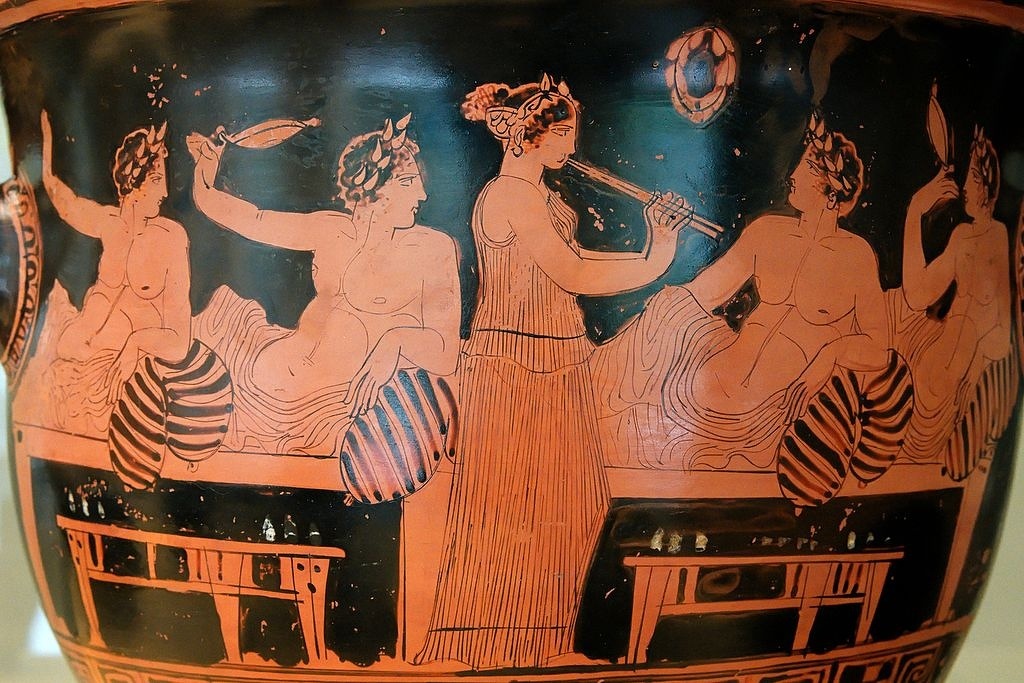
There were also plenty of festive occasions which gave opportunities for these common banquets; a public or private sacrifice was a very common excuse, if only because the flesh of the victim — of which, as a rule, only the entrails were burnt — could be best made use of in this manner. There were also birthdays, funerals, victories in some contest or game, departure or return from a journey of a friend, etc.; all these occasions were celebrated by feasts, and there were also great public banquets, which were usually of a simpler character, owing to the number of guests and the fact that the expenses were publicly defrayed. Besides these meals, to which individuals invited their friends or relations, picnics were very common. Very often all who participated sent baskets of provisions into the house of one who gave up his rooms for the purpose; but it was even commoner for each to contribute a certain share of money, and thus to defray the expenses of the meal, which was taken at the house of one of the participants, or of some obliging hetaera. We do not know what arrangement was made about the wine, and whether the expenses of this were also defrayed out of the general charge. [Source “The Home Life of the Ancient Greeks” by Hugo Blümner, translated by Alice Zimmern, 1895]
Generally speaking, in the fifth and fourth centuries there was a great deal of simple and pleasant social intercourse; friends were invited without any ceremony, during the course of the day, to come to the evening meal. If they did not appear at the appointed hour, the meal began without them, and if the guest put in his appearance later on, this was regarded as a matter of course. It seems not to have been unusual to go even uninvited to the meal or to the Symposium which followed it, and one of the speakers in Plato’s “Symposium” suggests the following version of a line in Homer: “To the feasts of the good, the good unbidden go.”
Sometimes idle fellows, such as the parasites who were always hunting for a dinner, made too liberal use of this hospitality, or persons made their appearance who did not suit with the rest of the company and would have disturbed the general harmony. In such cases the door keeping slave received the order to send away certain persons, saying, “My master is not at home,” or else, “He has already retired to rest.”
See Separate Article: ENTERTAINMENT IN ANCIENT GREECE: BANQUETS, GAMES, GAMBLING, PETS europe.factsanddetails.com
Eating Customs in Ancient Greece
At banquets the guests had all lain down and washed their hands in bowls handed round for the purpose, the little three-legged dining tables were brought in, which were always a little lower than the sofas. On these the food was arranged in dishes or plates, and always cut up small, for forks were never used at table, but only in the kitchen by the cooks for carving the meat, whilst the guests made use, instead, of a spoon or sometimes of a piece of bread hollowed out, and very seldom used a knife. Table cloths and napkins were unknown; the place of the latter was taken by soft dough, on which the fingers were rubbed. At large banquets, sometimes towels and water for washing the hands were handed round between the courses, and this was always done at the end of a meal. The practice of using the fingers for eating made this indispensable. [Source “The Home Life of the Ancient Greeks” by Hugo Blümner, translated by Alice Zimmern, 1895]
At Athens, and probably throughout Greece — except, perhaps, at Sparta — the chief meal of the day was taken in the evening. This was not, however, the case in the Homeric period, when it was taken at mid-day, and the evening meal was of less importance. The customs of the heroic age differed in many respects from those of later times. In particular, the practice of sitting on chairs at meals then prevailed, and, in fact, there was no large common table used by all, but each guest had his own little table before him, on which the attendants placed the food which had been carved at a special board used for the purpose. Another difference is that, though the Homeric heroes, in accordance with the condition of their times, which laid special stress on the pleasures of the senses, cared a good deal for plentiful food and drink, and though full cups were continually circling at the meals, still the regular drinking parties which were common in later times, and which followed the meal itself, were quite unknown in the heroic age.
We know very little of the proceedings at these family dinners, and that only from works of art. On Greek reliefs on tombstones we often find, from the classical to the Imperial period, representations of the family meal, where the master of the house lies on his couch, his wife sitting on it at his feet, for it was not considered correct for women to lie down at meals as the men did, and when we see on works of art women lying down along with the men, we may be certain that these are hetaerae, who were not bound by the same rules of custom. The children of the house sat round the table on chairs. But as a rule, the wife and children only dined in the most intimate family circle; when guests were invited they dined alone in the women’s apartments, and only on some few occasions, especially weddings and family festivals, were the women allowed to appear before the men.
See Separate Article: MEALS, COOKING AND DIET IN ANCIENT GREECE europe.factsanddetails.com
Drinking Customs in Ancient Greece
The customary drink at feasts and symposia was a mixture of wine and water. Even at the present day southern nations seldom drink strong wine unmixed with water, and in ancient times unmixed wine was only drunk in very small quantities;at the symposium, when it was customary to drink deep and long, they had only mixed wine, sometimes taking equal parts of wine and water, and sometimes, which was even commoner, three parts of water to two parts of wine.
Generally, at the beginning of every symposium, a president, or “Symposiarch,” was appointed by lot or dice to take command for the rest of the evening, and it was his duty to determine the strength of the mixture, for this might be of various kinds, as weak even as two parts of wine to five of water, or one to three, or even one part of wine to five of water, which last was certainly a somewhat tasteless drink, and was contemptuously called “frog’s wine.” In early times it was usual to put the water first into the mixing bowl and pour the wine upon it; afterwards the reverse proceeding took place.[Source “The Home Life of the Ancient Greeks” by Hugo Blümner, translated by Alice Zimmern, 1895]
Men used to hang out at wine shops where strong syrupy wine was poured from an amphorae and diluted with water in a large mixing bowl. Rich Greeks and Romans chilled their wine with snow kept in straw lined pits, even though Hippocrates thought that "drinking out of ice" was unhealthy.
See Separate Article: WINE, DRINKING AND ALCOHOLIC DRINKS IN ANCIENT GREECE europe.factsanddetails.com
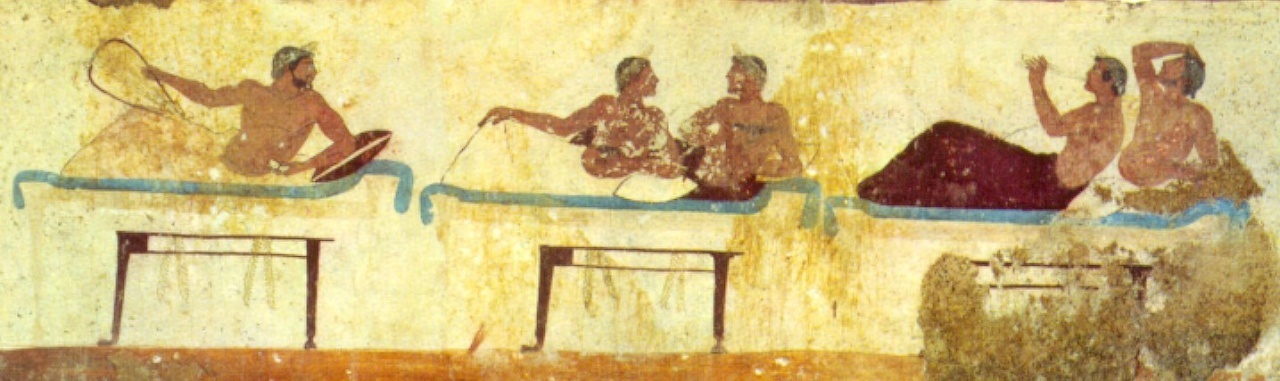
symposium scene
Banquets in Ancient Greece
In Athens and elsewhere in ancient Greece it seems large common banquets were relatively frequent among men and were different from the usual family meal. The custom of entertainments for men alone was far more common in antiquity than at the present day; for these banquets took the place not only of our parties and other social gatherings, but they also gave the men an opportunity, especially in the drinking which followed, while sitting together over their wine, to discuss at their leisure both serious and frivolous matters. [Source “The Home Life of the Ancient Greeks” by Hugo Blümner, translated by Alice Zimmern, 1895]
The usual course of proceedings at one of these banquets was as follows. The invited guests, who according to custom had previously attended the bath, first took their places sitting on the couches placed ready for them. The slaves of the host, or even of the guests, who often brought them to help wait at table, then took off their masters’ sandals or shoes, and as the dust of the street might have soiled their feet, which were but slightly protected by the soles, these were washed once more by the slaves, a proceeding which was the more necessary, as in lying down they often rested on couches covered with very valuable coverlets.
Hereupon they lay down, as a rule two guests on one sofa, but the monuments often show us three or even more persons on a single couch, and we cannot always determine with certainty whether the artist has adhered to the actual practice or introduced arbitrary changes of his own. In lying down they rested on their left elbow, or on numerous cushions at their back; the right arm was left free, in order to take the food from the table and reach it to the mouth; but plates, dishes, cups, etc., were also taken in the left hand.
See Separate Article: ENTERTAINMENT IN ANCIENT GREECE: BANQUETS, GAMES, GAMBLING, PETS europe.factsanddetails.com
Ancient Greek Parties and Symposia
A “ symposium “ was a dinner party with family, friends or associates. It generally began with a bout of drinking, followed by a big meal. There were often rules to ensure equality. Conversation topics included philosophy, politics, gossip. For a short period Greeks used birthday cakes.
The word symposia was used to describe the party and the place were it was held and is the source of the modern word symposium. The parties were usually lead by a feast master. Sometimes the guests wore garlands. Some people drank heavily; others held back.
There are vivid description of party entertainment in Xenophon’s dialogue “Symposium” (380 B.C.). The host pays a man from Syracuse to bring traveling performers (probably slaves), a girl flutists, acrobats, a dancing girl and a boy who dances and plays the “kithara”, a kind of lyre. The group played music and did performances involving music, dance, acrobatics and mine. The girl juggled hoops, performed acrobatic stunts over a hoop rimmed with knives, and acted out mythical love scenes with the boy. Socrates, one of the guests, was quite taken with the boy.
The citizens of Sybaris in present-day southern Italy were such big partiers they reportedly banned roosters so the populous would not be woken to early in the morning. They also supposedly had wine piped directly from the vineyards to the city.
See Separate Article: SYMPOSIUM IN ANCIENT GREECE europe.factsanddetails.com
Image Sources: Wikimedia Commons, The Louvre, The British Museum
Text Sources: Internet Ancient History Sourcebook: Greece sourcebooks.fordham.edu ; Internet Ancient History Sourcebook: Hellenistic World sourcebooks.fordham.edu ; BBC Ancient Greeks bbc.co.uk/history/; Canadian Museum of History, Perseus Project - Tufts University; perseus.tufts.edu ; MIT Classics Online classics.mit.edu ; Gutenberg.org, Metropolitan Museum of Art, National Geographic, Smithsonian magazine, New York Times, Washington Post, Live Science, Discover magazine, Natural History magazine, Archaeology magazine, The New Yorker, Encyclopædia Britannica, "The Discoverers" and "The Creators" by Daniel Boorstin. "Greek and Roman Life" by Ian Jenkins from the British Museum, Wikipedia, Reuters, Associated Press, The Guardian, AFP and various books and other publications.
Last updated September 2024