
Home | Category: Life and Culture in Prehistoric Europe
EARLIEST EVIDENCE OF CHEESE: 7,500 YEARS AGO IN POLAND

cheese
A study published in Nature in 2012 said that the earliest solid evidence of cheese-making comes from the chemical analysis on fragments from 34 pottery sieves discovered in Poland dated to 7,500 years ago. Maria Cheng of Associated Press wrote: “Though there is no definitive test for cheese, Richard Evershed at the University of Bristol and colleagues found large amounts of fatty milk residue on the pottery shards compared to cooking or storage pots from the same sites. That suggests the sieves were specifically used to separate fat-rich curds from liquid whey in soured milk in a crude cheese-making process. "It's a very compelling forensic argument that this was connected to cheese," Evershed said. "There aren't many other dairy processes where you would need to strain." He and colleagues weren't sure what kind of milk was used, but said there were lots of cattle bones in the region. [Source: Maria Cheng, Associated Press, December 13, 2012]
“"This is the smoking gun," said Paul Kindstedt, a professor of nutrition and food sciences at the University of Vermont and author of "Cheese and Culture." He was not involved in the study. "It's almost inconceivable that the milk fat residues in the sieves were from anything else but cheese," Kindstedt said, adding that many experts suspected cheese was being made in Turkey up to 2,000 years earlier than this latest finding in Poland but that there was no definitive proof.
“He said the discovery of cheese making marked a major development for Neolithic people and gave them a survival advantage by allowing them to turn milk into a form that provided essential calories, proteins and minerals. At that time, the adult population was largely lactose intolerant, so making a product with less lactose, like cheese, allowed everyone to digest the nutrients in milk.
“Kindstedt said the earliest cheeses were likely similar to spreadable cheeses like ricotta and fromage frais. He guessed that people either ate them soon after they were made or buried them in pots for months afterwards, saving them for the winter when food was scarce. Cheeses also served to spice up the Neolithic diet. "Food was incredibly dull and monotonous," Kindstedt said, noting the prehistoric farmers' dependence on grain porridge. After being buried in the ground for months, he said, the cheeses would have been non-perishable, "bomb-proof" and pretty pungent. "They probably would not be the first choice for a lot of people today," Kindstedt he said. "But I would still love to try it."
According to Archaeology magazine: Some of the earliest evidence of cheese making has been identified on pottery found on the Dalmatian coast of Croatia. A multinational team of archaeologists and chemists analyzed fatty-acid residues dating to the Middle Neolithic period, about 7,200 years ago. Evidence of cheese making dating to roughly the same period has also been found in Poland. At that time, milk production was already an established practice, but fermenting raw milk into cheese may have provided an additional survival advantage. Children who have been weaned from their mother’s milk are particularly vulnerable to malnutrition. As they age, they gradually lose the ability to digest the milk sugar lactose. Fermenting milk into cheese reduces its lactose content, while still providing a rich source of calories. The team also found that specific pottery shapes were associated with cheese production, including sieves and a type of footed pot with an opening on its side. [Source: Zach Zorich, Archaeology magazine, January-February 2019]
RECOMMENDED BOOKS:
“Cheese and Culture: A History of Cheese and its Place in Western Civilization”
by Paul Kindstedt (2012) Amazon.com;
“The Cow: A Natural and Cultural History” by Professor Catrin Rutland (2021) Amazon.com;
“Archaeology and Biology of the Aurochs by Gerd-C. Weniger (1999) Amazon.com;
“Aurochs and Auks: Essays on Mortality and Extinction” by John Burnside (2021) Amazon.com;
“The Process of Animal Domestication” by Marcelo Sánchez-Villagra (2022) Amazon.com;
“Cows, Pigs, Wars, and Witches: The Riddles of Culture” by Marvin Harris (1989) Amazon.com;
“Domesticated: Evolution in a Man-Made World” by Richard C. Francis Amazon.com;
“Evolution of Domesticated Animals” by I. L. Mason | Jan 1, 1984 Amazon.com;
“The Pig: A Natural History”by Richard Lutwyche (2019) Amazon.com;
“The Neolithic Revolution in the Near East: Transforming the Human Landscape”
by Alan H. Simmons and Dr. Ofer Bar-Yosef (2011) Amazon.com;
"First Farmers: The Origins of Agricultural Societies" by Peter Bellwood (2004) Amazon.com;
“Birth Gods and Origins Agriculture” by Jacques Cauvin (2008) Amazon.com;
“After the Ice: A Global Human History, 20,000–5000 BC” by Steven Mithen (2006) Amazon.com;
“The Dawn of Everything: A New History of Humanity” by David Graeber and David Wengrow (2021) Amazon.com;
“The Origins of Agriculture: An International Perspective” by C. Wesley Cowan, Paul Minnis, et al. (2006) Amazon.com;
History and Details of the 7,500-Year-Old Polish Cheese Discovery
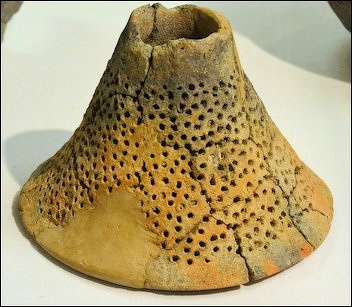
ancient cheese mold from Spain
Nature reported: “Peter Bogucki, an archaeologist at Princeton University in New Jersey, was in the 1980s among the first to suspect that cheese-making might have been afoot in Europe as early as 5,500 B.C. He noticed that archaeologists working at ancient cattle-rearing sites in what is now Poland had found pieces of ceramic vessels riddled with holes, reminiscent of cheese strainers. Bogucki reasoned that Neolithic farmers had found a way to use their herds for more than milk or meat. [Source: Nature, December 12, 2012 -]
“In a paper published in Nature, Bogucki and his collaborators now confirm that theory, with biochemical proof that the strainers were used to separate dairy fats. Mélanie Salque, a chemist at the University of Bristol, UK, used gas chromatography and carbon-isotope ratios to analyse molecules preserved in the pores of the ancient clay, and confirmed that they came from milk fats. “This research provides the smoking gun that cheese manufacture was practiced by Neolithic people 7,000 years ago,” says Bogucki. -
“This is the first and only evidence of [Neolithic] cheese-making in the archaeological record,” says Richard Evershed, a chemist at Bristol and a co-author of the paper. The finding, he adds, is not only an indication that humans had by that time learned to use sophisticated technology, but is also evidence that they had begun to develop a complex relationship with animals that went beyond hunting. “It’s building a picture for me, as a European, of where we came from: the origins of our culture and cuisines,” he says. -
Cheese-making would have given the Neolithic farmers a way to make the most out of the resources available from their herds. Early humans were unable to digest milk sugars, or lactose, after childhood; however, traditionally made cheese contains much less lactose than fresh milk. “The making of cheese would have allowed them to get around the indigestibility of milk without getting ill,” Evershed says.
“It’s one small step, but it’s filling out the picture of that transition from nomadism,” says Heather Paxson, a cultural anthropologist at Massachusetts Institute of Technology in Cambridge, who studies US artisan cheese-makers. She suggests that Neolithic people might have curdled their milk with bacteria that are found in nature, resulting in a clumpy version of modern mozzarella. Evidence of dairy farming has previously been found at archaeological sites dating from the fifth millennium bc in Africa and the seventh millennium bc near Istanbul. But no sieves have been found at those locations, so there is no indication that cheese was being made there.”
North Africans Began Making Milk Products 7000 Years Ago
North Africans may have made yoghurt 7,000 years ago according to an analysis of pottery shards published in Nature. Ewen Callaway wrote in Nature: “The fermented dairy product left tell-tale traces of fat on the ceramic fragments, suggesting a way that the region’s inhabitants may have evolved to tolerate milk as adults. The same team had previously identified the earliest evidence for dairying in potsherds nearly 9,000 years old from Anatolia. But the findings from 7,000 years ago still predate the emergence and spread of the gene variants needed for the adult population to digest the lactose found in milk, says biomolecular archaeologist Richard Evershed of the University of Bristol, UK, who led the study with archaeological scientist Julie Dunne. He suggests that making yoghurt may have made dairy products more digestible. “They could have consumed milk but it might have made them a little poorly,” Evershed says. “Perhaps they were processing the milk to lower the lactose content.” [Source: Ewen Callaway, Nature, June 20, 2012 \=/]

ancient cheese making
“Evershed and Dunne’s team analysed pottery shards dating from 5200 to 3000 BC, exavated from the Takarkori rock shelter in southwestern Libya’s Acacus mountains. Although today this area is in the Sahara, 7,000 years ago it would have been more lush landscape capable of supporting dairy animals. “The Takarkori shelter and others nearby are home to vivid and colourful rock art depicting cattle, some with full udders, and even pictures of people milking cows, but these images are nearly impossible to date precisely. Archaeologists have also found fragments of domestic cattle bones at these sites, but these do not indicate whether the animals were kept for meat, dairying or other uses. Evershed and Dunne hoped to overcome these problems by examining fat residues left on the pottery shards. \=/
“The researchers examined 81 shards, using mass spectrometry to identify specific animal fats and using the relative levels of carbon isotopes to pick out more exactly the origin of those fats in 29 of the samples. Of those 29, at least half contained fats came from dairy foods. Carbon isotopes from milk fat can also point to the sorts of food the dairy animals ate, as different plants incorporate varying amounts of carbon-13 relative to carbon-12. The team found that the milk fats came from a range of plants, potentially suggesting that the people milking the animals moved around a lot, Evershed says. They may even have grazed their cattle up and down mountains, depending on the season. \=/
“Mark Thomas, a geneticist at University College London, calls the latest work “a very exciting finding”. He speculates that mutations that allow adults to digest lactose, or lactase persistence, that arose around 7,000 to 8,000 years ago in Europe and later spread to Africa could have offered a unique benefit in a parching climate. Fresh milk is a reliably uncontaminated source of fluid, and people able to tolerate lactose may have stayed better hydrated than people without the gene. “From my point of view, what it says is that we have the selective pressure for lactase persistence in Africa very early, and that allows lactase persistence to evolve in Africa,” Thomas says. \=/
Did Dairy Products Influence Skull Shape?
According to a study published in 2017 by anthropologists at University of California Davis, the advent of farming, especially dairy products, had a small but significant effect on the shape of human skulls, Humans who live by hunting and foraging wild foods have to put more effort into chewing than people living from farming, who eat a softer diet. [Source: Science Daily, August 24, 2017]
Science Daily reported: Although previous studies have linked skull shape to agriculture and softer foods, it has proved difficult to determine the extent and consistency of these changes at a global scale. Graduate student David Katz, with Professor Tim Weaver and statistician Mark Grote, used a worldwide collection of 559 crania and 534 lower jaws (skull bones) from more than two dozen pre-industrial populations to model the influence of diet on the shape, form, and size of the human skull during the transition to agriculture.
They found modest changes in skull morphology for groups that consumed cereals, dairy, or both cereals and dairy. "The main differences between forager and farmer skulls are where we would expect to find them, and change in ways we might expect them to, if chewing demands decreased in farming groups," said Katz, who is now a postdoctoral researcher at the University of Calgary, Alberta.
The largest changes in skull morphology were observed in groups consuming dairy products, suggesting that the effect of agriculture on skull morphology was greatest in populations consuming the softest food (cheese!). "At least in early farmers, milk did not make for bigger, stronger skull bones," Katz said. However, differences due to diet tended to be small compared to other factors, such as the difference between males and females or between individuals with the same diet from different populations, Katz said.
Did Cheese-Making Help North Africans Settle Down?
People were processing dairy products such as butter, yogurt and cheese in the African Sahara more than 7,000 years ago which coincidently or not was also the time they began settling down. Emily Sohn wrote in Discovery News: “The discovery, based on the identification of dairy fats on ancient pottery shards found in Libya, is the first to provide a definitive date for early dairy farming in Africa. Adding to findings from Europe and the Middle East, the study points to milk products as a main reason why people in many places may have chosen to give up the hunter-gatherer lifestyle in favor of a more settled existence. “What we’re really beginning to know is that cattle were incredibly significant to early peoples,” said Julie Dunne, an archaeological scientist at the University of Bristol in the United Kingdom. “They gave a remarkably calorific source of food and allowed populations to expand dramatically. Milk and dairying seem to be so significant in human development, remarkably so.” [Source: Emily Sohn, DiscoveryNews, June 20, 2012 ~/~]
“Plenty of research has documented the domestication of sheep, goats and cattle, as well as the use of dairy products, beginning around 9,000 years ago in parts of modern-day Turkey, 8,000 years ago in eastern Europe and 6,000 years ago in Britain. In Africa, details have been murkier. Fossil evidence suggests the arrival of domesticated milk-producers in North Africa by about 8,000 years ago with an increase in animal numbers over the next 1,000 years, but remains are spotty. And even though archaeologists have discovered vivid rock art depicting cattle and even milking scenes in Algeria and other parts of the Sahara, it is impossible to accurately date those paintings. ~/~
“For the study, Dunne and colleagues analyzed organic residues on 81 well-dated pieces of pottery taken from the Takarkori rock shelter in the Libyan Sahara. The samples turned out to be incredibly well preserved, containing fat residues at high concentrations, probably because of the region’s dry conditions — though the climate there was much wetter during the period considered in the new study. Evidence showed that some pots were used to hold plant oils. But many contained chemical signatures that were unambiguously from animal fats, the researchers report today in the journal Nature. Analyses revealed the remains of dairy products made from cow, goat and sheep’s milk, dating back to between 7,200 and 5,800 years ago. ~/~
“At that time, Africans had not yet developed the genetic mutations that allow people to digest milk, according to other research. So, the Sahara’s lactose-intolerant dairy farmers were likely making yogurt and cheese rather than drinking straight from the udders of their animals. Only after people learned to process dairy foods did their bodies develop the ability to drink pure milk — through mutations that appear to have happened independently as many as three or four times in Africa. ~/~
“It is now becoming clear that dairying was a transformative development in human history, said Joachim Burger, an evolutionary anthropologist at the University of Mainz in Germany. Given their carbohydrate and nutrient profiles, dairy products would have been far superior to what people could get from hunting and gathering alone. And when our ancestors figured that out, society changed forever. “The general question behind all this is what actually made man to become sedentary and change his lifestyle completely,” Burger said. “Milk is not just a side effect of this change. It may even be a driving force behind it.”“~/~
Image Sources: Wikimedia Commons
Text Sources: National Geographic, New York Times, Washington Post, Los Angeles Times, Smithsonian magazine, Nature, Scientific American. Live Science, Discover magazine, Discovery News, Ancient Foods ancientfoods.wordpress.com ; Times of London, Natural History magazine, Archaeology magazine, The New Yorker, Time, Newsweek, BBC, The Guardian, Reuters, AP, AFP, Lonely Planet Guides, “World Religions” edited by Geoffrey Parrinder (Facts on File Publications, New York); “History of Warfare” by John Keegan (Vintage Books); “History of Art” by H.W. Janson (Prentice Hall, Englewood Cliffs, N.J.), Compton’s Encyclopedia and various books and other publications.
Last updated May 2024