
Home | Category: Neanderthal Life / Neanderthal Art and Culture
NEANDERTHAL VIOLENCE

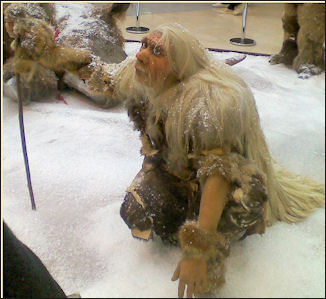
Reconstruction of the Chapelle-aux-Saints grave
The presence of so many healed fractures also seems to indicate Neanderthals experienced a fair amounts of violence. A Neanderthal skull found in Croatia showed evidence of a severe head wound that healed. A hole found in 36,000-year-old Neanderthal skull found in bear the village of St. Cesair in southwestern France appeared to have been made a flint spear or flint knife. Scarring shows the victim survived the attack, which had led some deduce that since the injury was so severe other people must have taken care of him for him to survive.
A skeleton of a Neanderthal man found in a cave near Shanidar, Iraq had a crushed right leg and foot, an injury to his skull that left him blind in one eye and a shattered right arm severed at the elbow.
Other Neanderthal bones show evidence of knife and spear wounds and frequent trauma injuries to their head, arms and trunks. The only 20th century people that sustain similar trauma injuries are rodeo riders. Neanderthals with spear wounds are sometimes offered as evidence of warfare but some scientists believe the wounds could have been caused by hunting accidents.
RECOMMENDED BOOKS:
“Kindred: Neanderthal Life, Love, Death and Art” by Rebecca Wragg Sykes (2020) Amazon.com;
“Neanderthal Man: In Search of Lost Genomes” By Svante Pääbo (2014) Amazon.com;
“The Neanderthals Rediscovered: How Modern Science Is Rewriting Their Story”
by Dimitra Papagianni and Michael A. Morse (2022) Amazon.com;
Neanderthal Religion? : Theology in Dialogue with Archaeology” by Thomas Hughson Amazon.com;
“Understanding Middle Palaeolithic Asymmetric Stone Tool Design and Use: Functional Analysis and Controlled Experiments to Assess Neanderthal” by Lisa Schunk Amazon.com;
“The Singing Neanderthals: The Origins of Music, Language, Mind, and Body”
by Steven Mithen (2007) Amazon.com;
“The Naked Neanderthal: A New Understanding of the Human Creature” by Ludovic Slimak Amazon.com;
“Perspectives on Our Evolution from World Experts” edited by Sergio Almécija (2023) Amazon.com;
“Evolution: The Human Story” by Alice Roberts (2018) Amazon.com;
“Who We Are and How We Got Here: Ancient DNA and the New Science of the Human Past” by David Reich (2019) Amazon.com;
“Our Human Story: Where We Come From and How We Evolved” By Louise Humphrey and Chris Stringer, (2018) Amazon.com;
“Lone Survivors: How We Came to Be the Only Humans on Earth” by Chris Stringer (2013)
Amazon.com;
“An Introduction to Human Evolutionary Anatomy” by Leslie Aiello and Christopher Dean (1990) Amazon.com;
“Basics in Human Evolution” by Michael P Muehlenbein (Editor) (2015) Amazon.com;
Neanderthal Murdered by Modern Humans
The skeleton of Neanderthal male found at Shanidar, who lived sometime between 50,000 and 75,000 years, had a broken rib that indicated he had been struck in rib and died of a collapsed lung one to three weeks later. Some researchers argued that this was evidence of a man being stabbed to death or being badly beaten up by another Neanderthal, but others say the wounds could just as easily been caused by an accident.
That is until Duke anthropologist Steven Churchill published a study in July 2009 that used modern forensic science and determined that the victim, known to scientists as Shanidar 3 after the Iraq site, was most likely killed by a thrown spear. What is perhaps even more remarkable about the finding is that at that time only humans had throwing spears, a technology that makes sense in open grassland of Africa, while Neanderthals used only thrusting spears.
 In an experiment Churchill’s team aimed to re-create the conditions of Shanidar 3's death using a crossbow, Stone Age projectiles and a pig carcass (pig skin and bones are thought to have the same toughness as Neanderthal skin and bones). When the projectiles were fired at a velocity consistent with that of a thrown spear the punctures left on the pig’s ribs resembled those found on the Shanidar 3's ribs. By contrast when the ribs were stabbed with a thrusting spear Churchill found the ribs “were busted al to hell. The high kinetic energy cased a lot of damage on the area.” In addition, the angle of entry of Shanidar 3's wound is “consistent with the ballistic trajectory of a thrown weapon.”
This isn’t the only evidence of the murder of Neanderthals by humans. A skull and bones from El Sidron cave in Spain were found with jagged edges, which Antonio Rosas of the National Museum of Natural Sciences in Madrid believes were made by blows from stone tools of modern humans. A Neanderthal jawbone found by French anthropologist Fernando Rozzi bore butchering marks like those found on deer carcasses butchered by humans. He says that humans probably removed and ate the Neanderthal tongue and used the teeth for decorative ornaments.
Neanderthal Cannibalism
There is strong evidence that Neanderthals practiced cannibalism Discoveries indicating the practice have been found in France, Portugal and Spain. Neanderthal bones between 100,000 and 120,000 years old found at Baume Moula-Guercy cave on the Rhone River in France have cut marks and gashes that indicate they were stripped of their flesh and broken apart and dismembered with a hammer stone and anvil. Marks also indicate the tendons were cut and joints were torn apart.
Excavations in 1999 by scientists uncovered 120 Neanderthal bones from six individuals, including two children, that showed signs of being cannibalized. The bones were intermingled with deer bones with similar cut marks. The discovery, reported by Alan Defleur of Marseilles Universitie de la Mediterranean in the October 1, 1999 edition of Science, is regarded as the most conclusive evidence of Neanderthal cannibalism.
According to Archaeology magazine: During a period of rapid warming, food became scarce, and, on at least one occasion, they were forced to eat their own. New insight into the Moula-Guercy Cave, where the dismembered and butchered remains of 6 individuals were found, suggests that, in the sudden absence of large mammals such as mammoth and reindeer, the meat-reliant Neanderthals were driven to cannibalism. See Below [Source: Archaeology magazine, July-August 2019]
Ritual Neanderthal Cannibalism in Croatia?
Fine cut marks and unusual fractures, similar to those made on the bones of butchered animals were found on Neanderthal bones from Croatia suggesting that Neanderthal's practiced cannibalism there. Cut marks on the bones of all nine Neanderthal bones at El Sidron Spain have led scientists to believe they too were cannibalized, perhaps out of hunger, perhaps as rituals — or perhaps they were eaten by modern humans.
Croatian archaeologist Jakov Radovcic told National Geographic, "We simply don't know whether this represents ritualistic cannibalism or whether these people had a taste for their fellow men, so to speak. I think it was an honored way to treat the dead. The animal bones in their caves suggests there was plenty of game. Why would they have to each other?"
Berkeley's Tim White disagrees. "I think they wanted the meat and marrow," he told National Geographic. "If it were part of a ritual to break open the bones then all the bones would have been broken. But they smashed open only the large bones of the limbs — the ones with lots of marrow."
Neanderthal Cannibalism in Spain?
In Spain it appears that a group of Neanderthals, including an infant, may have been cannibalized by another group of Neanderthals. In 2010, researchers reported the discovery of the skeletons of a family of Neanderthals — three adult females, three adult males, three teenagers, two kids and an infant — in El Sidrón in Spain. Their bones bore marks that some scientists suggest were signs of cannibalism. Some speculate the family may have been a meal for another group of Neanderthals. There is other evidence of Neanderthal cannibalism, archaeologists said. It seems that when times were rough and no other food was available Neanderthals ate their own kind. [Source: Stephanie Pappas, Live Science, April 08, 2011]
Keith Dobney, a bioarchaeologist from the University of Liverpool, told The Guardian Research looking at marks on the bones of Neanderthals from El Sidrón has suggested they might been the victims of cannibalism. While Dobney does not rule out the possibility, he points out that the two Neanderthals in a 2017 study are unlikely to have been feasting on their relatives. “You would expect if Neanderthals were eating each other, that the quantity of Neanderthal DNA would be a lot higher in [the tartar] — it would be part of the food debris,” he said. “[That] doesn’t appear to be the case.” [Source: Nicola Davis, The Guardian, March 8, 2017]
Neanderthal Cannibalism in Belgium
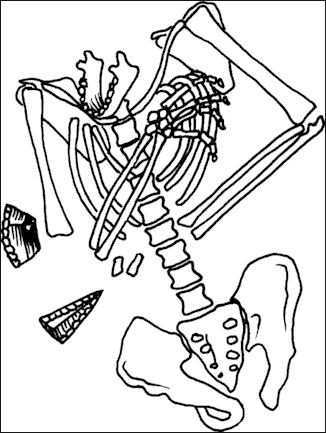
Neanderthal burial Neanderthal bones found in a Belgium cave bear show unmistakable signs of butchery, and some scientists say this is first evidence of Neanderthal cannibalism in northern Europe. Archaeology magazine reported: A set of human and animal bones from Goyet Cave, first excavated 150 years ago, have produced the first clear evidence of Neanderthal cannibalism north of the Alps. Bone fragments recently identified as Neanderthal show signs of cut marks and percussion breaking, and four of them hold evidence of having been used as implements for crafting and retouching stone tools. The bones date to around 40,000 to 45,000 years ago, not long before the human subspecies went extinct. Other Neanderthal groups in the region appear to have buried their dead. [Source: Samir S. Patel, Archaeology magazine, November-December 2016]
Kacey Deamer wrote in Live Science: “Archaeologists pieced together 99 bone fragments to identify five distinct Neanderthals, four adults and a child. Markings on the bones included indentations from hammering (likely to remove bone marrow), and cut marks from carving the flesh away from the bone. Also in the cave were the remains of horses and reindeer, which had been similarly butchered. "Similarities in anthropogenic [human-created] marks observed on the Neanderthal, horse and reindeer bones … suggest similar processing and consumption patterns for all three species," the scientists wrote in their research, published July 6, 2016 in the journal Scientific Reports. [Source: Kacey Deamer, Live Science, July 12, 2016 /*]
“The Neanderthal remains provide "unambiguous evidence" of cannibalism, the researchers said. Other Neanderthal bones have also shown signs of cannibalism, but the Belgian site is the farthest north to do so — showing regional variability of Neanderthal mortuary behavior. “Beyond cannibalism, it appears that the Neanderthals also used their peers' remains as tools. A few of the bones bore markings that suggested they'd been used to help sharpen stone tools. "The big differences in the behavior of these people on the one hand, and the close genetic relationship between late European Neanderthals on the other, raise many questions about the social lives and exchange between various groups," Hervé Bocherens, one of the lead researchers, told CBS News. /*\
“An analysis of DNA within the Neanderthal mitochondria (energy-making organelles in cells that carry their own DNA) suggested that the Belgian Neanderthals were genetically similar to other Neanderthal communities living in Germany, Spain and Croatia. This suggests the Neanderthal population in Europe at the time was small, as there was "only modest genetic variation despite large geographic distances when compared to modern humans," the scientists wrote.” /*\
Did Climate Change Drive the Neanderthals to Cannibalism
The Neanderthal cannibalism that occurred 100,000 and 120,000 years ago in Baume Moula-Guercy in France appears to have been prompted by climate change according to The findings were published online in the April, 2019 issue of the Journal of Archaeological Science. Mindy Weisberger wrote in Live Science: While prior studies have interpreted Neanderthal remains to find proof of cannibalistic behavior, this is the first study to offer clues as to what may have led Neanderthals to become cannibals. Scientists found that rapid shifts in local ecosystems as the planet warmed may have extinguished the animal species that Neanderthals ate, forcing them to look elsewhere to fill their bellies. [Source: Mindy Weisberger, Live Science, April 3, 2019]
The researchers examined a layer of sediment in Baume Moula-Guercy. In 2014, another group of researchers analyzed the cave deposits to a depth of 26 feet (8 meters), dividing them into 19 layers associated with three climate shifts. For the 2019 study, the authors turned their attention to layer 15, a silty sediment layer about 16 inches (40 centimeters) thick, covering approximately 98 to 131 feet (30 to 40 m) of the cave floor. In that layer, charcoal and animal bones were so well-preserved that scientists could reconstruct an environmental snapshot representing 120,000 to 130,000 years ago. They discovered that the climate in the area was likely even warmer than it is today, and that the transition from a cold, arid climate to a warmer one happened quickly, "maybe within a few generations," study co-author Emmanuel Desclaux, a research associate at the University of Nice Sophia Antipolis in France, told Cosmos magazine. As the animals that once populated the landscape vanished, some Neanderthals ate what they could find — their neighbors.
Cannibalism is by no means exclusive to Neanderthals, and has been practiced by humans and their relatives "from the early Palaeolithic to the Bronze Age and beyond," the study authors reported. The behavior adopted by the starving Neanderthals in the Baume Moula-Guercy should therefore not be viewed as "a mark of bestiality or sub-humanity," but as an emergency adaptation to a period of severe environmental stress, according to the study.
Image Sources: Wikimedia Commons
Text Sources: National Geographic, New York Times, Washington Post, Los Angeles Times, Smithsonian magazine, Nature, Scientific American. Live Science, Discover magazine, Discovery News, Ancient Foods ancientfoods.wordpress.com ; Times of London, Natural History magazine, Archaeology magazine, The New Yorker, Time, Newsweek, BBC, The Guardian, Reuters, AP, AFP, Lonely Planet Guides, “World Religions” edited by Geoffrey Parrinder (Facts on File Publications, New York); “History of Warfare” by John Keegan (Vintage Books); “History of Art” by H.W. Janson (Prentice Hall, Englewood Cliffs, N.J.), Compton’s Encyclopedia and various books and other publications.
Last updated April 2024