
Home | Category: Orthodox Christians
ORTHODOX CHRISTIAN ORGANIZATION
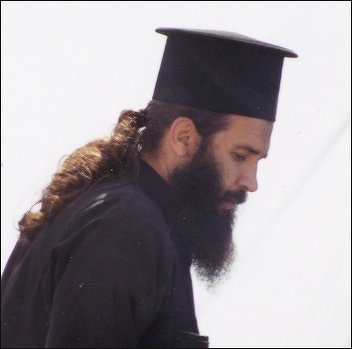
Orthodox priest in Greece
The churches that make up Eastern Orthodoxy are autonomous, or self-governing. The highest church official is the patriarch. Matters relating to faith are decided by ecumenical councils in which all member churches of Eastern Orthodoxy participate. Followers of the church regard the councils' decisions as infallible. [Source: Library of Congress, 1996]
The Orthodox church is divided into 15 autocephalous (self-headed) Orthodox churches, such as the Russian Orthodox Church and the Greek Orthodox Church, each of whom is led by it own Patriarch. The Ecumenical Patriarch in Istanbul (Constantinople), "the first among equals," presides over the sects.
Each church is independent from the others. They are bound by the same beliefs and same type of worship. Of the 15, five date back to the time of the Byzantine Empire (ones based in Constantinople, Alexandria, Antioch, Jerusalem and Cyprus). Six other are in nations that have a majority Orthodox population (Russia, Romania, Serbia, Bulgaria, Georgia and Greece). Three others are in countries with a minority Orthodox population (Albania, Poland and the Czech Republic). The Monastery at Sinai has been considered independent since ancient times. There is some dispute as to whether the Orthodox churches of America, Estonia and Macedonia should be regarded as self-headed Orthodox churches.
The Orthodox Christian hierarchy from bottom to top: priests, bishops, and the Patriarch. The bishops have different names such as Patriarch, Catholcos. Metropolitan, Archbishop and Exarch. These name generally reflect seniority, experience and honors. Otherwise they are regarded as equal and their functions are the same.. Bishops in council have authority in doctrine and policy. Synods of bishops elect the patriarch, archbishops or metropolitans.
Each church is divided into diocese governed by a bishop. The diocese are divided into parishes. A priest, or sometimes several priests, assisted by deacons, are in charge of each parish.
Websites and Resources Orthodox Church in America oca.org/saints/lives ; Online Orthodox Catechism published by the Russian Orthodox Church orthodoxeurope.org ; Internet Sourcebook sourcebooks.fordham.edu ; BBC on Orthodox Christian bbc.co.uk/religion/religions/christianity ; Christian Answers christiananswers.net ; Christian Classics Ethereal Library www.ccel.org ; Sacred Texts website sacred-texts.com ; Christianity.com christianity.com/church/denominations ; Christianity Comparison Charts religionfacts.com ; Difference between Christian Denominations Quoracom
RECOMMENDED BOOKS:
“The Orthodox Church: An Introduction to Eastern Christianity” by Timothy Ware Amazon.com ;
“The Orthodox Study Bible, Hardcover: Ancient Christianity Speaks to Today's World
“by St. Athanasius Academy of Orthodox Theology Amazon.com ;
“Early Christian Fathers” by Cyril Richardson Amazon.com ;
“When the Church Was Young: Voices of the Early Fathers” by Marcellino D'Ambrosio Amazon.com ;
“Byzantium: The Apogee” by John Julius Norwich Amazon.com ;
“Byzantium: The Surprising Life of a Medieval Empire” by Judith Herrin, Phyllida Nash, et al.
Amazon.com ;
“The Age of Division: Christendom from the Great Schism to the Protestant Reformation” by John Strickland Amazon.com ;
“The Complete Guide to Christian Denominations: Understanding the History, Beliefs, and Differences” by Ron Rhodes Amazon.com ;
“Thinking Orthodox: Understanding and Acquiring the Orthodox Christian Mind”
by Eugenia Scarvelis Constantinou Ph.D. Amazon.com ;
“A Basic Guide to Eastern Orthodox Theology: Introducing Beliefs and Practices” Amazon.com ;
“Feasts for the Kingdom: Sermons for the Liturgical Year” by Khaled Anatolios and Cornelius Plantinga Jr. Amazon.com
Priests, Bishops and Laymen in the Orthodox Church
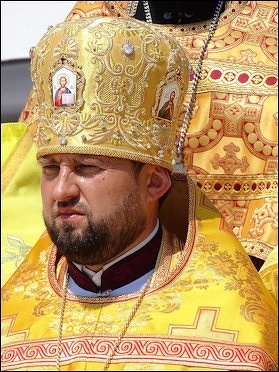
Orthodox bishop in the Ukraine
Greek Orthodox priests typically wear black robes and flat-topped hats have beards in accordance the Biblical scripture: “You shall not round off the hair on your temples or mar the edges of your beard” (Leviticus 19:27). According to the BBC: “Although the Church is a self-governing community the Church recognises the diaconate, the presbyterate or priesthood and the episcopate (bishops). [Source: BBC, June 11, 2008 |::|]
“The Bishops in the Orthodox Church are considered to be the direct successors of the original Apostles and they are very much a unifying focus in the Church. Priests in the Orthodox Church are permitted to be married but may not marry after ordination. Bishops must always be celibate. Orthodox priests normally do not shave their beards, in accordance with the Bible. |::|
Orthodox priests give communion and carry out ceremonial duties, but otherwise they are regarded as equals of lay-people and often work closely with the laity to further church goals. The laity is very active in the Orthodox church. They perform educational, philanthropic and missionary work. Any confirmed person can be a teacher. Many of the best-known Orthodox theologians and missionaries have been laymen. Laymen can take part as selected representatives at church councils on the national, diocesan and parochial level.
The primary duty of a Orthodox Christian bishop is to ordain priests. A bishop is a priest. Bishops are celibate but Orthodox priests don't necessarily have to be. Any man can become a priest provided he not been married twice. Widowers and divorcees can become priests.
Orthodox Christian priests, bishops and Patriarchs generally have long beards and wear elaborate robes, often decorated with sophisticated designs made with gold and silver thread. The degree of elaborateness is often an indication of rank, with Patriarchs wearing the most elaborate robe of all. Priests in the Greek Orthodox Church wear red cloaks embroidered with gold thread. Greek bishops wear heavy golden crowns and gold vestments. Russian Orthodox priests wear long black robes and elaborate headpieces.
The process of ordination in the Orthodox church begins with a nomination by a local congregation and ends with the formal laying of hands by a bishop in the name of the Church Universal. In the ordination ceremony, a candidate is brought before the congregation assembled to authorize the ordination. After formal approval is granted by the laity, the bishop lays his hands on the candidate and invokes divine help. The united prayers of the whole church are necessary to fulfil this sacrament.
Orthodox Christian Patriarchs
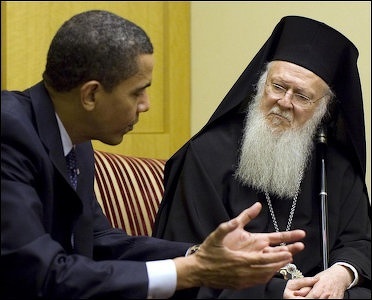
US President Obama meeting with Greek Orthodox Patriarch Bartholomew I
The patriarch is the head of an independent Orthodox Church, such as the Russian Orthodox Church. There are 15 Orthodox Patriarchs. The main patriarchs are in Istanbul, Jerusalem, Antioch and Alexandria (all of which have relatively small memberships).
The Patriarchs and the clergy are not regarded as authorities in their own right but rather as people who oversee doctrine recognized as the truth by all the faithful. Unlike the Catholic church which is headed by a single infallible pope, the Orthodox church spreads its authority around. In an important address on authority in 1848 four leading Orthodox Patriarch declared that the guardian of truth in the Church was not a single leader, or the clergy not the entire body of faithful. Orthodox Christians believe that he Holy Spirit is infallible not the Pope and it guides every follower directly.
The Ecumenical Patriarch, the spiritual leader of the world's Orthodox Christians, resides in Istanbul as his predecessors have since the year A.D. 787. The position has been held since 1991 by Patriarch Bartholomew, a Ukrainian. Primates of the 15 churches met in 1995, It was the first time all the patriarchs had met since the Middle Ages.
Patriarch Bartholemew made a name for himself as a peacemaker and a globetrotter. He has visited patriarchs in Alexandria, Antioch, Russia, Serbia, Romania, Greece, Georgia and Bulgaria. He met with Pope John Paul II and the leader of the Anglican Church. In February 1994 he hosted a multi-religious meeting with Christians, Muslims and Jews to discuss the role of spirituality in a world he said had "so many vacuums and so many people in despair."∈
Orthodox Christian Patriarch and Turkey
Istanbul is the seat of the Orthodox Patriarch even though only a few thousand Orthodox Christians remain in Turkey. The Turkish government has a say in the selection of the patriarch and insist that the patriarch and all 12 members of his holy synod be drawn form Turkey’s very small ethnic Greek minority. As of 1997 there were only 19 bishops remaining with Turkish citizenship. Many were in their 70s.
Normally Turkish authorities—who have traditionally held veto power over the Patriarch's selection—have insisted that the Patriarch be a Turkish citizen drawn from the Greek minority living in Istanbul. But the fact that the Turks raised no objections to an outsider (Patriarch Bartholemew ) in 1991 may have something to do with the fact that the Greek community in Istanbul has shrunk from 150,000 a century ago to 5,000 today.∈
A European diplomat once said, "The Turks kind of like having the patriarchate around as an advertisement of their religious tolerance." However Turkish nationalists and Islamic fundamentalists have threw rocks at the patriarchate and desecrated Orthodox tombs in the 1990s in response to attacks by Orthodox Serbians on Muslims in Bosnia.∈
Embalming the Orthodox Patriarch
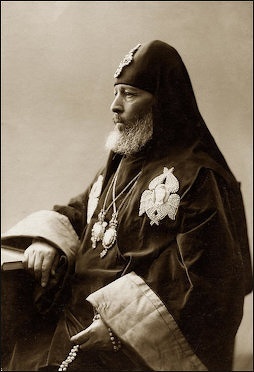
Patriarch Kyrion II of Georgia
Describing the embalming of the Patriarch, Charles Lewis Meryon wrote from Lebanon in 1815, "What was my surprise...to see the dead patriarch sitting in a chair, with a crosier in his left hand and the New Testament in his right, whilst the incense pan smoked by his side. Prostrate, before and around him, were men and women, some of whom religiously approached the corpse, plucking a hair from the beard, or kissed the hand."
"It is customary for the Greek Catholic Church to embalm its patriarchs: and this is generally done by priests: but...little or no care was used by the priest” so “Ivolunteered my services, which were accepted....The copse was immediately carried into a vault or cellar near the door of the church...I opened the body, I removed each viscus, one by one, observing the external phenomena only...The contents of the abdomen and chest being removed, I rubbed in the powdered ingredients over the interior surface of the cavities just as some salt down meat. Then, stuffing the whole with bran, I sewed up the body with the usual stitch...I took out the brains and filled the skull with powdered drugs...The body was afterwards washed as clean as I could do it."
"They now dressed the corpse in a pair of drawers, a "kombáz" (or gown) of white silk, with gold tinsel running through it; a silk band or cape, in the shape of a horseshoe, which came over the shoulders from behind and reached the ground...The miter was then placed on his head and the body being tied in armchair to keep it erect was carried in the church, which was lighted for the mass of the dead."
Orthodox Theological Institutions
Heybeli Island (a short ferry ride from Istanbul) is the home of the Halki Theological University, one of the most important religious centers in the world. Every ecumenical patriarch and generations of Orthodox clergy were educated for more than a thousand years until 1971, when it was closed by a military government concerned that the patriarch might try to open a Vatican-like Orthodox state in Istanbul.
Chalki embraces a monastery, small chapel and richly-stocked library. It is currently deserted and watched over by a caretakers who polish the marble floors and arrange the latest scholarly journals in the library and clean the dormitories. The failure to reopen the school is regarded as an obstacle to training future patriarchs. Orthodox leaders and U.S. presidents have pleaded that it be reopened. But these pleas have been ignored. Many clerics are now training in the theological department at University of Salonica in Greece.
Monasteries and convents were opened on the island early in the Byzantine era. In the 6th century ousted Byzantine emperors and empresses were exiled here. The Holy Trinity monastery and school was established in the 9th century. The current theological school was built in 1844. The current Patriarch was trained here and makes regular visits.
Orthodox Christian Monks and Nuns
Orthodox Christian church places a heavy emphasis on monasticism. The strict life of a monk or nun is seen as an important expression of faith. Orthodox monks and nuns are individuals who have chosen a life of celibacy, poverty and obedience and have made the decision to dedicate themselves entirely to prayer and the service of the Church. There are no orders of monks in the Orthodox church but rather different communities specialized in different kinds of work.
Most Orthodox monks and nuns are laymen and laywomen. Only a few are ordained priests or deacons. Monasteries and convents also serve as places that any member of the community can go to to retreat from everyday life and/or receive some kind of training or spiritual help. Worship in the Orthodox church has been molded by Orthodox monks, particularly those of Mount Athos. The Matins or Vespers that are chanted today are not that different than those chanted by monks centuries ago.
Orthodox monks are often tall, stern and imposing-looking men with long beards and long hair. They dress in black robes with heavy silver crosses that hang from chains that reach their stomach. Orthodox church nuns resemble veiled Islamic women more than they do Catholic nuns.
See Separate Article: ORTHODOX CHRISTIAN MONKS AND MOUNT ATHOS europe.factsanddetails.com
Image Sources: Wikimedia Commons
Text Sources: Internet Sourcebook sourcebooks.fordham.edu ; “World Religions” edited by Geoffrey Parrinder (Facts on File); “ Encyclopedia of the World’s Religions” edited by R.C. Zaehner (Barnes & Noble Books, 1959); King James Version of the Bible, gutenberg.org; New International Version (NIV) of The Bible, biblegateway.com; Christian Classics Ethereal Library (CCEL) ccel.org , Frontline, PBS, Wikipedia, BBC, National Geographic, New York Times, Washington Post, Los Angeles Times, Smithsonian magazine, The New Yorker, Time, Encyclopedia.com, Reuters, Associated Press, Business Insider, AFP, Library of Congress, Lonely Planet Guides, Compton’s Encyclopedia and various books and other publications.
Last updated March 2024