
Home | Category: Ice Age Animals / Ice Age Animals
MAMMOTHS
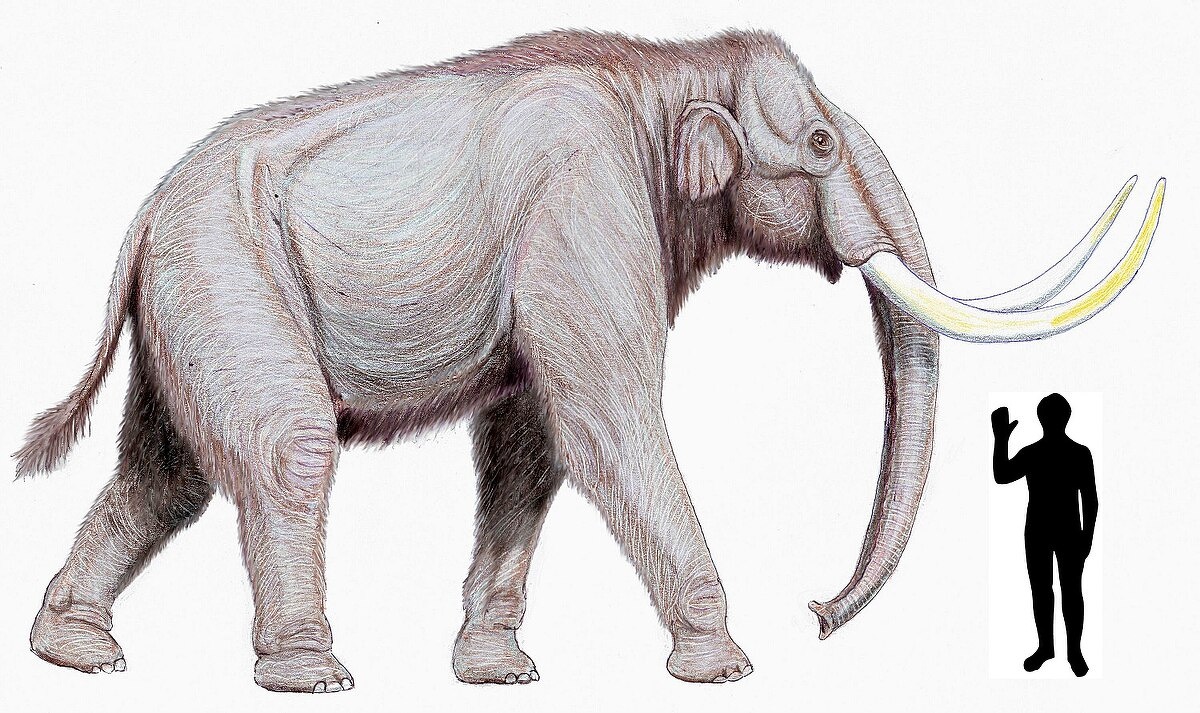
steppe mammoth
A mammoth is any species of the extinct elephantid genus Mammuthus. They lived from the late Miocene epoch (from around 6.2 million years ago) into the Holocene until about 4,000 years ago. Mammoth species at various times inhabited Africa, Asia, Europe, and North America. Mammoths are distinguished from living elephants by their — usually large — spirally twisted tusks and in some later species, the development of numerous adaptions to living in cold environments, including a thick layer of fur. Mammoths and Asian elephants are more closely related to each other than they are to African elephants. The oldest mammoth representative, Mammuthus subplanifrons, appeared around 6 million years ago during the late Miocene in what is now southern and Eastern Africa. [Source: Wikipedia]
There were several species of mammoth. On those found in North Americas, Discovery News reported: “The woolly mammoth was a smaller furrier beast, that lived in the north closer to the glaciers of the Ice Ages, from Alaska through Canada, and east to the Great Lakes and New England. The larger Columbian mammoth lived further south. It inhabited the western and southern portion of the U.S. as far south as Florida, and nearly to Chiapas in Mexico. The mammoths should not be confused with the American mastodon (Mammut americanum), another ancient elephant from North and Central America. [Source: Discovery News, June 1, 2011]
Woolly mammoths lived from 400,000 to 3,900 years ago and for a while lived at the same time as American mastodons (who lived from 3.75 million to 11,500 years ago) and African elephants and Asian elephants (who first appeared about 4 million years ago). Woolly mammoths were like elephants adapted for cold weather. They had thick skin and a heavy woolly coat. Reaching a height of four meters (14 feet) at the shoulder and possessing upward curving tusks, considerably larger than those of an elephants, they lived in North America and Eurasia. Mammoths had a short tail, sloping backs and tusks that curved outward, then inward.
Mastodons were endemic to North America and lived from the late Miocene (11.6 to 5.3 million years ago) to the early Holocene (11,700 to 8,300 years ago). Mastodons belonged to the order Proboscidea along with elephants and mammoths (which belong to the family Elephantidae). Mastodons were about the size of today’s elephants but more stoutly built. They had straight backs and fed mostly on twigs and leaves. They had cone-shaped cusps for teeth that were good for crushing. Mammoths mostly grazed on grasses.They had ridged teeth that were good for grinding,[Source: National Geographic]
See Separate Articles: STONE AGE ANIMALS: CAVE LIONS AND HYENAS AND GIANT APES factsanddetails.com ; WOOLLY RHINOS AND CAVE BEARS factsanddetails.com ; MAMMOTHS, HUMANS, HUNTING AND CLONING factsanddetails.com
Websites on Neanderthals: Neandertals on Trial, from PBS pbs.org/wgbh/nova; The Neanderthal Museum neanderthal.de/en/ ; Hominins and Human Origins: Smithsonian Human Origins Program humanorigins.si.edu ; Institute of Human Origins iho.asu.edu ; Becoming Human University of Arizona site becominghuman.org ; Hall of Human Origins American Museum of Natural History amnh.org/exhibitions ; The Bradshaw Foundation bradshawfoundation.com ; Britannica Human Evolution britannica.com ; Human Evolution handprint.com ; University of California Museum of Anthropology ucmp.berkeley.edu; John Hawks' Anthropology Weblog johnhawks.net/ ; New Scientist: Human Evolution newscientist.com/article-topic/human-evolution
RECOMMENDED BOOKS:
“Mammoths: Giants of the Ice Age” by Adrian Lister and Paul G. Bahn (2015) Amazon.com;
“The Rise and Reign of the Mammals: A New History, from the Shadow of the Dinosaurs to Us” by Steve Brusatte (2023) Amazon.com;
“How to Clone a Mammoth: The Science of De-Extinction” (Princeton Science Library)
by Beth Shapiro Amazon.com;
“Mastodon, Mammoth, and Man” by John Patterson MacLean Amazon.com;
“Mammoths, Sabertooths, and Hominids: 65 Million Years of Mammalian Evolution in Europe” by Jordi Agustí and Mauricio Antón (2002) Amazon.com;
“Megafauna: First Victims of the Human-Caused Extinction by Baz Edmeades (2021) Amazon.com;
“Mega Meltdown: The Weird and Wonderful Animals of the Ice Age by Jack Tite Amazon.com;
“Animal World: Ice Age” by Camelot Editora, Francine Cervato, et al. (2024) Amazon.com;
“Vanished Giants: The Lost World of the Ice Age” by Anthony J. Stuart (2024) Amazon.com;
“End of the Megafauna: The Fate of the World's Hugest, Fiercest, and Strangest Animals” by Ross D E MacPhee (Author), Peter Schouten (Illustrator) (2018) Amazon.com;
“The Rise and Reign of the Mammals: A New History, from the Shadow of the Dinosaurs to Us” by Steve Brusatte (2023) Amazon.com;
“Mammoths: Giants of the Ice Age” by Adrian Lister and Paul G. Bahn (2015) Amazon.com;
“Smilodon: The Iconic Sabertooth” by Lars Werdelin, H. G. McDonald, et al. (2018) Amazon.com;
“Giant Sloths and Sabertooth Cats: Extinct Mammals and the Archaeology of the Ice Age Great Basin by Donald Grayson (2016) Amazon.com;
“The Clan of the Cave Bear: Earth's Children, Book One” by Jean M. Auel Amazon.com
Ancestors of Elephants and Mammoths
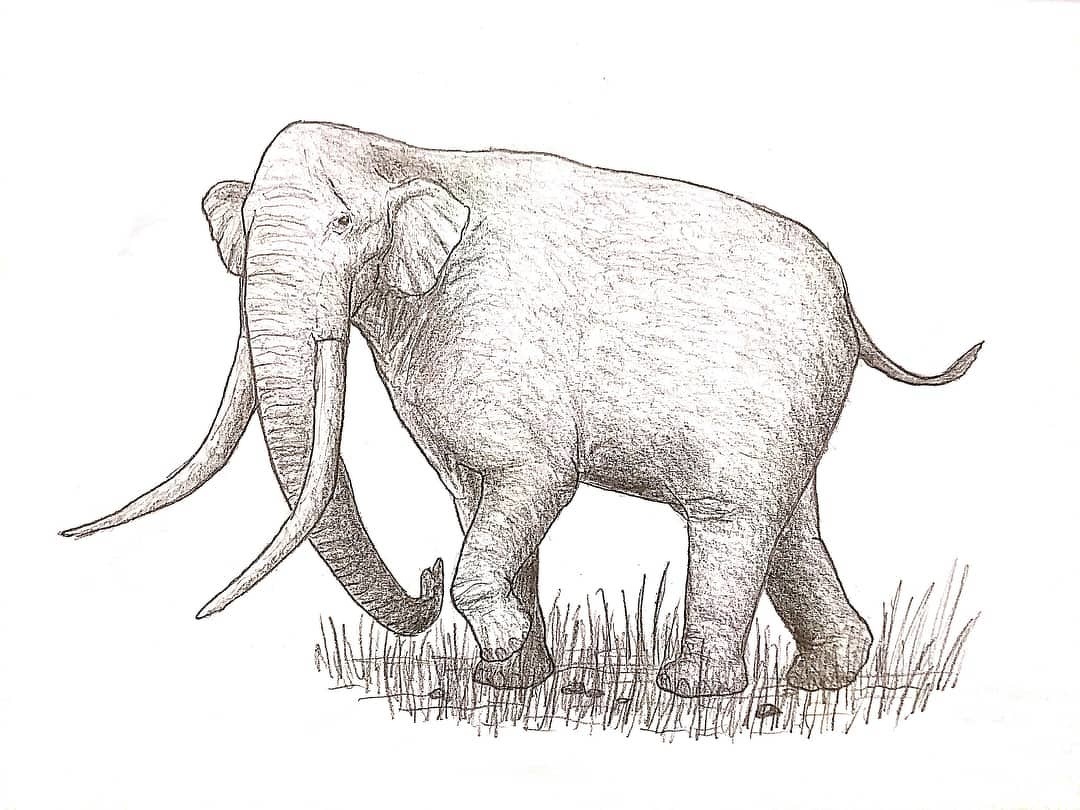
reconstruction of Mammuthus subplanifrons
The ancestor of elephants, mammoths and mastodons was a pig-size animal with an upper lip like a tapir that lived about 55 million years ago. As these creatures evolved their heads got small and their upper lip became longer and more flexible until it became a trunk. More than 250 species of elephants and elephant-like creatures have roamed the earth in the past.
Ancestors of the elephant include the Moeritherum (a pig-like animal that lived 40 million to 30 million years ago), the Piomia (a pig-like animal with a long snout that lived 37 million to 28 million years ago), Deinotherium (an elephant-like animal with downward-hooking tusks that lived 24 million to 1.8 million years ago), the Primelephas (an animal that looked like a modern elephant and lived from 6.2 million to 5 million years ago).
African elephants and Asian elephants diverged from a common ancestor about 6 million years ago. They lived at the same time as American mastodons (who lived from 3.75 million to 11,500 years ago) and Woolly mammoths (who lived from 400,000 to 3,900 years ago). Ancestors of elephants, such as mastodons and Woolly mammoths, have been found all the continents except Antarctica and Australia.
Origin of Mammoths
The family Elephantidae, which includes elephants and mammoths, originated in Africa. The earliest mammoths, Mammuthus subplanifrons, are found in southern and eastern Africa, dating back to the Late Miocene (6.2-5.3 million years ago). These mammoths were tropically adapted browsing animals related to living elephants. Mammoths differ from elephants in a number of ways, such as having long and gracefully curved tusks instead of straight tusks and a domed skull instead of a flat head.
Genetics reveal mammoths in Siberia are the ancestors of both woolly mammoths and the mammoths that later occupied North America. According to Business Insider: “Mammoths and living elephants diverged from a common ancestor around 5.3 million years ago, according to a genetic study from 2018. By calculating the number of mutations in the ancient mammoths' DNA, the study authors could estimate how much time had passed between that separation and the mammoth's birth. “The more differences there are between lineages, the more time that has elapsed," Alfred Roca, an animal scientist from the University of Illinois at Urbana-Champaign, told Insider. [Source: Aylin Woodward, Business Insider, February 18, 2021]
According to the University of California, Berkeley: “Mammoths stem from an ancestral species called M. africanavus, the African mammoth. They spread from southern and eastern Africa northward and eventually disappeared about 3 or 4 million years ago, with its descendants migrating north and covering most of Eurasia.
Mammoth Species and Their Evolution in Time and Places
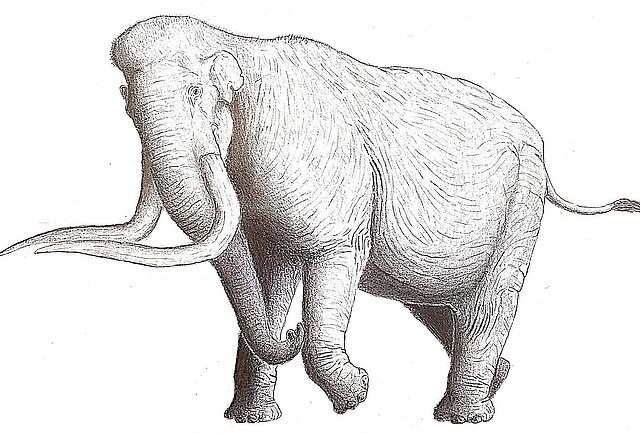
southern mammoth
Mammoth species can be identified from the number of enamel ridges/lamellae on their molars. The earliest species had few ridges, which increased gradually as new species evolved and replaced the former ones. While this was happening the crowns of the teeth became longer, and the skulls became higher from top to bottom and shorter from the back to the front over time to accommodate this. [Source: Wikipedia]
The earliest mammoths — Mammuthus subplanifrons — are known from southern and eastern Africa, with the earliest records dating to the Late Miocene, around 6.2–5.3 million years ago. By the Late Pliocene ( 3.6 million and 2.6 million years ago), mammoths had become confined to the northern portions of the African continent with remains from this time assigned to Mammuthus africanavus. Around 3.2 million years ago, mammoths dispersed into Eurasia via the Sinai Peninsula. The earliest mammoths in Eurasia are assigned to the species Mammuthus rumanus. The youngest remains of mammoths in Africa are from Aïn Boucherit, Algeria dating to the Early Pleistocene, around 2.3–2 million years ago (with a possible later record from Aïn Hanech, Algeria, dating to 1.95–1.78 million years ago).
Mammuthus rumanus is thought to be the ancestor of southern mammoths (Mammuthus meridionalis), which first appeared at the beginning of the Pleistocene, around 2.6 million years ago. Southern mammoths subsequently gave rise to steppe mammoths (Mammuthus trogontherii) in Eastern Asia around 1.7 million years ago. Around 1.5–1.3 million years ago, steppe mammoths crossed the Bering Land Bridge into North America, becoming ancestral to Columbian mammoths (Mammuthus columbi). At the end of the Early Pleistocene, steppe mammoths migrated into Europe, replacingsouthern mammoths around 1–0.8 million years ago. Woolly mammoths (Mammuthus primigenius) evolved from steppe mammoths in Siberia by around 600,000–500,000 years ago, replacing steppe mammoths in Europe by around 200,000 years ago, and migrated into North America during the Late Pleistocene.
Several dwarf mammoth species, with small body sizes, evolved on islands as a result of insular dwarfism. These include Mammuthus lamarmorai on Sardinia (late Middle-Late Pleistocene), Mammuthus exilis on the Channel Islands of California (Late Pleistocene),[27] and Mammuthus creticus on Crete (Early Pleistocene).
Spread and Diversification of Mammoths
Columbian mammoth
Descendants of ancestral African mammoth, M. africanavus, moved north and eventually covered most of Eurasia. These were M. meridionalis, the “southern mammoths.” The first major step in the evolution of the woolly mammoth occurred in China, around 2 million years ago. Later, the woolly mammoth evolved further in northeast Siberia about a million years later. The woolly mammoth, a specific species of mammoth, evolved from the steppe mammoth, which was present in Siberia around 1 million years ago. The evolution of the woolly mammoth, including its adaptations to cold climates, occurred in northeast Siberia. Mammoths migrated from Eurasia to North America across the Bering land bridge.
According to Business Insider: ““In the early Pleistocene, about 1.8 million years ago, M. meridionalis took advantage of low sea levels (during an Ice Age) and crossed into North America via a temporary land bridge across the Bering Strait. The southern mammoth then radiated throughout North America. In the Middle Pleistocene, a new North American species evolved, the imperial mammoth, M. imperator (though some question whether M. imperator is a legitimate genus). Then, in the Late Pleistocene, the Columbian mammoth, M. columbi (also known as the Jefferson mammoth, M. jeffersoni), appeared. Its range covered the present United States and as far south as Nicaragua and Honduras. Source: Aylin Woodward, Business Insider, February 18, 2021]
“Back in Eurasia, another species of mammoth, the steppe mammoth (M. trogontherii), lived from 200,000 to 135,000 years ago. And later in the Pleistocene, the woolly mammoth (M. primigenius), which incidentally was the smallest of the mammoths, made its debut. With the advent of another Ice Age and low sea levels lasting from 35,000 to 18,000 years ago, woolly mammoths were able to enter North America via a new land corridor across the Bering Strait. Woolly mammoths’ southern migration extended as far south as present-day Kansas.
Dwarf forms of mammoth are known from fossils found on islands: M. exilis from California’s Channel Islands stood only about four to six feet at the shoulder. The last Woolly mammoths were also dwarf versions. They lived on Wrangel Island in the Arctic Ocean. About 500 to 1000 of them lived there until just before 1700 BC when they fully became extinct.
Back-and-Forth Migration of Mammoths Between Asia and North America
Asian mammoths went to North America and thrived there and then returned to Asia. According to New Scientist: A new analysis of DNA from more than 100 mammoth fossils suggests that returning American populations replaced Asian mammoths, before going extinct themselves. “For some reason the North American guys went back over and became kings,” says Hendrik Poinar, an evolutionary geneticist at McMaster University in Hamilton, Ontario, who led the study. His team’s analysis of mammoth DNA spanning tens of thousands of years and two continents also hints that the ancient pachyderms weathered climate changes that eradicated other beasts. Previous work had suggested that woolly mammoths, who first reached the New World roughly 200,000 years ago, returned to their ancestral stomping grounds.[Source: Ewen Callaway, New Scientist, September 4, 2008]
Poinar and his colleagues collected DNA samples from 108 mammoths, and decoded a swathe of DNA in their mitochondria — the cell’s power generators. They added 52 previously published samples, giving Poinar’s team a total of 160 samples from North America and Siberia. When the researchers sorted the samples according to similarities in their DNA sequences, mammoths clumped into five distinct groups, Poinar says. One was found exclusively in Asian mammoths and another in North American, while three spanned both continents, which were connected by an intermittent land bridge across the Bering Strait. Yet by 22,000 years ago, the Asian population had disappeared, replaced by transcontinental and North American populations. More detailed analysis of theses sequences suggests that the North American mammoths gave rise to the transcontinental herds, which moved back and forth, from Alaska to Siberia, beginning between 200,000 and 50,000 years ago. “It’s a two way rough road,” Poinar says.
Mammoth Steppe and the Preservation of Fossils
In place of the tundra that exists today in northern Canada, Alaska and grew in the time of the mammoths there was a vast, arid grassland that paleobiologist R. Dale Guthrie has called the mammoth steppe, according to National Geographic, stretching from Ireland to Kamchatka and across the Bering land bridge to Alaska, the Yukon, and much of North America. The grasses, broad-leaved herbs, and low shrubs of the steppe provided nutritious food, and in addition to mammoths, nourished a profusion of other outsize, exuberantly hairy mammalian megafauna — woolly rhinoceroses, enormous long-horned bison, and bearsize beavers, as well as the fearsome carnivores that hunted them: saber-toothed cats, cave hyenas, and giant short-faced bears.
Many well-preserved fossils from the mammoth steppe have been found. Amy Grisdale wrote in How It Works: One excellent method of animal preservation is freezing. Cold weather grinds the speed of organic decomposition to a halt by preventing the growth of bacteria that would otherwise feed on the decaying flesh. Although Earth is about 11 degrees Fahrenheit (6 degrees Celsius) warmer than it was during the last ice age, which ended around 20,000 years ago, several ancient creatures have been found in the frozen areas of Russia, Asia and North America, with their bodies intact. The presence of food in the stomachs of these ice age animals indicates that their bodies were frozen rapidly, preventing decay. [Source: Amy Grisdale, How It Works June 5, 2021]
On how a baby mammoth nicknamed Lyuba was preserved and managed to be in good shape when it was discovered, National Geographic reported: Her body was immediately entombed in a mixture of silt and clay, setting in motion a process that preserved her for some 40,000 years: 1) Upon death she is submerged in wet clay and silt, which seal out oxygen and thwart aerobic microbes that would otherwise break down her soft tissue. 2) Other microbes that produce lactic acid colonize her tissues. The acid acts as a preservative, pickling her carcass. 3) As the ground turns to permafrost, her body dehydrates and shrinks to half its weight. 4) !n 2006 a river undercuts a block of permafrost containing Lyuba. The block melts, exposing her body. Floodwaters wash it downstream to a sandbar. The smell of lactic acid wards off scavengers. Lyuba superb state of preservation appears to have been the result of being naturally pickled by microbes called lactobacilli after she died, which protected her from rot once her body was exposed again, thousands of years later. The lactic acid produced by the microbes also could have caused odd bone distortion and muscle separation and perhaps even encouraged the formation of vivianite crystals by freeing phosphate from bones. [Source: National Geographic, May 2009]
World's Smallest Mammoth Found in Crete

dwarf mammoth
In 2012 scientists announced that the world's smallest mammoth on Crete, with an adult being approximately the same size a newborn modern elephant. GrrlScientist reported: “In 1904, some remarkable elephant fossils were unearthed on Cape Malekas on the island of Crete by Dorothea Bate, a famous fossil hunter. Some of these fossils appeared to be from a mammoth. [Source: GrrlScientist, The Guardian, May 10, 2012 ~]
“But for many years, all dwarf elephant fossils found on Mediterranean islands, including these from Crete, were thought to be descendants of the mainland straight-tusked elephant, Palaeoloxodon antiquus. Indeed, this European elephant was the ancestor of nearly all other extinct dwarf elephants found on a number of Mediterranean islands including Sicily, Malta and Cyprus. But not everyone in the scientific community was convinced that the Bate fossils were from Palaeoloxodon elephants. ~
“Fossil elephant researcher, Victoria Herridge, at the Natural History Museum in London, found the original coastal cliff on Crete's Cape Malekas where Bate found her fossils. Some of these fossils were exposed and included "[m]ultiple disarticulated bone and tooth fragments", writes Dr Herridge and her co-author, Adrian M. Lister, in their newly-published paper. And as Dr Herridge suspected, this treasure trove of fossils contained the remains of a mammoth, Mammuthus creticus — the smallest mammoth yet identified. But how did Drs Herridge & Lister determine that these fossils were from a mammoth and not an elephant? This tooth was key: as teeth wear down during an animal's life, the surface develops characteristic enamel 'rings'. Mammoth teeth differ from elephant teeth by having three oval rings instead of the one oval ring seen on elephant teeth: The structure of the fossil tooth not only shows that it came from a Mammuthus, but it is most similar to earlier mammoth taxa; most likely M. meridionalis or possibly M. rumanus, rather than the more derived M. trogontherii. ~
“M. meridionalis lived in Europe from 2.5 million to 800,000 years ago. "But we couldn't rule out another species, M. rumanus," explains Dr Herridge. "M. rumanus is the earliest species of mammoth found in Europe (as long ago as 3.5 million years). This means the ancestor of M. creticus could have reached Crete as long ago as 3.5 million years." ~
“Even though the diminutive size of the fossil teeth gave the team a rough idea of the size of the mammoth, the team found a fossil humerus (upper arm) bone that provided concrete evidence as to this mammoth's small size. The bone was completely fused, meaning that growth had stopped, so the team knew this bone came from an adult animal. By measuring this bone (figure 1f) and extrapolating from there, the team found that this particular adult mammoth was just 1.1m tall — roughly the size of a modern baby African or Asian elephant:
“Based on size, they estimated that the adult weighed about 300kg — half the weight of the previously known smallest dwarf mammoth, M. lamarmorai. Although they didn't test fossil dates in this research, the team's findings suggest M. creticus may have been on Crete longer than previously thought. "I hadn't previously considered M. rumanus as a plausible ancestor because it was so old, geologically speaking, and so the evidence here has reminded me it doesn't do well to make assumptions in science!" Dr Herridge explained. "In fact, this has now got us wondering about how long ago M. creticus arrived on Crete. Perhaps it got there much earlier than people generally think." ~
Extinction of Mammoths
Around 120,000 years ago mammoth populations declined dramatically during warm climate phase, but the species survived. The first direct evidence of humans hunting mammoths in Siberia — a spear point embedded in a mammoth vertebra — dates to 15,000 years ago. Around 14,000-10,000 years ago mammoths disappear from North America, Europe, and most of northern Asia. [Source: Tom Mueller, National Geographic, May 2009]
The last Woolly mammoths died out only 3,800 years ago (700 years after the pyramids) on the Wrangel island north of Siberia. The Woolly mammoths that lived on the island were smaller than other Woolly mammoths. They stood only six feet at the shoulder. Animals that evolve on islands are usually smaller than their mainland counterparts.
DNA analysis indicates that while North American mammoths eventually went extinct around 12,000 years ago, they lived through previous eras of climate change that spelled the doom of other large animals, including bears, bison and horses. “They saw the ebb and flow of climate for many generations,” said Hendrik Poinar, an evolutionary geneticist at McMaster University in Hamilton, Ontario. “I think it shows they were probably fairly resilient to the effects of climate change.” Mammoths were affected by global weather shifts that occurred after the end of the last ice age. Dense forests replaced open grasslands — the mammoth’s preferred habitat, and the Bering land bridge vanished. The appearance of humans seems to have been a tipping point. “I certainly think that humans probably played a role and to some effect contributed to the ultimate demise of these guys,” Poinar says. [Source: Ewen Callaway, New Scientist, September 4, 2008]
Why Did Woolly Mammoths Become Extinct
It is not clear why the Woolly mammoths became extinct possible explanations include overhunting by humans, rapid climate change, a mysterious virus, perhaps some combination of these. Many Woolly mammoths are believed to have died out after the end of the most recent ice age. It has been suggested they may have been done in by human hunters and a diet of low-nutrient mosses that took over the grassland after the Ice Age. One study claims a mystery 'random event' killed off Earth's last woolly mammoths in Siberia. Another says pollen allergies were behind the woolly mammoth’s demise. Genetic data shows there were two major population declines, one some 300,000 years ago and another around 12,000 years ago, at the end of the last Ice Age.
Predation by early men and the shrinking of Ice Age grasslands are both believed to have led to the sudden extinction of the Woolly mammoth, cave bears, mastodons, saber tooth tigers, cave lions, Woolly rhinoceros, steppe bison, giant elk, and the European wild ass. Other species such as the musk ox and saiga antelope managed to survive in only small pockets. The mass extinctions are believed to have been partly the result of these animals having never been hunted by humans and having little fear of them.
Tom Mueller wrote in National Geographic: Then, between 14,000 and 10,000 years ago, the mammoths disappeared from most of their range, along with most of the other large mammal. species in the Northern Hemisphere — as many as 70 percent in some regions. These extinctions were so sweeping that scientists have evoked a number of cataclysmic events to explain them — a meteorite strike, killer fires and droughts, and a virulent, cross-species hyperdisease. Since the extinctions coincided with the end of the most recent ice age, however, many researchers believe that the primary cause of the great die-off was the sharp rise in temperature, which dramatically altered the vegetation. A recent computer simulation of landscape changes during the late Pleistocene suggests that 90 percent of the mammoths former habitat disappeared. “We have strong evidence that climate change played a significant part in their extinction,” says Adrian Lister, a paleontologist and mammoth expert at the Natural History Museum in London. [Source: Tom Mueller, National Geographic, May 2009]
The extinctions also coincided, however, with the arrival of another ecology-altering force. Modern humans arose in Africa about 195,000 years ago and spread into northern Eurasia some 40,000 years ago. As time went on, their expanding populations brought increasing pressure to bear on prey species. In addition to exploiting mammoths for food — a big male killed in the autumn would see a band of hungry hunters through many lean winter days — they used their bones and ivory to make weapons, tools, figurines, and even dwellings. Some scientists believe that these human hunters, using throwing spears fitted with deadly stone points, were as much to blame as climate change for the great die-off. Some say they caused it. The debate over the megafaunal extinction is one of the liveliest in paleontology today
Through his career Dan Fisher, a professor at the University of Michigan, has taken hundreds of tusk samples, and he believes they suggest an answer to the vexing question of the great extinction in the late Pleistocene. At least in the Great Lakes region of North America, where the bulk of his samples were unearthed, mammoth and mastodon tusks show that these animals continued to thrive, despite late Pleistocene climate change. On the other hand, to Fisher, the tusks often revealed telltale evidence of human hunting. His samples from late in the mammoths reign frequently came from animals that had died in the autumn, when they should have been at their physical peak after summer grazing and less likely to die of natural causes — but also when human hunters would have been most eager to stockpile food for the coming winter. These tusks often came from males, who, like living elephants, probably lived alone and would have made easier targets for hunters than females traveling in matriarchal herds. Many remains were found in peat bogs and bodies of water, where according to Fisher early hunters may have submerged them to preserve the meat. The North American specimens also appeared to show a decline through time in the average age of maturation, which Fisher believes might also be caused by hunting pressure. He had done limited work in Siberia, but his measurements of tusks from Wrangel Island, off the coast of northeastern Siberia, where the last mammoths died out 3,900 years ago, suggest similar conclusions..
A decade-long DNA study published in Nature in October 2021 said climate change not humans was reason woolly mammoths became extinct. In the “large-scale environmental DNA metagenomic study of ancient plant and mammal communities,” led by Professor Eske Willerslev, a Fellow of St John’s College, University of Cambridge, researchers used advanced technology and sequencing to examine prehistoric DNA in “535 permafrost and lake sediment samples from across the Arctic spanning the past 50,000 years.” The Nerdist reported: “The samples came from a 20 year collection in that region where woolly mammoth remains have been found. While the study gets deep into the scientific weeds, the conclusion is far too accessible for all of us. The genetic evidence points to melting icebergs as the leading cause of the animals extinction 4,000 years ago. The increase in water all but eliminated the vegetation they survived on. That was enough to kill them off after they survived for nearly five million years on this planet. [Source: Michael Walsh, Nerdist, October 22, 2021]
Million-Year-Old Mammoth Teeth Yield Oldest DNA Ever Recovered
In February 2021, scientists announced they had recovered the oldest DNA on record. It was extracted it from the molars of mammoths that roamed northeastern Siberia up to 1.2 million years ago. The researchers said they had recovered and sequenced DNA from the remains of three individual mammoths entombed in permafrost conditions conducive to preservation of ancient genetic material. The remains were discovered starting in the 1970s. New scientific methods made it possible to extract the DNA. Before this the record belonged to an ancient horse with DNA between 560,000 and 780,000 years old. [Source: Reuters Videos, February 18, 2021]
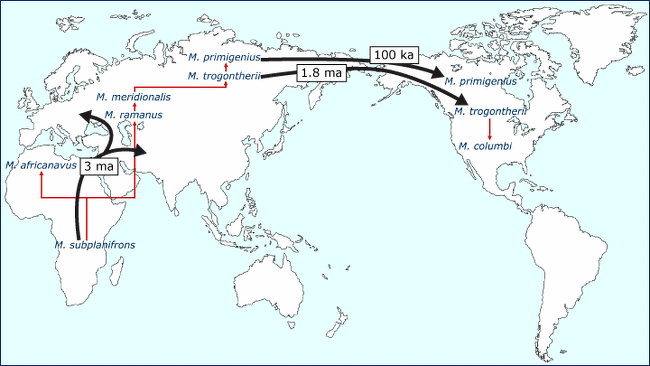
Mammoth migration and evolution around the world. Thick black lines indicate migration events of mammoths and thin red lines represent evolutionary relationships between mammoth species
Aylin Woodward wrote in Business Insider: “In their study about the mammoth teeth, the researchers reported that the molars came from two different types of mammoth. One species, the steppe mammoth, is well-known: its descendants were woolly mammoths. The other, according to Love Dalén, a geneticist at the Center for Palaeogenetics in Sweden, is from a "previously unknown mammoth that lived in Siberia around 1.2 million years ago." This second species, Dalén told Insider, interbred with woolly mammoths about 420,000 years ago, which gave rise to the Columbian mammoths that went onto occupy North America. [Source: Aylin Woodward, Business Insider, February 18, 2021]
The study, published in the journal Nature, pinpointed how old the teeth are for the first time. To accomplish this, Dalén's team first looked at the age of the rock deposits where Andrei Sher, a Russian paleontologist, collected the teeth in the 1970s. The researchers named the molar from the previously unknown mammoth species Krestovka, after the place it was found. The rock there is between 1.1 and 1.2 million years old. The other tooth, which the team named Adycha, was pulled from a rock layer dating back between 500,000 and 1.2 million years.
“The researchers compared this geologic dating information with genetic data. Over time, DNA builds up mutations: changes in a species' genetic sequence. Those mutations accrue at a fairly constant rate over time, so researchers can count the number of mutations to figure out how much time has passed since a given evolutionary event, like the point when a species split into two, for example. That method showed that the the Krestova specimen is about 1.65 million years old, while Adycha is around 1.34 million years old. Dalén's team also pulled DNA from a third tooth found in Siberia named Chukochya. It was about 870,000 years old, likely from one of the oldest woolly mammoths.
Dalén has worked with ancient rhino fossils, too. Two years ago, he co-authored a paper that looked at a 1.7-million-year-old rhino tooth. Although that specimen is older than the mammoth molars, Dalén's team was not able to recover DNA from it — only protein. Proteins aren't as informative as DNA, since they only code for a tiny piece of an animal's genetic code. However, DNA degrades over time, especially if it's exposed to heat or sunlight. That's why scientists had never previously found genetic molecules more than hundreds of thousands of years old. Siberia, however, offers a resting place for fossils that increases the chances the DNA inside can survive. “Cold temperatures keep the DNA from degrading, much as a freezer keeps food from spoiling," Roca said.
Even so, the DNA in the mammoth teeth was very fragmented when the researchers pulled it out — "broken into tens of millions of small pieces," according to Dalén. So analyzing it was a challenge, but the achievement creates new opportunities to study how ancient species interbred and evolved. Dalén's group showed it's possible to study the genes of creatures far older than scientists previously thought possible.
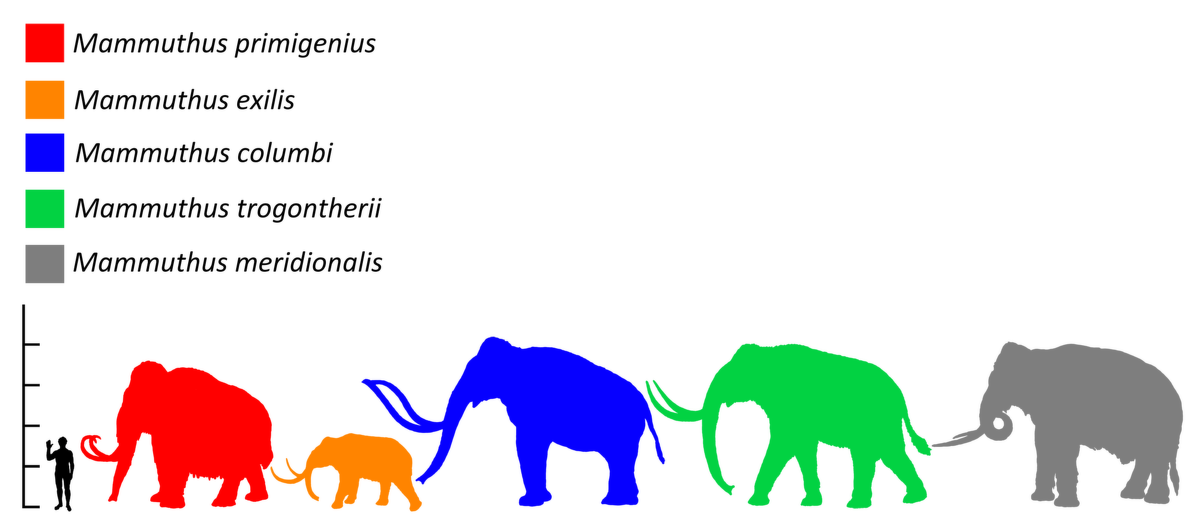
Size comparison of mammoth species (shoulder heights): 1) Red: wooly mammoth, M, primigenius (3,4 meters), 2) orange: pygmy mammoth or Channel Islands mammoth, M, exilis (1,8 meters), 3) blue: Columbian mammoth, M, columbi, 4) green: steppe mammoth, M, trogontherii, and 5) grey: southern mammoth, M, meridionalis (4 meters)
“The study authors think that based on what they learned from this work, they'll be equipped to extract DNA that's even older from other fossils that may emerge from the permafrost. “We haven't reached the limit yet. An educated guess would be that we could recover DNA that is 2 million years old, and possibly go even as far back as 2.6 million," Anders Götherström, a molecular archaeologist and co-author of the study, said in a press release. "Before that, there was no permafrost where ancient DNA could have been preserved."
Hybrid Mammoth DNA Found
In 2011, scientists announced that they had found hybrid mammoth DNA. Tim Wall wrote in Discovery News, June 1, 2011“Woolly and Columbian mammoths, two species of elephant that once lived in North America, may have interbred. [Source: Tim Wall, Discovery News, June 1, 2011]
“Mitochondrial DNA analysis of a Columbian mammoth (Mammuthus columbi) found in Utah suggests that its mitochondrial DNA was nearly identical to that of the woolly mammoth (Mammuthus primigenius). "We think this individual may have been a woolly-Columbian hybrid," said Jacob Enk of the McMaster Ancient DNA Centre, the group that led the research, which was recently published in Genome Biology. "Living African elephant species interbreed where their ranges adjoin, with males of the bigger species out-competing the smaller for mates," he explained in a press release. The mitochondrial genomes in the smaller females then show up in populations of the larger species. "Since woolly and Columbian ranges periodically overlapped in time and space, it's likely that they engaged in similar behaviour and left a similar genetic signal," Enk said.
“Modern examples of this can be seen where two varieties of elephant in Africa encounter each other. The larger savanna elephant (Loxodonta africana africana) and the smaller forest elephant (Loxodonta africana cyclotis) are capable of interbreeding. Genetic evidence has fueled a debate that these two modern elephants are indeed separate species. The hybridization of mammoths may explain other fossils that look like intermediates between the two species. These fossils were sometimes assigned to the species Mammathus jeffersonii, but further research may show them to be hybrids of the woolly and Columbian mammoths.”
Image Sources: Wikimedia Commons except dwarf mammoth, Nature
Text Sources: National Geographic, New York Times, Washington Post, Los Angeles Times, Smithsonian magazine, Nature, Scientific American. Live Science, Discover magazine, Discovery News, Natural History magazine, Archaeology magazine, The New Yorker, Time, BBC, The Guardian, Reuters, AP, AFP and various books and other publications.
Last updated May 2025