
Home | Category: People, Marriage and Society
SOCIAL CLASSES IN REPUBLICAN ROME

Patricians
The people of the Republic of Rome (509-27 B.C) were basically divided into three classes: the slaves, who had virtually no rights; the plebeians, ordinary people that included ex-slaves (freedmen); and the patricians, the descendants of the first ruling families, who by their ancestry were allowed to serve in the Roman senate. The internal history of the Republican Rome is marked by conflicts between the patricians and the plebeians, who wanted and eventually received more political power.
The upper classes and elite consisted of landowners, military officers, government officials and administrators and wealthy soldier-landowners who were similar to medieval knights. Together they made up less than 1 percent of the population. Rich Romans had land, slaves, livestock and wealth. They could easily be identified by their clothes. The historian Michael Grant said the standard of grand villas built in Pompeii "was never achieved again until the 19th century, To pay for their indulgences, many rich Romans, particularly in Italy, exploited the slaves, farmers and peasants under their control. One scholar wrote: "They were permitted to do a great deal — as long as they did nothing constructive."
Dr Valerie Hope of the Open University wrote for the BBC: ““The main legal distinctions were between those who were free, and those who were slaves. All inhabitants of the empire were either free or in servitude. Slaves were either born into slavery, or were forced, often through defeat in war, into it. Slaves were the possessions of their masters and the latter had the power of life and death over them. Slavery was not, however, always a life-long state. Slaves could be - and regularly were - given their freedom. [Source: Dr Valerie Hope, BBC, March 29, 2011. Hope is a lecturer in Classical Studies at the Open University.|]
RECOMMENDED BOOKS:
“Class Struggle in the Roman Republic” by Alan Woods (2023) Amazon.com;
“Patricians and Plebeians: The Origin of the Roman State” by Richard E. Mitchell (1990) Amazon.com;
“Roman Inequality: Affluent Slaves, Businesswomen, Legal Fictions” by Edward E. Cohen (2023) Amazon.com;
“Patricians and Emperors: The Last Rulers of the Western Roman Empire”
by Ian Hughes MA (2020) Amazon.com;
“Peasants, Citizens and Soldiers: Studies in the Demographic History of Roman Italy 225 BC–AD 100" by Luuk de Ligt (2012) Amazon.com;
“Peasants and Slaves: The Rural Population of Roman Italy (200 BC to AD 100) by Alessandro Launaro (2011) Amazon.com;
“Slaves and Masters in the Roman Empire: A Study in Social Control”
by K. R. Bradley (1987) Amazon.com;
“Invisible Romans: Prostitutes, Outlaws, Slaves, Gladiators, Ordinary Men and Women ... the Romans that History Forgot” by Robert C Knapp (2011) Amazon.com
“Poverty in Ancient Greece and Rome: Realities and Discourses” (Routledge) by Filippo Carlà-Uhink, Lucia Cecchet, et al. (2022) Amazon.com;
“Violence in the Forum: Factional Struggles in Ancient Rome (133–78 BC)”
by Natale Barca (2024) Amazon.com;
“Roman Society and Roman Law in the New Testament” by A. N. Sherwin-White (1961) Amazon.com;
Roman Society: A Social, Economic, and Cultural History”
by Henry Boren (1991) Amazon.com;
“Roman Social Relations, 50 B.C. to A.D. 284" by Samsay MacMullen (1974) Amazon.com;
Social Struggles in Archaic Rome: New Perspectives on the Conflict of the Orders”
by Kurt A. Raaflaub (2005) Amazon.com;
“Ambition in Ancient Rome”| by A. David Singh and Swati Chavda (2024) Amazon.com;
“Dining Posture in Ancient Rome: Bodies, Values, and Status” by Matthew B. Roller Amazon.com;
“The Oxford Handbook of Roman Law and Society” by Paul J du Plessis , Clifford Ando, et al. (2020) Amazon.com;
“Constructing Autocracy: Aristocrats and Emperors in Julio-Claudian Rome”
by Matthew B. Roller (2016) Amazon.com;
“Roman Lives: Ancient Roman Life” Illustrated by Latin Inscriptions, by Brian K. Harvey (Author) Amazon.com;
“Houses and Society in Pompeii and Herculaneum” by Andrew Wallace-Hadrill (1996) Amazon.com;
“Roman Lives: A Selection of Eight Roman Lives” (Oxford World's Classics) by Plutarch (2009) Amazon.com;
“SPQR: A History of Ancient Rome” by Mary Beard (2015) Amazon.com
“The History of the Decline and Fall of the Roman Empire” by Edward Gibbon (1776), six volumes Amazon.com
Early Roman Society: Gens (Clans), Curia and Tribes
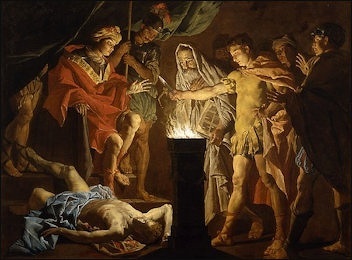
Rome under the Etruscan kings
Scholars are fairly well agreed that the city of Rome grew out of a settlement of Latin shepherds and farmers on the Palatine hill; and that this first settlement slowly expanded by taking in and uniting with itself the settlements established on the other hills. But to understand more fully the beginnings of this little city-state, we must look at the way in which the people were organized; how they were ruled; and how their society and government were held together and made strong by a common religion. [Source: “Outlines of Roman History” by William C. Morey, Ph.D., D.C.L. New York, American Book Company (1901) \~]
Roman Gens: A number of families which were supposed to be descended from a common ancestor formed a clan, or gens. Like the family, the gens was bound together by common religious rites. It was also governed by a common chief or ruler (decurio), who performed the religious rites, and led the people in war. \~\
Roman Curia: A number of gentes formed a still larger group, called a curia. In ancient times, when different people wished to unite, it was customary for them to make the union sacred by worshiping some common god. So the curia was bound together by the worship of a common deity. To preside over the common worship, a chief (curio) was selected, who was also the military commander in time of war, and chief magistrate in time of peace. The chief was assisted by a council of elders; and upon the most important questions he consulted the members of the curia in a common place of meeting (comitium). So that the curia was a small confederation of gentes, and made what we might call a little state. \~\
Roman Tribes: There was in the early Roman society a still larger group than the curia; it was what was called the tribe. It was a collection of curiae which had united for purposes of common defense and had come to form quite a distinct and well-organized community, like that which had settled upon the Palatine hill, and also like the Sabine community which had settled upon the Quirinal. Each of these settlements was therefore a tribe. Each had its chief, or king (rex), who was priest of the common religion, military commander in time of war, and civil magistrate to settle all disputes. Like the curia, it had also a council of elders and a general assembly of all people capable of bearing arms. Three of such tribes formed the whole Roman people. \~\
Plebeians and Patricians
The idea of citizenship first evolved in ancient Greece. Roman mythology claims that the Roman idea of citizenship was created by it legendary rulers but more likely the idea was imported at least in part from the Greeks. The Athenians had a form of citizenry that excluded a lot of people but did grant certain rights those who possessed citizenship.
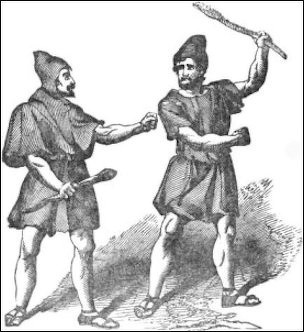
plebeians
In the early days of Rome, patricians were the ruling class. Only certain families were members of the patrician class and members had to be born patricians. The patricians were a very small percentage of the Roman population, but they held all the power. All the other people were Plebeians.
Over time the separation between the patricians and the plebeians was gradually broken down, with old patrician aristocracy passing away, and Rome becoming in theory, a democratic republic. Everyone who was enrolled in the thirty-five tribes was a full Roman citizen, and had a share in the government. But we must remember that not all the persons who were under the Roman authority were full Roman citizens. The inhabitants of the Latin colonies were not full Roman citizens. They could not hold office, and only under certain conditions could they vote. The Italian allies were not citizens at all, and could neither vote nor hold office. And now the conquests had added millions of people to those who were not citizens. The Roman world was, in fact, governed by the comparatively few people who lived in and about the city of Rome. [Source: “Outlines of Roman History” by William C. Morey, Ph.D., D.C.L. New York, American Book Company (1901) \~]
“But even within this class of citizens at Rome, there had gradually grown up a smaller body of persons, who became the real holders of political power. Later, this small body formed a new nobility—the optimates. All who had held the office of consul, praetor, or curule aedile—that is, a “curule office”—were regarded as nobles (nobiles), and their families were distinguished by the right of setting up the ancestral images in their homes (ius imaginis). Any citizen might, it is true, be elected to the curule offices; but the noble families were able, by their wealth, to influence the elections, so as practically to retain these offices in their own hands. \~\
Jamie Frater wrote for Listverse: “In modern days we tend to use the term plebeian to refer to the common or poor classes, but in Rome, a plebeian was just a member of the general populace of Rome (as opposed to the Patricians who were the privileged classes). Plebeians could, and very often did, become very wealthy people — but wealth did not change their class. [Source: Jamie Frater, Listverse, May 5, 2008 ]
See Separate Article: PLEBEIANS AND PATRICIANS IN THE EARLY ROMAN REPUBLIC europe.factsanddetails.com
Social Classes in the Roman Empire
Roman society was organized according to a similar hierarchy of social classes in the Roman Empire (31 B.C.-A.D. 476) . J. A. S. Evans wrote in New Catholic Encyclopedia: Because these classes were not based solely on birth — wealth and political standing were also important considerations — there was some social mobility. At the top of the hierarchy, of course, was the emperor, his family, and the imperial court. Next came the senatorial elite, whose status was politically based and depended on the favor of the emperor. The status of the equestrian class was largely economically derived, though many equestrians gained social mobility through army service. The equestrians, a class that had emerged during the late Republic, were businessmen who had profited from manufacturing and trade; this class came to dominate the imperial bureaucracy. On the lower end of the hierarchy were the plebeians, the ordinary citizens of Rome. Individually, the plebeians had little power, but as a group they could have great influence. Recognizing this, Augustus implemented a plan of “bread and circuses” — free grain and popular entertainment such as chariot races and gladiatorial contests — to keep them appeased. At the very bottom of the social order were slaves, freedmen (former slaves), and finally women. [Source: J. A. S. Evans, New Catholic Encyclopedia, Encyclopedia.com ^^]
Whereas under the republic there had been equality for all citizens before the law, in the empire of the second and third centuries a legal distinction arose which divided the citizen body into two classes: the honestiores and the humiliores, also called plebeii or tenuiores. To the first class belonged Roman senators and knights with their families, soldiers and veterans with their children, and men who held or had held municipal offices in towns and cities outside of Rome, with their descendants. All other citizens belonged to the second, and unless wealth or ability brought them into public office, they remained there. The humiliores were subject to the most severe and humiliating punishments for infraction of the laws. They might be sent to the mines, thrown to the beasts in the amphitheater, or crucified. The honestiores, on the other hand, enjoyed certain privileges. In case of grave misconduct, they were spared punishments which would tend to degrade their position in the eyes of the people and generally got off with banishment, relegation, or losing their property. [Source: “Daily Life in Ancient Rome: the People and the City at the Height the Empire” by Jerome Carcopino, Director of the Ecole Franchise De Rome Member of the Institute of France, Routledge 1936]
After the division of the empire between the sons of Theodosius, east and west increasingly went their own ways, though in law the empire was still one, and the consulship which conferred great social prestige if nothing else, was divided: one consul would hold office in Rome and the other in Constantinople. In the west, society came to be dominated by a small group of great land-owning aristocrats. Their great estates were worked by unfree coloni (tenants), tied to the land by a law of Constantine, and landowners were reluctant to supply them as recruits for the army. They liked lives of cultivated leisure, but they were also eager to hold the high offices of the empire, such as the praetorian prefecture, the urban prefecture, or the powerful post of "Master of the Offices," which brought status and wealth. A senator bore the title "illustris "; lesser grades of order which now did not imply senate seats were "spectabilis " (distinguished), and "clarissimus " (honorable). The title "Patrician" indicated immense prestige. ^^
Free peasants survived better in the eastern empire. Constantius II founded a Senate in Constantinople in the 350s, and it expanded rapidly from barely 300 to 3,000 members before he died. The attraction was that achieving senatorial status made a man a citizen of the capital, and thus he could escape the curial duties of his own civitas. High offices in the bureaucracy were coveted for they were a road to prestige and wealth, and since a good classical education was necessary for entry to the civil militia, schools flourished, and though elementary education was left to private enterprise in both East and West, higher education was subsidized. Knowledge of Latin was necessary for the study of law, but in everything else, the language of culture in the East was Greek. The linguistic divide sharpened: the Greek-speaking East had never shown much interest in Latin except for professional reasons, but since Greek had been widely taught in the west, the ruling class in the early empire had been largely bilingual. Now the West was turning its back on Greek. At the same time Syriac in the patriarchate of Antioch and Coptic in the patriarchate of Alexandria were emerging as written languages with literatures of their own. ^^
Book: “Roman Social Relations,” 50 B.C. to A.D. 284 by Samsay MacMullen, a historian at Yale.
Equestrian Order and Plebs Urbanus
J. A. S. Evans wrote: The term "equestrian order" (ordo equestris) is used in two senses. Strictly speaking, it was the 18 centuries of equites equo publico which once made up the cavalry of the Roman army, but their military function had been lost long ago and now they were only voting units in the Centuriate Assembly. Augustus tried to revitalize the equites equo publico, enlarging its number from 1,800 to 5,000 and reviving the annual march past, where the consuls inspected them. But in popular parlance and, in due time, officially as well, all freeborn citizens assessed at a minimum of 400,000 sesterces were equites, enjoying equestrian privileges such as the equestrian gold ring and the first 14 rows of seats in the theater. [Source: J. A. S. Evans, New Catholic Encyclopedia, Encyclopedia.com]
Augustus drew a number of his officials from their ranks. Augustus recruited his prefects from the equites with the exception of the urban prefect, the chief constable of Rome and commander of the three urban cohorts of security police, who was a senator and ex-consul. There were the two prefects of the Praetorian Guard, the prefect of Egypt, which Augustus ruled directly, the prefects of the Roman fleets, one based at Misenum on the Gulf of Naples and the other at Ravenna, the prefect of the night patrol (vigiles), and the prefect of the grain supply (praefectus annonae).
Also recruited from the equites were Augustus' deputies, the procuratores, who might act as his private financial agents or govern small provinces. Small provinces in Alpine districts or Judaea were governed initially first by prefects but later by procurators. Pontius Pilate is designated a procurator in the Gospels, but in fact his title is proved to have been "prefect" by an inscription found in Jerusalem. It can hardly be true, however, that Augustus established a cursus honorum for the equites which paralleled that of the senators, for we can discern no regular path of promotion.
Beneath the equestrians in the Roman social hierarchy was the plebs urbanus, "the common people of city of Rome" who were entitled to a free distribution of grain every month until 2 B.C., when this privilege was restricted to a fixed group, the plebs frumentaria numbering eventually about 150,000. But beyond the city, the population of the empire was made up of freeborn citizens, freedmen, and provincials. All Italians were now citizens and increasing numbers of provincials were beginning to acquire it as well. Freedmen, that is, manumitted slaves who bore the family names of their former masters, were citizens with qualifications: they were, for instance, excluded from public office and military service. Augustus retained the disabilities for freedmen; yet the corps of 7,000 night watchmen (vigiles) which he instituted in A.D. 6 were all freedmen, and in the crises of Pannonian revolt of A.D. 6 and the disaster in the Teutoberg forest in A.D. 9, he recruited them into special cohorts in the army. But they did not become legionary soldiers. However, he allowed many Italian towns to institute the seviri Augustales, an annual board of six freedmen who looked after the cult of the Lares Augusti ; contributions from them for public works and spectacles were expected in return. Later, under the emperor Claudius (81–54) freedmen were to capture positions of great power in the imperial bureaucracy, but under Claudius' successors, a shift in favor of equestrians began again, culminating with the emperor Hadrian.
Upper and Lower Classes in the Roman Empire
In ancient Rome, the number of persons receiving public assistance rose in the course of the second century from 150,000 to 175,000. We can without hesitation deduce from this that about 130,000 families, represented by their heads, were fed at the public expense. If we accept Martial's estimate of an average of five mouths per family, the total number must have been between 600,000 and 700,000. If we reckon only three persons per family, the total would be 400,000. [Source: “Daily Life in Ancient Rome: the People and the City at the Height the Empire” by Jerome Carcopino, Director of the Ecole Franchise De Rome Member of the Institute of France, Routledge 1936]
Directly or indirectly then, at least one-third and possibly one-half of the population of the city lived on public charity. But we should be wrong to conclude that two-thirds or onehalf of the population were independent of it, for the total of the population includes three classes already mentioned as being ineligible for the distributions of free grain: the soldiers of the garrison at the lowest computation spme 12,000 men; the peregrin passing through Rome, whose numbers we cannot calculate; and finally the slaves, whose ratio to the free inhabitants may have been at least one to three, as was recorded for Pergamum about the same period. If we suppose that Trajan's Rome had a population of 1,200,000 souls, we may deduct 400,000 slaves. This leaves less than 150,000 heads of Roman families who were sufficiently well off not to need to draw on the largesse of Annona.
The numerical inferiority of the Haves to the horde of the Have-Nots, sufficiently distressing 1n itself, becomes positively terrifying when we realise the inequality of fortune within the ranks of the minority; the majority of what we should nowadays call the middle classes vegetated in semistarvation within sight of the almost incredible opulence of a few thousand multimillionaires. A yearly income of 20,000 sesterces ($800) was the "vital minimum" for a Roman citizen to exist on. This is the income which a ruined reprobate whom Juvenal draws in one of his satirical scenes craves for his own old age. In another passage the poet, speaking on his own behalf, limits a wise man's desire to a fortune of 400,000 sesterces ($16,000): "If you turn up your nose at this sum," he says to his imaginary interlocutor, "take the fortune of two equites (or even three) ; if that doesn't satisfy your heart, neither will the riches of Croesus, nor all the treasures of the Persian kings!"
It is clear that in Juvenal's eyes a wise man ought to be happy with modest ease and comfort; clear also that modest ease presupposes a capital of 400,000 sesterces, the property qualification for a "knight." These two pieces of evidence corroborate and complement each other, since we know beyond possibility of doubt, thanks to the researches of Billeter, that in the poet's day the normal interest on money was 5 per cent. It follows that in the Rome of Trajan the "middle classes" began with the Equestrian Order, and unless a person was in a position to spend at least the 20,000 sesterces which this capital yielded annually, he could not maintain even the most modest standard of bourgeois life. Below this were the pauperised masses, to which the "lower middle classes" approximated much more closely than to the wealthy capitalists with whom a legal fiction classed them.
Middle Class in the Roman Empire
Transition between the plebs and the middle classes was relatively easy. Prosperity had followed on the successful campaigns of Trajan; his victories and Hadrian's diplomacy had given an impulse to commerce by opening the routes to the Far East; the economic liberalism of which the first Antonines had set an example had tempered the evils caused through the accumulation of lands in the same hands, and created independently of and when necessary in spite of the great landowners the right of hereditary enjoyment for those who had the courage to clear their own fields. All these things gave stimulus to business and multiplied the opportunities for industrious and energetic men, farmers-general or tenant-partners of the great estates, shipowners or bankers, wholesale or retail merchants, honestly to acquire a comfortable fortune. [Source: “Daily Life in Ancient Rome: the People and the City at the Height the Empire” by Jerome Carcopino, Director of the Ecole Franchise De Rome Member of the Institute of France, Routledge 1936]
On the other hand the salutary changes which sovereigns at last worthy of their office had imposed on all branches of their administration, the re-establishment of a simple but vigorous discipline in the army, the care with which civil and military chiefs were chosen and promoted, coinciding with the larger salaries and increased pay which rewarded their services and preserved their independence, constituted a series of factors or of measures favorable to the rise and prosperity of a middle class of a new social standing. There was not a procurator who then drew less than 60,000 sesterces a year, not a centurion or a primipilus whose salary fell below the 20,000 to 40,000 range. The former were in a position to double or treble the equestrian fortune they already possessed; and the others to acquire it, as so many inscriptions of the second century bear witness. The man who best incarnates the spirit of the middle classes at this period, Juvenal, is in fact himself one of these ex-officers who had been able to make his little pile and secure himself a respectable position in the bosom of the Roman bourgeoisie.
True, Juvenal sighs for the happier life which his limited means would have enabled him to enjoy in the country but denied to him in Rome. In this he is representative of his time. A man in his stratum of society found in fact his real home in the cities and provinces of Italy. In Rome people of his type were swamped by the superabundance of riches in which they had no share, and if a chain seemed to link them on the one hand to the plebs from which they had risen and on the other to the great magnates who had risen from their ranks, they were more conscious of the weight of the latter than the support of the former, and they lost all hope of shaking off the burden and rising to join the ranks above. The large fortunes on the plane above increased automatically or benefited from circumstances which profited the wealthy alone: from the exercise of the office and authority which they monopolised (a pro-consulate for instance brought in a million sesterces per annum); from the arbitrary favor of an emperor who might delegate his powers indefinitely to the same favorite; from a gust of wind on the stock exchange, where speculation was all the more unbridled since at Rome, the banking house of the world, speculation was the life-blood of an economic system where production was losing ground day by day and mercantilism was invading everything. Work might still ensure a modest living, but no longer yielded such fortunes as the chance of imperial favor or a speculative gamble might bestow. Middlemen and entertainers, these parasites who feed on multitudes, raked in millions. Martial voices his indignation to see advocates accepting their fees in kind and the fairest mental gifts cultivated without adequate reward.
"To what master, Lupus, should you entrust your son? I warn you... let him have nothing to do with the works of Cicero or the poems of Virgil.... Let him learn to be a harpist or a player of the flute; or if he seems dull of intellect make him an auctioneer (praeco) or architect." In another place he exclaims: "Two praetors, four tribunes, seven advocates, and ten poets recently approached an old father, suing for his daughter's hand. Without hesitation he gave the girl to Eulogus the auctioneer. Tell me, Severus, was that the act of a fool?" Outside the city, the middle classes still found it worth while to believe in the value of work, but inside Rome they had lost all confidence in it.
Happiness and Responsibilities of the Middle Class in the Roman Empire
Let us reread the charming epigram where the "parasite" poet has graven what I should like to call the "Plantin sonnet" of Latin literature, which assuredly served Plantin as a model : The things that make life happier, most genial Martial, are these: means not acquired by labour but bequeathed; fields not unkindly, an ever-blazing hearth; no lawsuit, the toga seldom worn, a quiet mind; a free man's strength, a healthy body; frankness with tact, congenial friends, good-natured guests, a board plainly spread; nights not spent in wine but freed from cares, a wife not prudish yet pure; sleep such as makes the darkness brief: be content with what you are and wish no change; nor dread your last day nor long for it. [Source: “Daily Life in Ancient Rome: the People and the City at the Height the Empire” by Jerome Carcopino, Director of the Ecole Franchise De Rome Member of the Institute of France, Routledge 1936]
This poem voices no cry of happiness; it utters a sigh in which resignation blends with content. It formulates no aspiration toward the unattainable. It places happiness in the negation of work, whose vanity it implies. The clouds of reality cast their shadow over this dreary ideal which breathes the fatigue of an aging world. Society, at least in Rome, was beginning to become fossilised. The hierarchy, still fluid in the center, was growing petrified toward the summit. The regular inflow which should have continuously renewed it gave way too often before accidental pressure and unexpected shocks. Slowed down and diverted from their course, the equalitarian currents tended to exaggerate essential inequalities.
The democratic order tottered with the wavering of the middle classes, who had been its firm foundation; it was crushed under the double weight of the masses, from whom a crazed economic system had stolen all hope of normal betterment, and of a corrupt bureaucracy which aggravated the absolutism of the monarch whose fabulous wealth it commanded and translated into acts of arbitrary omnipotence. Thus the brilliance of the Urbs of the second century was already shrouded in the shadows which under the later empire spread from Rome over the rest of the known world, and Rome lacked the courage to shake herself free of the sinister gloom that thickened round her. To struggle with success against the 'evils of their day, societies have need to believe in their own future. But Roman so^'ety, cheated of its hopes of gradual and 'equitable progress, obsessed alternately by its own stagnation and by its instability, began to doubt itself just at the time when the conscious unity f its established families was cracked and breaking.
Slave Numbers — Middle Versus Upper Class Roman Households
At the beginning of the second century B.C. houses in the Urbs which could boast of more than one slave were rare. This is proved by the custom of adding the suffix -por (=puer) to the genitive of the master's name to designate a slave: Lucipor, the slave of Lucius; Marcipor, the slave of Marcus. In contrast, during the second century A.D. there existed practically no masters of only one slave. People either bought no slave at all for the belly of a slave took a lot of filling or they bought and kept several together, which is why Juvenal in the verses already quoted uses the word "belly" in the plural: "... magno servorum venires!" [Source: “Daily Life in Ancient Rome: the People and the City at the Height the Empire” by Jerome Carcopino, Director of the Ecole Franchise De Rome Member of the Institute of France, Routledge 1936]
Two slaves to carry him to the circus was the very minimum with which the disillusioned old reprobate whose moderation we have appreciated above could manage to get along. But the average was four or five times as many. The humblest householder could not hold his head up unless he could appear with a train of eight slaves behind him. Martial records that the miser Cimber arranged for eight Syrian slaves to carry the microscopic loads of his contemptible little gifts at the Saturnalia. And according to Juvenal a litigant would have thought his case already lost if it had been entrusted to an advocate not accompanied to the bar by a train of slaves of at least this size. A squad of eight was usually sufficient for a petit bourgeois. The man of the upper.middle classes on the other hand commanded a battalion or more. Not to be completely swamped by the number of their retainers, they divided them into two parties, one of which they employed in the Urbs and one in the country; and they redivided the town staff again into two, those who served indoors (servi atrienses) and those who served without (cursores, viatores).
Finally, these different batches were again divided into tens, each decuria being distinguished by a number. Even these precautions were unavailing. Master and slaves ended by not knowing each other by sight. In the very middle of his banquet Trimalchio fails to know which of his slaves he is giving orders to: "What decuria do you belong to?" he asks the cook. "The fortieth," answers the slave. "Bought or born in the house?" "Neither," is the reply. "I was left you under Pansa's will." "Well, then, mind you serve this carefully, or I will have you degraded to the messengers' decuria" Reading such a dialogue, one can easily imagine that scarcely one slave in ten among Trimalchio's hordes really knew his master. One gathers that there were at least 400 of them, but the fact that Petronius alludes only to the fortieth decuria is no proof that there were not many more. Pliny the Younger who, as we have seen, was at least poorer than Trimalchio by a matter of 10,000,000 sesterces had at least 500 slaves, for his will manumitted 100; and the law Fufia Caninia, probably passed in 2 B.C. and still in force in the second century A.D., expressly permitted owners of between 100 and 500 slaves to set one-fifth free, and forbade owners of larger numbers to emancipate more than 100.
It is impossible to repress our amazement in the face of figures so.extravagant; yet it is known that in the second century they were often exceeded. The surprise felt by the jurist Gaius a century and a half after the passing of the law Fufia Caninia to think that it had not extended its scale of testamentary manumission beyond 100 per 500 slaves, is a sure indication that the scale had no longer fitted the reality. Toward the end of the first century A.D. under the Flavians the freedman around Caelius Isidorus left 4,116 slaves, and while this figure for a private individual was sufficiently noteworthy to be judged worthy of mention by the elder Pliny, there is no doubt whatever that the familiae serviles in the service of the great Roman capitalists often reached 1,000, and that the emperor, infinitely more wealthy than the richest of them, must easily have possessed a "slave family" of 20,000.
Image Sources: Wikimedia Commons
Text Sources: Internet Ancient History Sourcebook: Rome sourcebooks.fordham.edu ; Internet Ancient History Sourcebook: Late Antiquity sourcebooks.fordham.edu ; “Outlines of Roman History” by William C. Morey, Ph.D., D.C.L. New York, American Book Company (1901) ; “The Private Life of the Romans” by Harold Whetstone Johnston, Revised by Mary Johnston, Scott, Foresman and Company (1903, 1932); BBC Ancient Rome bbc.co.uk/history/ ; Project Gutenberg gutenberg.org ; Metropolitan Museum of Art, National Geographic, Smithsonian magazine, New York Times, Washington Post, Los Angeles Times, Live Science, Discover magazine, Archaeology magazine, Reuters, Associated Press, The Guardian, AFP, The New Yorker, Wikipedia, Encyclopædia Britannica, Encyclopedia.com and various other books, websites and publications.
Last updated October 2024