
Home | Category: Themes, Archaeology and Prehistory
SOURCES ON ANCIENT ROME
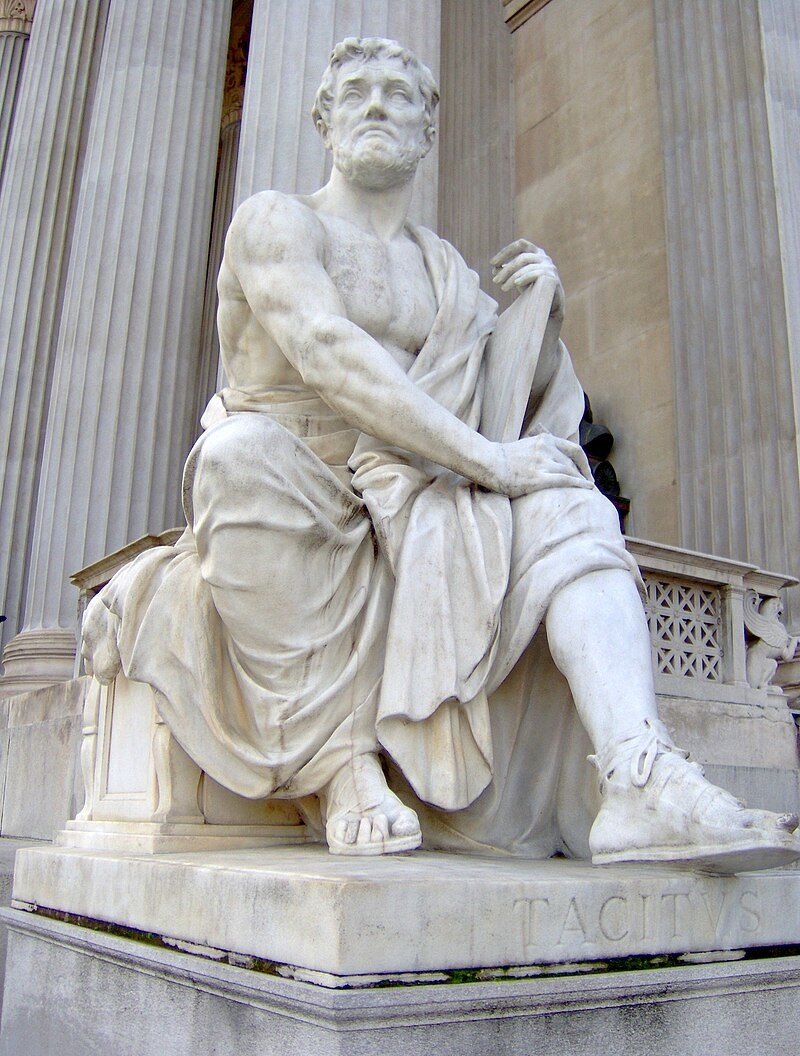
Statue of Tacitus outside the Austrian Parliament Building
There is lot more materials and sources for the study of the ancient Romans than there is for the study of the ancient Greeks. Most of the Roman sources are from the members of the ruling elite. There generally is not much information on the lower classes and how they lived. Archaeologists and historians warn that in the study of ancient Rome it is important to tread carefully and go only as far as the data takes you, understanding the limits and realizing the fragility of the constructs and presence of contradictions.
Herodotus (484?-425? B.C.) has been called the Father of History, a compliment initially given to him Cicero. He is given credit for recording information from all over but criticized for using less than reliable sources and sometimes espousing what seems like propaganda. Most of Herodotus's histories were stories he picked up from travelers, merchants and priests. He seems to have known many were exaggerations or unproven claims and he made some effort to pick out what was plausible. Occasionally he ascribed events to myths. Aristotle called him a “legend monger.” [Source: Daniel Mendelsohn, The New Yorker, April 28, 2008]
Strabo (64 B.C. – c. A.D. 24) was a Greek geographer, philosopher, and historian who came from Asia Minor at around the time the Roman Republic was becoming the Roman Empire. Strabo is best known for his work Geographica ("Geography"), which describes the history and characteristics of people and places in different regions known during his lifetime. Strabo was born to an affluent family from Amaseia in Pontus (in present-day Turkey). He traveled extensively during his life, venturing to Egypt and Kush (Sudan) and as going far south as Ethiopia. He lived in Rome and journey throughout throughout the Mediterranean and Near East. Strabo studied under several prominent teachers of various specialities throughout his early life at different stops during his Mediterranean travels. Geographica was not utilized much by contemporary writers but numerous copies survived throughout the Byzantine Empire. It first appeared in Western Europe in Rome as a Latin translation in 1469.
Procopius of Caesarea (c. A.D. 500 – after 565) was a prominent late antique Greek scholar from Caesarea Maritima (in present-day Israel). He accompanying the Byzantine general Belisarius in Emperor Justinian's wars and was principal Byzantine historian of the 6th century. His works include “History of the Wars”, “Buildings”, “Secret History”. He is often described as the last major historian of the ancient Western world.
RECOMMENDED BOOKS:
“Livy: The Early History of Rome, Books I-V” (Penguin Classics)
by Titus Livy , Aubrey de Sélincourt , et al. (2002) Amazon.com
“Annals” by Tacitus (Penguin Classics) Amazon.com
“Histories” by Tacitus (Penguin Classics) Amazon.com
“The Twelve Caesars” (Penguin Classics) by Suetonius (121 AD) Amazon.com
“Procopius of Caesarea: Tyranny, History, and Philosophy at the End of Antiquity”
by Anthony Kaldellis (2004) Amazon.com
“The Complete Procopius Anthology: The Wars of Justinian, The Secret History of the Court of Justinian, The Buildings of Justinian” Kindle Edition by Procopius of Caesarea Amazon.com;
“The Landmark Julius Caesar: The Complete Works : Gallic War, Civil War, Alexandrian War, African War, and Spanish War : in One Volume, with Maps, Annotations, Appendices, and Encyclopedic Index” by 2017) Amazon.com
“The Histories” by Polybius , translated by W. R. Paton (2019) Amazon.com;
“The Jewish War” by Flavius Josephus , Betty Radice, et al. (Penguin Classics) Amazon.com ;
“Parallel Lives” by Plutarch Volume 1 (Modern Library Classics) Amazon.com;
“Parallel Lives” by Plutarch Volume 2 (Modern Library Classics) Amazon.com;
“Strabo's Geography: A Translation for the Modern World”
by Strabo, translated by Sarah Pothecary Amazon.com;
“Delphi Complete Works of Strabo - Geography (Illustrated)” Amazon.com;
“Pliny's Natural History in Thirty-Seven Books” by Pliny and the Elder Amazon.com;
“Readings in the Classical Historians” by Michael Grant Amazon.com;
“Histories” by Herodotus (Landmark) Amazon.com;
“The History of the Decline and Fall of the Roman Empire” by Edward Gibbon (1776), six volumes Amazon.com
Roman Historians
The Romans were great historians who seemed to record and write down almost everything they saw. Much of what we know about the Greece, Greek art, early Christianity and life the Holy Land when Jesus was alive is based on Roman accounts. The Romans left behind so much information in fact we know more about more about Europe 2,000 years ago than were know about North America 300 or 400 years ago.
Influential writers, observers and historians included Horace, Pliny, Seneca, Juvenal, Cato, Martial the historians Tacitus (A.D. 56-120) and L. Casius Dio, the biographer Suetonius and the prose Romantic Petronius (d. A.D. 66). Livy (59 B.C.- A.D. 17) is one of the main sources on the Roman Republic and the early, legendary period of Rome. It him 40 forty years to write his 142-book “History of Rome.”
Polybius (c.200-after 118 B.C.) wrote “Rome at the End of the Punic Wars.” he was a Greek historian of the Hellenistic period noted for his work “The Histories,” which covered the period of 264–146 B.C., when the Roman Republic became dominant power in the ancient Mediterranean world. Julius Caesar (100-44 B.C.) wrote “War Commentaries”: 1) “The African Wars”, 2) “The Alexandrian Wars”, 3) “The Civil Wars”, 4) “The Gallic Wars”, 5) “The Spanish Wars”.
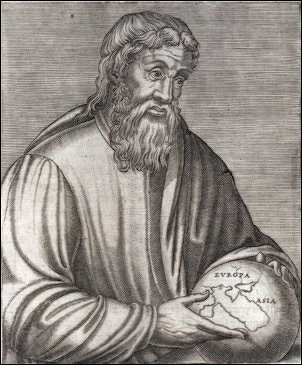
Strabo
Much of what we know about the Holy Land around the time of Jesus is based on accounts by Flavius Josephus (A.D. 37-100), the pro-Roman Jewish governor of Galilee, in his books The Jewish War and Jewish Antiquities . Josephus was born to an upper-class Jewish family. He became the governor of Galilee at the age of 31 in A.D. 68 and later led a Jewish liberation army against Rome. When he was Rome, he was spared when he told the Roman general Vespasian that he was a Jewish messiah and a future emperor of Rome. When Vespasian did in fact become emperor, Josephesus was give a generous pension and comfortable apartment. He spent the rest of his life writing books that attempted to explain whey the Jews revolted. Josephus (A.D. 37- after 93): Complete Works: includes Antiquities of the Jews, The Jewish War and Against Apion.
Plutarch (A.D. c.46-c.120) wrote “Lives of the Noble Greeks and Romans,” commonly called “Parallel Lives” or “Plutarch's Lives.” The work is a series of biographies of famous men, arranged in Greek and Roman pairs to illuminate their common moral virtues or failings, probably written at the beginning of the second century A.D. The most widely circulated versions were translated by John Dryden (1730-1700). Among the history figures included are Aemilius Paulus, Agesilaus, Agis, Alcibiades, Alexander, Antony, Aratus, Aristides, Artaxerxes, Caesar, Caius Gracchus, Caius Marius, Camillus, Cato the Younger, Cicero, Cimon, Cleomenes, Coriolanus, Crassus, Demetrius, Demosthenes, Dion, Eumenes, Fabius, Flamininus, Galba, Lucullus, Lycurgus, Lysander, Marcellus, Marcus Brutus, Marcus Cato, Nicias, Numa Pompilius, Otho, Pelopidas, Pericles, Philopoemen, Phocion, Pompey, Poplicola, Pyrrhus, Romulus, Sertorius, Solon, Sylla, Themistocles, Theseus, Tiberius Gracchus, Timoleon.
Comparisons in Plutarch’s “Lives of the Noble Greeks and Romans”: The Comparison of Alcibiades with Coriolanus, The Comparison of Crassus with Nicias, The Comparison of Demetrius and Antony, The Comparison of Demosthenes and Cicero, The Comparison of Dion and Brutus, The Comparison of Fabius with Pericles, The Comparison of Lucullus with Cimon, The Comparison of Lysander with Sylla, The Comparison of Numa with Lycurgus, The Comparison of Pelopidas with Marcellus, The Comparison of Philopoemen with Flamininus, The Comparison of Pompey with Agesilaus, The Comparison of Poplicola with Solon, The Comparison of Romulus with Theseus, The Comparison of Sertorius with Eumenes, The Comparison of Tiberius and Caius Gracchus with Agis and Cleomenes, The Comparison of Timoleon with Aemilius Paulus,. Suetonius (c. A.D. 69-after 122): “De Vita Caesarum: Julius” (Life of Julius Caesar”), “De Vita Caesarum: Augustus” (“Life of Augustus”), “De Vita Caesarum: Tiberius”, “De Vita Caesarum: Caius Caligula”, “De Vita Caesarum: Claudius” (“Life of Claudius”), “De Vita Caesarum: Nero”, “De Vita Caesarum: Galba”, “De Vita Caesarum: Otho”, “De Vita Caesarum: Vitellius”, “De Vita Caesarum: Vespasian”, “De Vita Caesarum: Titus”, “De Vita Caesarum: Domitian”, “De Viris Illustris”.
Suetonius was a Roman historian and biographer. He served briefly as secretary to Emperor Hadrian (some say he lost his position because he became too close to the emperor's wife.) His position gave him access to privileged imperial documents, correspondence and diaries upon which he based his accounts. For this reason, his descriptions are considered credible. [Source: eyewitnesstohistory.com]
Major Historians of Ancient Rome and Links to Their Works
Polybius (c.200-after 118 B.C.)
The Histories, trans. W.R. Paton (Loeb) Lacus Curtius penelope.uchicago.edu
The Histories Vol 1 and The Histories Vol 2, trans. Evelyn S. Shuckburgh Internet Archive archive.org
The Histories Vol 1 and The Histories Vol 2, trans. Evelyn S. Shuckburgh Project Gutenberg Project Gutenberg gutenberg.org;
Rome at the End of the Punic Wars [The Histories, Book 6, Ancient History Sourcebook sourcebooks.fordham.edu;
Julius Caesar (100-44 B.C.)
War Commentaries M Univ, Internet Archive web.archive.org;
War Commentaries MIT Classics classics.mit.edu ;
De Bello Gallico and Other Commentaries, trans. W.A. McDevitte Project Gutenberg Project Gutenberg gutenberg.org;
Livy (59 B.C.-17 A.D.): History of Rome
Volume I [Books 1-8] Project Gutenberg Project Gutenberg gutenberg.org;
Volume II [Books 9-2] Project Gutenberg Project Gutenberg gutenberg.org;
Volume III [Books 27-3] Project Gutenberg Project Gutenberg gutenberg.org;
Volume IV [Books 37-End] Project Gutenberg Project Gutenberg gutenberg.org;
Roman History, Books I-III, different translation Project Gutenberg Project Gutenberg gutenberg.org;
Periochae Internet Archive web.archive.org;
Augustus (3 B.C.-14 A.D.)
Acts of the Divine Augustus (Res Gestae Divi Augusti) MIT Classics classics.mit.edu ;
Josephus (37- after 93 A.D.)
Complete Works CCEL ccel.org Includes Antiquities of the Jews, The Jewish War and Against Apion
Complete Works [different presentation] CCEL ccel.org , Includes Antiquities of the Jews, The Jewish War and Against Apion
Plutarch (c.4-c.120 A.D.)
Lives, trans. John Dryden MIT Classics classics.mit.edu ;
Lives Vol 1, trans. Aubrey Stewart and George Long Project Gutenberg Project Gutenberg gutenberg.org;
Lives Vol 2, trans. Aubrey Stewart and George Long Project Gutenberg Project Gutenberg gutenberg.org;
Lives Vol 3, trans. Aubrey Stewart and George Long Project Gutenberg Project Gutenberg gutenberg.org;
Lives Vol 4, trans. Aubrey Stewart and George Long Project Gutenberg Project Gutenberg gutenberg.org;
Lives of the Noble Grecians and Romans, trans. Arthur H. Clough Project Gutenberg Project Gutenberg gutenberg.org;
Tacitus (b.5/57-after 117 A.D.)
Annals MIT Classics classics.mit.edu ;
Annals Ancient History Sourcebook sourcebooks.fordham.edu;
Histories MIT Classics classics.mit.edu ;
Life of Cnaeus Julius Agricola (40-93 A.D.), c.98 CE trans. J. Church and W. J. Brodribb. Ancient History Sourcebook sourcebooks.fordham.edu;
Germania. trans. J. Church and W. J. Brodribb, Medieval Sourcebook sourcebooks.fordham.edu
Suetonius (c.9-after 122 A.D.)
Index to Suetonius, Lives Ancient History Sourcebook sourcebooks.fordham.edu;
Rolfe Translation
De Vita Caesarum: Julius
De Vita Caesarum: Augustus
De Vita Caesarum: Tiberius
De Vita Caesarum: Caius Caligula
De Vita Caesarum: Claudius
De Vita Caesarum: Nero
De Vita Caesarum: Galba
De Vita Caesarum: Otho
De Vita Caesarum: Vitellius
De Vita Caesarum: Vespasian
De Vita Caesarum: Titus
De Vita Caesarum: Domitian
Also: De Viris Illustris, c. 10-113 C.E.
Worthington Translation
Life of Augustus, (3 B.C.-14 A.D.)
Life of Claudius
Appian (c.95-c.15) (writes in Greek)
Roman History (The Mithridatic Wars) Livius livius.org/sources
Cassius Dio (c.155-c.235 A.D.)
Roman History trans. Earnest Cary, in Greek and English [Loeb], one big file.Internet Archive web.archive.org;
Roman History trans. Earnest Cary, chapter files Lacus Curtius penelope.uchicago.edu;
Roman History trans. Earnest Cary, chapter files Wikisource en.wikisource.org;
Roman History trans Herbert B. Foster in volumes Project Gutenberg Project Gutenberg gutenberg.org;
Tacitus
Tacitus was born in the year 56 or 57 probably in Rome. He was in Rome during the great fire. During his lifetime he wrote a number of histories chronicling the reigns of the early emperors. His final — and arguably greatest — work “Annals” was written around A.D. 116. Tacitus: (A.D. b.56/57-after 117) wrote: “Annals,” “Histories ,” “The Life of Gnaeus Julius Agricola” (40-93 A.D.), translated by J. Church and W. J. Brodribb; “Germania”. translated by J. Church and W. J. Brodribb and by Thomas Gordon.
J. Vanderspoel of the University of Calgary wrote: “P. Cornelius Tacitus wrote his history of the Roman Empire from the death of Augustus (A.D. 14) to the death of Domitian (A.D. 96) during the reigns of Trajan (A.D. 98-117) and Hadrian (A.D. 117-138). This consists of two works, the Annals and the Histories; the first covers the period to the death of Nero (A.D. 68), the second from that point to the death of Domitian, but of each work only portions survive. Previously, after the accession of Nerva (A.D. 96-98), Tacitus had written three shorter works, the Agricola, the Germania, and the Dialogue on Orators. Born about A.D. 56 or 57, Tacitus was a member of the Senate, served Domitian in several capacities and was to serve Nerva and Trajan as well; he held the consulship in 97 and governed Asia some years later, probably 112/113. For the portions that survive, his works are the most detailed treatment of the early empire available from antiquity; he himself was able to use a variety of sources that are no longer extant, including the records of the Senate. [Source: J. Vanderspoel, Department of Greek, Latin and Ancient History, University of Calgary]
Cambridge classics professor Mary Beard told an interviewer that Tacitus's The Annals is the best work of history ever written. “Take the murder of Nero's mother," she said. “There is no better story than Nero's attempts to murder his mother with whom he is finally very pissed off! Nero the mad boy emperor decides that he is going to get rid of mum by a rather clever collapsible boat. He has her to dinner, waves her fondly farewell. The boat collapses. Sadly for Nero, his mum, Agrippina, is a very strong swimmer and she makes it to the land and back home. And she's clever, she knows boats don't just collapse like that — it was a completely calm night, so she works out Nero was out to get her. She knows things are going to end badly. Nero can't let her off, so he sends round the tough guys to murder her. Agrippina looks them in the eye and says, “Strike me in the belly with your sword." There are two things going on. One is: my son who came out of my belly is trying to murder me. But the other thing we know is that they were widely reputed to have had an incestuous relationship in the earlier days. So it's not just Nero the son murdering his mother, but Nero the lover murdering his discarded mistress. And if you read Robert Graves's I, Claudius, some of it comes directly from this.
When asked if it's better than a Hollywood plot, Beard said, “Yes but it's not just that. What he does is seduce you with an extraordinary tale. But, there is also a cynical, hard-hitting analysis of corruption. Reading Tacitus in Latin is like reading James Joyce. It's language which is really at the margins of comprehensibility as well as being very exciting. But, actually, he wants to talk about the corruption of autocracy. It's about one-man rule going bad."
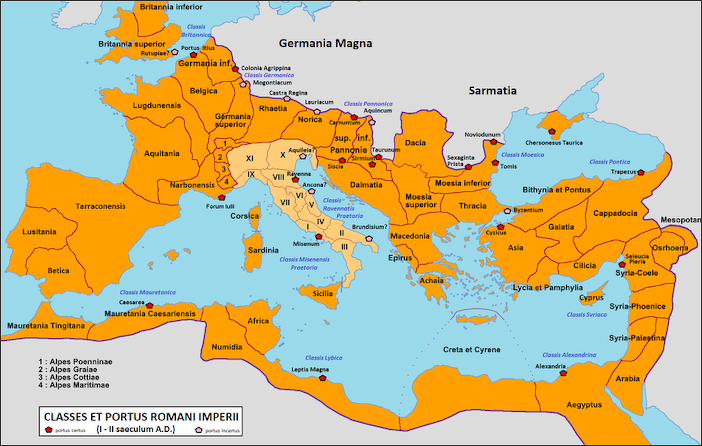
Provinces of the Roman Empire
Roman History: Created by Roman Nobility, Ignoring the Masses
Adam Kirsch wrote in The New Yorker: “Much of what we know about the Roman emperors is based on myth and misunderstanding. But even that much can’t be said for the vast majority of their subjects, whose way of life has left barely a trace in the historical record.As Robert Knapp points out in “Invisible Romans” (Harvard), “What survives was generally created by or for the rich and the powerful, and hides the actions and perspectives of any but their own class.” Almost everybody we read about in Roman history was a member of one of the three ruling orders—senators, equestrians or knights, and provincial aristocrats. Yet “the three orders amounted to no more than 100,000-200,000 people, less than half a percent of the empire’s population of 50-60 million.” [Source: Adam Kirsch, The New Yorker, January 2, 2012 ]
“In this passionately moral book, Knapp asks the same question as Occupy Wall Street: What about the ninety-nine per cent? What did they think about work, sex, religion, power, and death? “Invisible Romans” attempts to elicit a world view from the scraps of evidence that remain: popular dream-interpretation guides, inscriptions on gravestones, fragments of papyri, and, very often, the New Testament. Although the Gospels are from the Near East and were written in Greek, Knapp argues that “likenesses in attitudes and behavior” make it possible to generalize to the Empire at large. To him, the New Testament is “the single richest collection of literature written by what I call invisibles and expressing their outlook.”
“Wherever possible, Knapp tries to restore to these “invisibles” some of the dignity of agency, eliminating the bias of the sources, which see them merely as raw material to be shaped or wasted by their rulers. Roman women, for instance, were “always in the power, under the legal authority, of a male,” either a father or a husband. Deprived of legal power, they turned to magic. Amulets and spells, Knapp observes, were “a major weapon for women against the perils of their world,” and he quotes some surviving examples of love charms: “I will bind you, Nilos”; “You are going to love me, Capitolina . . . with a divine passion, and you will be for me in everything a follower, as long as I wish.”
Lost Classics and Roman Historical Works
John Seabrook wrote in The New Yorker: “One could dare hope for one or two of the lost histories of Livy, of whose hundred and forty-two books on the history of Rome only thirty-five survive. Or perhaps one of the nine volumes of verse written by Sappho, the Greek poet; only one complete poem remains. By some estimates, ninety-nine per cent of ancient Greek literature has been lost, and Latin has not fared much better. [Source: John Seabrook, The New Yorker , November 16, 2015 \=/]
“Among those works we know are missing are Aristotle’s second volume of the Poetics, which was on comedy; Gorgias’ philosophical work “On Non-Existence”; the four missing books of the Roman historian Tacitus’ Annals, covering Caligula’s reign and the beginning of Claudius’; Ovid’s version of “Medea”; and Suetonius on the Greek athletic games. (His “Lives of Famous Whores” also, sadly, has not survived.) Greek tragedy has been decimated. According to the Suda, the tenth-century Byzantine encyclopedia of classical culture, Euripides wrote as many as ninety-two plays; eighteen survive. \=/
“We have seven each from Aeschylus and Sophocles, who wrote about ninety and a hundred and twenty, respectively. “And that’s just the big three of tragedy,” the writer and classics professor Daniel Mendelsohn told me. “Of the thousand that were likely written and performed during the hundred-year heyday of tragedy, we have only thirty-three extant plays—that’s about a three-per-cent survival rate.” \=/
Edward Gibbons and the Decline and Fall of the Roman Empire
On June 7, 1787, at the age of 50, Edward Gibbons wrote the last line of the final chapter of the sixth and last volume, of “ The History of the Decline and Fall of the Roman Empire” from his house at Lausanne, Switzerland. He started the work in 1772. It took him 24 years to complete.
In the third volume of “ Decline and Fall of the Roman Empire” Gibbon’s concluded "the decline of Rome was the natural and inevitable effect of immoderate greatness. Prosperity ripened the principal of decay; the causes of destruction multiplied with the extent of the conquest; and, as soon as time or accident removed the artificial supports, the stupendous fabric-yielded to the pressure of its on weight. The story of its ruin is simple and obvious; and, instead of inquiring why the Roman empire was destroyed, we should rather be surprised that it had subsisted so long."
In the end he said "after a diligent inquiry" there are "four principal causes of the ruin of Rome, which continued to operate in a period of more than a thousand years...I. The injuries of time and nature. II. The hostile attacks of the barbarians and Christians. III. The use and abuse of materials. And, IV. The domestic quarrels of the Romans."
Gibbons was independently wealthy, and had neither a wife nor children, which explains how he had the time and money to complete his monumental task. What made the work so revolutionary, other than its length, was the fact it focused on the tragic and humorous human aspects of history.
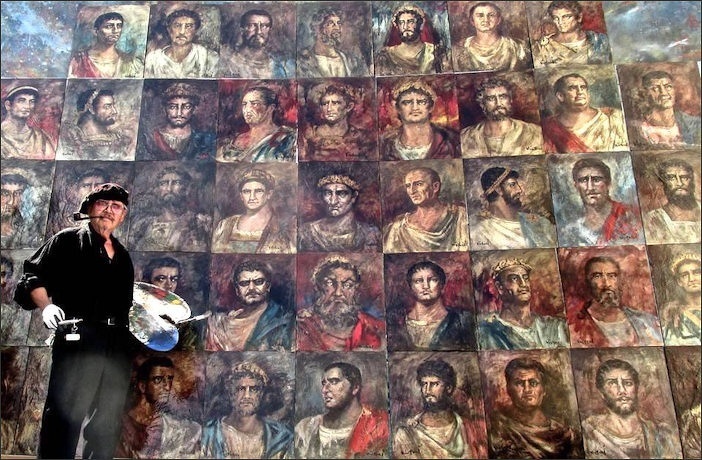
Western Impression of Rome Shaped by Shakespeare?
In a review of Garry Wills’ book “Rome and Rhetoric”, Adam Kirsch wrote in The New Yorker: “ For many English speakers since the Renaissance,” Shakespeare’s “Julius Caesar” has been their first and perhaps only contact with Roman history. “The accomplishment of this play is hard to exaggerate,” Wills writes. “It is the first play to bring a strong feel for Romanitas to the English stage. . . . Shakespeare has a feel for Roman rhetoric, Stoicism, nobility, and cynicism that are immediately convincing.” [Source: Adam Kirsch, The New Yorker, January 2, 2012 ]
“For Wills, the nobility is less interesting than the cynicism. Shakespeare gave us Brutus, “the noblest Roman of them all,” willing to sacrifice his life for freedom; but, Wills reminds us, he also created Antony, the warlord who manipulates public frenzy in order to consolidate his bloody grip on power. Wills draws attention to the scene in which Antony explains that he regards his fellow-ruler of Rome, Lepidus, as a beast of burden like “my horse. . . . He must be taught and trained and bid go forth,” until his usefulness is exhausted, whereupon Antony will “turn him off / Like to the empty ass to shake his ears / And graze in commons.” Shakespeare, Wills writes, “saw all around the Roman ethos, its bellicose and cold-blooded side, as well as its aspirations after honor and nobility.”
“Wills is characteristic of the current wave of writers in his deep skepticism about the nature of Rome’s “lasting image.” Thanks to historians like Suetonius and Tacitus, the Rome of the emperors has always had a reputation for dissoluteness and tyranny; but the Roman Republic, which flourished until Julius Caesar became dictator, was an altogether nobler memory. For centuries, Europeans and Americans read Livy, the first-century- B.C. historian of early Rome, and took his stories as exempla of heroism, to be cherished and emulated: Scaevola, thrusting his hand into the fire to prove his fearlessness before the enemy Etruscan king Lars Porsena; Horatius Cocles, a junior officer who, with two comrades, successfully defended a bridge into Rome against Lars Porsena’s invading army; Lucretia, who was raped by the son of the king of Rome and took her own life, after pledging her father to revenge. And there was Cincinnatus, the Roman who took up dictatorial power, saved Rome, then willingly relinquished it and returned to his plow—an example that led the veterans of America’s Revolutionary War to name themselves the Society of Cincinnati.”
Did Rome Really Rise and Fall as Was Claimed?
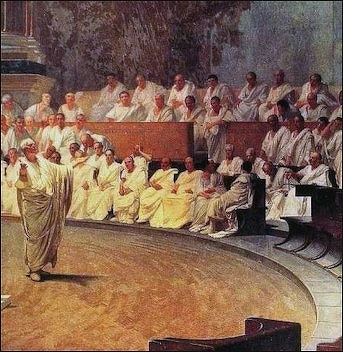
Roman Senate
Dr Peter Heather wrote for the BBC: “The 1960swere famously a time when all established certainties were challenged, and this applied to ancient history. The eastern half of the Roman empire not only survived the collapse of its western partner in the third quarter of the fifth century, but went on to thrive in the sixth. Under Justinian I (527 - 565 AD), it was still constructing hugely impressive public monuments, such as the Hagia Sophia in Constantinople, and had reconquered Italy, North Africa, and parts of Spain. At the same time, there still lived in the west many individuals, who continued to describe themselves as Romans, and many of the successor states, it was correctly pointed out, were still operating using recognisably Roman institutions and justifying themselves ideologically with reference to canonical Roman values. [Source: Dr Peter Heather, BBC, February 17, 2011 |::|]
Consequently, by the late 1990s the word 'transformation' had come into vogue. No one denied that many things changed between 350 and 600 AD, but it became fashionable to see these changes as much more the result of long-term evolution than of a violent imperial collapse. These revisionist arguments have some real substance. There really was little change at one deep level - the life of the peasant producers who made up perhaps 90% of the population.
“I am still staggered by feats of Roman engineering, blown away by the beauty of some the buildings Romans lived in, and delighted by the sophistication of the empire's literary and political culture. But these cultural glories were limited to a tiny privileged elite - those who owned enough land to count as gentry landowners. They represented maybe 3% of the whole population. Its structures were probably unspeakable vile to pretty much everyone else. As late as 383 AD, captive barbarians were being fed to wild animals in the Colosseum, and its criminal law dealt ruthlessly with anyone seeking to remedy the highly unequal distribution of property. |In 650 AD, as in 350 AD, peasants were still labouring away in the much the same way to feed themselves and to produce the surplus which funded everything else.” |::|
Romans and Popular Culture
“Ben Hur” (1959) is regarded as one of the greatest spectacles of all time. It won 11 Academy Awards and saved MGM from bankruptcy. It is based on a novel by Gen. Lew Wallace. The first version of the film, made in 1907 and only 15 minutes long, was one of the most expensive silent movie ever made. “Ben-Hur: A Tale of the Christ” (1925) – silent film directed by Fred Niblo and starring Ramon Novarro, is noteworthy for its color segments and for the female nudity in the parade sequence. “Ben-Hur” (2016), directed by Timur Bekmambetov, was an expensive flop.
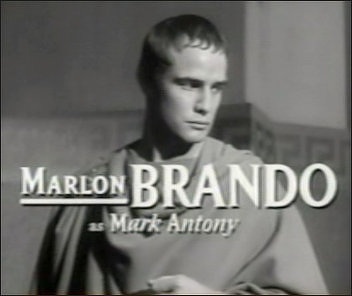
1953 Hollywood version of Shakespeare's Julius Caesar
Other famous Roman-themed films have included “Gladiator” (2000), directed by Ridely Scott, with and “Spartacus” (1960) directed by Stanley Kubrik with Kirk Douglas as Spartacus. “Julius Caesar” (1953) –deals with the assassination of Julius Caesar and the Liberators' civil war, with Marlon Brando as Mark Antony and John Gielgud as Gaius Cassius “The Robe” (1953) – based on the novel by Lloyd C. Douglas — features Richard Burton as Marcellus and Jean Simmons as Diana.. “Caligula” (1979) was produced by Penthouse magazine, with Malcolm McDowell as Caligula. The 1959 version of “The Last Days of Pompeii” was directed Mario Bonnard & Sergio Leone of spaghetti Western fame. “Fellini Satyricon” (1969) was fantasy drama loosely based on Petronius's work and directed Federico Fellini. “I, Claudius’ was a well-received BBC TV series (1976), with Derek Jacobi as Claudius, based on Robert Graves's novels “I, Claudius” and “Claudius the God.”
The Inquiry (2006) boasts Max von Sydow as Tiberius. Quo Vadis (1951) featured Peter Ustinov as Nero. Titus (1999) has Anthony Hopkins in the leading role. “Attila” (1954) featured Anthony Quinn as Attila the Hun and Sophia Loren as Justa Grata Honoria. “Sign of the Pagan” (1954) – with Jack Palance as Attila the Hun. And there are the Cleopatra movies. Cecil B. DeMille’s “Cleopatra (1934)” starred Claudette Colbert as Cleopatra. “Caesar and Cleopatra” (1945), based on the play by George Bernard Shaw, featured Vivien Leigh as Cleopatra and Claude Rains as Julius Caesar. Cleopatra (1963) featured Elizabeth Taylor as Cleopatra, Richard Burton as Mark Antony and Rex Harrison as Julius Caesar. Directed by Joseph L. Mankiewicz it included the Battle of Actium and the Final War of the Roman Republic but is regarded as one of the most expensive, box-office busts of all time.
On “Spartacus: Blood and Sand,” a 13-part series shown in 2010 on cable channel Starz, Charles McGrath wrote in the New York Times, “Overtaxed, militarily overextended and with an increasing gap between the haves and the have-nots, the Romans, we learn, were a lot like us, but for entertainment purposes they had some signal advantages: They were more violent, they wore skimpier clothes and they had orgies. “Spartacus: Blood and Sand,” a retelling of the history of the famous slave and his rebellion, does not neglect any of these traits. It features abundant nudity, both male and female. (“In the early days we had a lot of conversations about how many penises we could show in a single episode,” Rob Tapert, one of the producers, recalled recently.) There is a great deal of simulated sex, of both the gay and straight variety. And the subtitle is not false advertising: the characters do not merely bleed; they spray great fountains and gouts, arterial geysers, that splash up on the inside of your TV screen or else hang in midair like red Rorschach blots. Mr. Tapert and his co-producer, Sam Raimi (better known as the director of the “Spider-Man” films), got their start with the “Evil Dead” horror-movie franchise, and the new show at times suggests their early experiments with high-pressure circulatory systems. “The apple doesn’t fall far from the tree,” Mr. Tapert admitted. [Source: Charles McGrath, New York Times, January 15, 2010]
Book: “Pompeii” by Robert Harris (Random House, 2003) is a historical novel with a Chinatown-like plot that begins in 79 B.C. two days before the eruption of Vesuvius. The central character is a hydraulic engineer who sets out to discover what is happening to the missing water from the aqueduct he helped build to Pompeii. It is an entertaining and informative read. There has been some discussion about Roman Polanski directing a film version of the book. The film’s proposed $200 million budget would make it the most expensive movie ever filmed in Europe.
Rome: the HBO-BBC Miniseries
“Rome” was a critically-acclaimed 22-episode television series that ran for two seasons on HBO and the BBC (2005–2007). The joint British-American-Italian production on Rome's transition from Republic to Empire was directed by Michael Apted. Newsweek described it as “seamy, grandiloquent and compulsively watchable...It’s “Upstairs, Downstairs” with swords and sandals...The witchy women are more or less equals of the swinish men, and whenever Julius Caesar and Octavian says he’s acting not for himself but for the empire, you are invited to roll your eyes.”
“Rome” is set during the 1st century B.C. before and after Caesar crossed the Rubicon, marking the end of the Roman Republic and the beginning of the Roman Empire. It has its share of soft-core sex and exposed male genitals but lacks the big battle scenes that we have came to expect from such works. Among the characters are Cicero, Cleopatra and Marc Antony. The series reportedly cost over $100 million to make.
Jamie Frater wrote for Listverse: “HBO/BBC created an excellent series called “Rome” which covers a number of years of the Roman Empire. In the series they have, unfortunately, slandered the good name of one of the main Characters, Atia (Mother of Octavian – Augustus – and niece of Julius Caesar). In the show she is seen as a licentious, self-absorbed and manipulative schemer who is Mark Antony’s lover. In reality, Atia was a highly moral woman, well regarded by Roman Society at the time. Tacitus had this to say of her: “In her presence no base word could be uttered without grave offence, and no wrong deed done. Religiously and with the utmost delicacy she regulated not only the serious tasks of her youthful charges, but also their recreations and their games.” [Source: Jamie Frater, Listverse, May 5, 2008]
Image Sources: Wikimedia Commons
Text Sources: Internet Ancient History Sourcebook: Rome sourcebooks.fordham.edu ; Internet Ancient History Sourcebook: Late Antiquity sourcebooks.fordham.edu ; “Outlines of Roman History” by William C. Morey, Ph.D., D.C.L. New York, American Book Company (1901) ; “The Private Life of the Romans” by Harold Whetstone Johnston, Revised by Mary Johnston, Scott, Foresman and Company (1903, 1932); BBC Ancient Rome bbc.co.uk/history/ ; Project Gutenberg gutenberg.org ; Metropolitan Museum of Art, National Geographic, Smithsonian magazine, New York Times, Washington Post, Los Angeles Times, Live Science, Discover magazine, Archaeology magazine, Reuters, Associated Press, The Guardian, AFP, The New Yorker, Wikipedia, Encyclopædia Britannica, Encyclopedia.com and various other books, websites and publications.
Last updated October 2024